

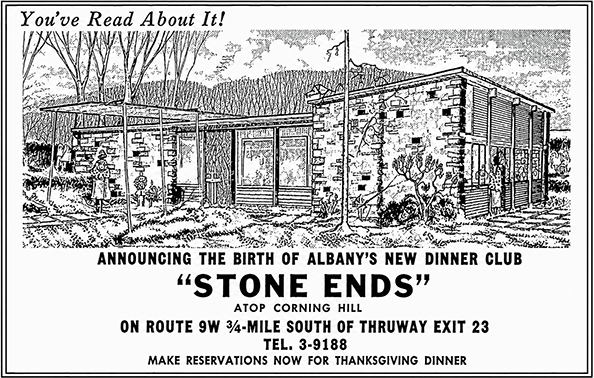
In May 1955, motorists on U.S. Route 9W a mile south of the Thruway exit in Glenmont, New York, began noticing an unusual construction crew at work just below Corning Hill Road. The men digging the foundations, mortaring fieldstone walls, and nailing up cedar clapboard were not builders by trade. They were restaurant men — Henry and Lou (Luciano) Junco, their brothers, and other relatives — erecting, with their own hands, the restaurant they intended to run. “We didn’t have any professional building experience,” Lou Junco told a reporter that year. “It was just sort of a sideline, a hobby with us.”
The Juncos were sons of Fernando and Franqualina Junco, a family of Spanish descent that had settled in Amsterdam, New York, west of Schenectady. By the mid-1950s the brothers were already veterans of the trade, having owned several restaurants, including one on State Street near the Capitol in Albany and another in Plattsburgh. Henry, born in 1925, had graduated from Albany Business College and worked his way up as a busboy, waiter, and kitchen hand in prominent restaurants in New York and Florida; he would later study at Le Cordon Bleu in Paris and travel the world on gourmet tours. He had also served in the Army during World War II, from 1944 to 1946, and spent eight months as a prisoner of war. What the brothers wanted now was elbow room — a modern restaurant outside the city, with space to build and, just as important in the automobile age, a place for customers to park. They had been planning it for two years.
Their architects — Ernest N. Wright and Francis S. Woods, members of the architectural faculty at Rensselaer Polytechnic Institute — drew up a one-story building organized around stone: flagstone floors, a white slag-stone roof, an open-beam cathedral ceiling over the dining room, a distinctive fireplace at the center of the dining room, banks of picture windows, and — the feature that gave the place its name — two end walls built entirely of fieldstone a foot thick. The Juncos gathered and hauled 25 truckloads of the stuff from the 19th-century mill hamlet of Alcove, in the Helderberg country south of Albany. The stone was Devonian-era Helderberg bluestone, laid down in seabeds hundreds of millions of years earlier, and for the next six decades it would prove more durable than any of the businesses it housed. The dining room, when Stone Ends opened its doors late in 1955, seated 52.
The restaurant announced itself modestly. An advertisement the following year promised “the finest of foods,” along with “all legal beverages,” at the top of Corning Hill. But the operation behind the ads was a genuine family enterprise, five brothers deep. Lou and Henry were the principals; Vincent worked the floor, eventually as maître d’hôtel; Anthony and Paul served as hosts at the bar. Around 1958 the kitchen introduced what would become the house’s most beloved eccentricity: a corn fritter, drenched in maple syrup, served as a “refresher course” between appetizer and entrée. “We kept it because it’s different,” Vincent Junco explained a quarter-century later. “The majority of people eat them, so they must like them.”
The brothers were building more than a dining room. In August 1958 Henry and Lou opened the 14-unit Stone Ends Motel on the adjoining property — a single-story, modern structure — and announced plans for 38 additional units by September 1959. A few months later they opened Junco’s Stone Ends Gift Shop in the motel’s spacious lobby, advertising imports from Europe and Scandinavia in the spirit of “all that’s modern but in the tradition of fine taste.” The complex atop Corning Hill was becoming a destination in its own right.
Through the 1960s, Stone Ends built its reputation on a kind of dining that was already becoming scarce: Continental cooking with theatrical, tableside flourish. Henry Junco demonstrated the chafing-dish arts at local cooking programs; the restaurant advertised its “Intimate Quarry Lounge,” a nod to the stone all around; and Vincent won local renown for his tableside Caesar salad, mixed from a service cart stocked with garlic, anchovies, Worcestershire, oil, and vinegar — the glamorous dish, as one account of his demonstrations put it, that Hollywood stars were forever ordering in the movies. The menu ran to genuine exotica: antelope, buffalo, pheasant, rabbit, and venison shared space with the standards, and an hors d’oeuvre cart circulated for adventurous appetites.
The family was expanding, too. In 1965 the Juncos broke ground at 1400 Central Avenue in Colonie for Junco’s Golden Fox Steak House, a $250,000 project with seating for 200 — nearly four times the capacity of the Stone Ends dining room. The brothers were prospering enough that in the summer of 1968 Lou and his wife departed on a six-week grand tour behind the Iron Curtain and back — Moscow, Leningrad, Kiev, Sofia, Bucharest, Budapest, Warsaw, Prague, Berlin, and London — seen off by friends at the airport.
The crowning moment came on July 14, 1969. On what the Juncos would remember as the most beautiful July afternoon they had ever seen, corks and flashbulbs popped, the patio fountain splashed, and strolling musicians played Latin melodies for hundreds of guests as a representative of the Curtis Circulation Company presented the five brothers — Lou, Henry, Vincent, Anthony, and Paul — with Holiday Magazine’s dining award, formally placing the restaurant they had built with their own hands among the finest restaurants in North America. “Stone Ends,” the magazine declared, “is a fine American restaurant of the kind that is fast disappearing.” Holiday’s judgment was rendered by anonymous gastronomic experts on three inflexible criteria — exceptional food, an inviting atmosphere, and polished service — and the Juncos took it as the reward for some 15 years of devotion to all three.
The magazine’s elegy for a disappearing breed proved prophetic, though the disappearance took decades. Through the 1970s, Stone Ends clung happily to its traditions. A 1978 survey of the region’s restaurants found the dining room grown to 92 seats, the menu still the most extensive and exotic in the area. Suckling pig for ten could be had for $135 with ten days’ notice, and the menu promised that, by reservation, the chef “will be delighted to prepare any Continental dish.” Ladies received menus without prices (a quaint courtesy, the writer noted, then under growing attack in the name of women’s liberation), a wine steward selected agreeable bottles, and male waiters remained adept at tableside theatrics.
By the 1980s, Henry Junco was gradually stepping back. In 1981 he and James (Jimmy) Scalzo, a member of the Albany Common Council, acquired Quintessence, a chrome-fixtured 1948 diner in Albany that they ran as an Art Deco restaurant and nightspot. In 1985 the Golden Fox closed after 20 years in Colonie, with the family continuing to operate Stone Ends, Quintessence, and Ozzie’s in Albany. The following year Henry sold Stone Ends to an ambitious young chef named Dale Miller and his partners, Jerry and Ginger Menagias, the owners of Schenectady’s Olympic diner. “We bought it for its reputation,” Miller said, “and its potential for being a beautiful restaurant again.”
The transition, at first, was gentle. When B. A. Nilsson, a restaurant critic for a local magazine, visited in August 1986, he found a dining room out of another era — orange lanterns, copper chafing dishes, flagstone underfoot — and pronounced it, approvingly, “a restaurant with fins, and proud of it.” The new executive chef, Roger Herwerth, had trimmed the classic Fifties menu by about a third and modernized it without stooping to nachos or fried potato skins. Every table still received a complimentary warm-up of curried chicken salad with walnuts; soup was ladled tableside; the corn fritter intermezzo arrived thick with maple syrup; and the captain running the floor that night, flaming veal cutlets in Calvados over a copper chafing dish, was none other than Vincent Junco.
Miller was not a man to leave things gentle for long. Raised in a farming family in Tribes Hill, near Amsterdam — the Juncos’ own hometown territory — he had started cooking at his mother’s side at age 5, bought himself a set of Wilton cake pans when he was 11 or 12 to earn money decorating wedding and birthday cakes, and lied about his age at 15 to get hired at the Red Barn restaurant in Amsterdam, working everything from the front counter to the grill. He graduated from the Culinary Institute of America — the CIA of Hyde Park, New York — in 1979 near the top of his class and cooked at the Albany Marriott Hotel in Colonie and the Tavern on the Square in Schenectady before buying Stone Ends. “I’ve been dreaming about this since I was 10 years old,” he said. “When I walked in that door I just knew this was the place.” In the summer of 1987 he bought out his partners and became the restaurant’s sole chef-owner, fortifying his kitchen with Wallace Foster, a Cordon Bleu graduate, and William Hohenstein, a veteran of Chaucer’s Restaurant in Clifton Park as well as Tavern on the Square. Asked to explain the drive behind his turnaround of the old house, Miller was blunt: “When somebody says, ‘You can’t,’ I will. I like to prove people wrong.”
The old guard, meanwhile, was passing: Luciano Junco, a founder of Stone Ends and president of the Golden Fox from 1967 until his retirement in 1976, died in February 1988 at age 69.
Under Miller, Stone Ends became the standard-bearer of fine dining in the Capital Region, championing what he called “progressive American cuisine” with an international accent. He obsessed over details, down to buying and arranging the flowers himself, and kept renovating: By 1990 his brother, an interior designer, had spent months on the restaurant’s appearance, with carpenters completely refurbishing the lounge and the upstairs. The piano bar he had imagined when he first set eyes on Stone Ends materialized, and local lore would later hold that Liberace himself once stroked its keys. In 1996 Miller passed the grueling examination to become a Certified Master Chef, at the time one of only about 55 in the United States.
The honor, paradoxically, helped kill the restaurant. Job offers began streaming in from around the country, just as the arithmetic of the old building turned merciless. “We had a steady clientele, we never declined in revenues, but we didn’t grow enough to keep up with increasing utility bills and food costs,” Miller told a reporter for the Schenectady Gazette after he closed the restaurant in August 1997, ending an 11-year run. He had poured nearly $300,000 into the 42-year-old structure, and the repairs devoured whatever the dining room earned. “More and more money went into the building,” he said—and then, the clinching question: “Why would I continue to struggle when other attractive offers are coming in?” Within weeks, Jack’s Oyster House in Albany had recruited him as managing partner and executive chef. But as the president of Stone Ends LLC, Miller had personally guaranteed much of the restaurant’s debt, including the mortgage, and that autumn he filed for personal bankruptcy protection in U.S. Bankruptcy Court in Albany.
The empty building on Route 9W became an object of regional intrigue. Yono and Donna Purnomo, the owners of the acclaimed Yono’s in downtown Albany, offered $260,000 shortly after the bankruptcy filing but balked at the $300,000 asking price and went off to open restaurants at Albany’s new Armory Center instead. A second suitor, Lawrence Edinger, wanted to run the property as a banquet house, but financing snags stalled the deal past a July 1998 deadline. The holder of the mortgage, as it happened, was Henry Junco, and by November 1998 Junco’s patience was exhausted; his attorney moved to foreclose. “Henry Junco is going home again,” Jimmy Scalzo, who would be his partner in the venture, announced. The property went on the auction block on March 30, 1999, and before the end of the year Junco — then in his seventies — had his building back.
The restoration was a labor of filial piety toward the stone itself. Junco and Scalzo stripped away a decade of upscale overlays to expose the fieldstone and wood beneath. “All that natural beauty had been covered up,” Scalzo said. They installed the veteran Paul Persico as head chef over a moderately priced Northern Italian menu and reopened around the end of 1999. Even Miller, watching from Jack’s, paid tribute to Junco, his predecessor and successor: “He’s a legend. He’s a restaurant legend.” Scalzo put it more simply: “Henry picked the rock to build this place. That’s his baby.”
The third act was brief. William M. Dowd of the Albany Times Union, reviewing the reborn Stone Ends in January 2000, found a kitchen capable of an excellent lemon pepper shrimp stew and a heavenly chocolate pâté but prone to lapses — a strip steak sauced against explicit instructions, a stuffed chicken breast served partly raw and struck from the bill by Scalzo himself, working that night as maître d’. Two stars. The deeper problem was the ledger. Weekday sales sagged, and the region’s independents were falling around them: Within a single stretch of autumn 2001, the Old Daley Inn in Troy, the Cranberry Bog in Colonie, and the Allegro Cafe in Troy all went dark, squeezed by well-financed chains — Applebee’s, Olive Garden, Outback — that had added some 4,000 seats to the Wolf Road corridor alone in five years. In early October 2001, Stone Ends joined the casualty list. Gnocci, Inc., the restaurant’s operating company, shut the doors, and Scalzo conveyed the bad news to creditors. “Despite my diligent efforts,” he wrote, “the restaurant has not proved profitable.” Junco confirmed that a steep decline in weekday sales had forced the closing and moved nearly all of the restaurant’s 12 staff members to Quintessence.
Even shuttered, Stone Ends kept pulling its owners down. Scalzo later acknowledged that he had been draining the diner in Albany to prop up the operation in Glenmont. ”I used Quintessence to more or less keep Stone Ends alive,” he said when Quintessence itself filed for Chapter 11 protection in November 2002, listing $172,283 in liabilities against $147,750 in assets, most of it unpaid property, withholding, and sales taxes. “It’s very difficult to pay two restaurants’ bills with one restaurant.” A related company, Maccheroni Inc., followed into Chapter 11 in 2003, its attorney predicting that a sale of the Stone Ends property would clear the books. Quintessence served its last meal on December 31, 2004.
The stone, as ever, outlasted the misfortune. In the fall of 2004 a new owner, Robin Leyden, reopened the building as Stone Ends, with Persico back at the stove and John Burgess as sous chef. Dowd, returning that November, awarded it three stars and marveled that the place refused to die, enduring “like Banquo’s ghost in ‘Macbeth.’ ” That incarnation, too, eventually gave way, and the building at 9 Frontage Road cycled through a series of humbler lives — an Italian spot called Bella Bistro, a biker-friendly bar called Duke’s, and finally the Milestone Restaurant & Bar, opened in 2011 by the Mastrantuono family with their 21-year-old son Michael as chef, its interior still looking much as it always had between the soaring stone walls. Milestone closed in 2015, and the Helderberg bluestone that the Junco brothers hauled from Alcove some 60 years earlier stood empty beside Route 9W. Henry Junco did not live to see that last vacancy resolved. He died at age 86 on April 29, 2012, at the VA Hospital in Miami, survived by his companion of more than 65 years, Bertha Costas, his brothers Vincent and Paul, his sister Amelia, and, by one family count, more than 100 nieces and nephews.
Corn Fritters
 (No Ratings Yet)
 Loading...
From nearly the moment the Stone Ends Restaurant opened in Glenmont, New York, in 1955, these corn fritters, drizzled with maple syrup and served as a “refresher course” between appetizer and entrée, were a hit. Originally developed by chef James C. Hogan, they were still on the menu a quarter-century later. “We kept it because it’s different,” Vincent Junco, a member of the restaurant's founding family, explained. “The majority of people eat them, so they must like them.”
Ingredients
- 1 generous cup corn
- 4 large eggs
- Kosher salt and black pepper
- 1 teaspoon baking powder
- About 1 cup all-purpose flour
- Neutral oil or shortening, for frying
- Maple syrup, for drizzling over fritters
Instructions
In a medium bowl, combine the corn and eggs. Season with salt and pepper, then stir in the baking powder.
Add the flour gradually, stirring until a thick batter forms. You may not need all of it.
Pour about 1/2 inch of oil into a large skillet and heat over medium-high.
Working in batches, drop spoonfuls of batter into the hot oil, taking care not to crowd the pan. Fry until golden brown on the bottom, then turn and cook until browned on the second side.
Transfer the fritters to paper towels to drain. Serve hot, drizzled with maple syrup.
In Our Vault: More Recipes from Stone Ends Restaurant
- Banana Tart
- Beef Wellington
- Cheddar Cheese Scones
- Chicken with Fresh Pesto on Roasted Red Pepper Sauce
- Chocolate Chip Bourbon Pecan Pie
- Crème Fraîche
- Hazelnut Cream
- Hot Valrhona Chocolate Soufflé with Banana Tart and Maple Ice Cream
- Madeira Sauce
- Maple Ice Cream
- Mushroom Duxelle
- Red Asian Slaw
- Peppercake
- Porcini Sauce
- Quail Broiled in Grape Leaves
- Quail Quickie
- Roast Breast of Pheasant with Venison Prosciutto and Sage, Porcini Sauce
- Salmon Pillow in Cornmeal Crust with Sherry-Chive Vinaigrette Sauce
- Sesame, Orange, and Ginger Glazed Shrimp
- Shrimp à la Stone Ends
- Sour Cream Prune Pie
- Toasted Sesame Couscous
- Wild Rice for Stuffing
- Baked Acorn Squash
- Red Cabbage Slaw
- Warm Duck Salad with Pecan Sage Vinaigrette
- Whole Boneless Chicken, au Champagne, Wild Rice




No Comments