

In the early 1940s Johnny Gekas found what he was looking for at the end of a rough dirt road several miles from the center of Tucson, Arizona, where he had recently settled with his wife, Mary, in the hope that the desert climate would ease his tuberculosis. It was a ramshackle cantina called the Watering Hole, sitting at the corner of North Swan Road and East Fort Lowell Road amid the mesquite and horse country northeast of town — and to Gekas, whose family had been running restaurants in Tucson since the early 1930s, it looked like a diamond in the rough. In 1942 Gekas and his cousin, John Paulos, took over the place, renamed it Venice Gardens, and refashioned it as a little roadside nightclub, furnished with card tables and red-checkered tablecloths and offering mariachi music for dining and dancing under the stars.
Within a few years the club had been rechristened the Palomino, a name inspired by the large horse ranches that dotted the surrounding countryside, and it prospered along with fast-growing postwar Tucson. In 1948 Gekas and Paulos sold the Palomino and moved on to other ventures. The building and grounds eventually came into the hands of Beatrice Padilla, and when fire destroyed the restaurant in the 1950s, it was Padilla who rebuilt it. The Palomino name survived the flames, and the restaurant carried on under a succession of proprietors — among them, at one point, Christopher and Betty Tsaguris — until, sometime in the mid-1960s, it finally went dark.
The Gekas family, meanwhile, had been busy. Over the decades the family would be associated with a dozen restaurants in Tucson, including the Flame Room, at the northeast corner of West Congress Street and North Church Avenue downtown, which was gutted by fire in the 1950s; the Cliff House, near West Rudasill and North Oracle roads, which the family ran from the late 1950s into the early 1960s; and, by 1964, the Coat of Arms in the Casas Adobes Shopping Center. Paulos, for his part, opened Paulos Steak & Chop House in 1956 in a converted garden and pottery shop, where it would stand for nearly five decades.
Then, in 1968, Padilla approached John Gekas with a proposition: Would he reopen the Palomino? “Johnny was really excited with the idea of running the Palomino again, turning it into the dance place that it once was,” Mary Gekas recalled years later. She wasn’t quite so excited. “When I saw it for the first time I nearly had a heart attack,” she said. “It had orange walls and lime-green carpeting and chrome tables and chairs.”
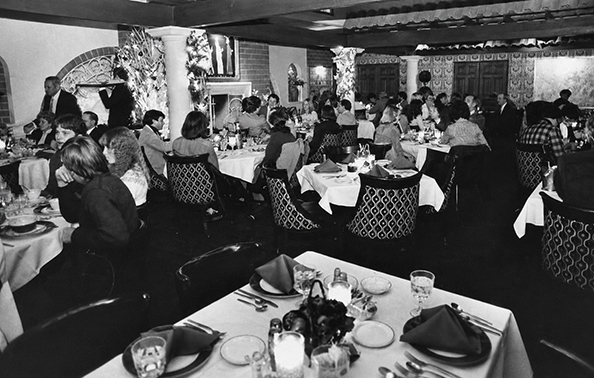
Working with professional decorators, the Gekases gutted the interior and redid the whole place in a Spanish-Mediterranean style, dressing up the windows with spindles and stained glass and dividing the space into separate dining rooms that together seated 120. The reborn Palomino opened in March 1968.
The nightclub half of John Gekas’s dream, however, refused to come back to life. Tucson had changed since the war years, and so, it seemed, had Tucsonans’ appetite for open-air revelry. As Mary Gekas put it, “It was always either too hot or too dusty or too buggy to dance outside.”
So the Gekases changed course. In the early 1970s John Gekas decided to sell one of his two remaining restaurants. A buyer for the Coat of Arms turned up first, in 1972, and Gekas threw himself into the Palomino. The big outdoor patio — the scene of all that hot, dusty, buggy dancing — was enclosed, and the restaurant was reconceived as a series of handsome rooms devoted to fine dining. Now billed as Johnny Gekas’ Palomino Restaurant and advertising itself as “the finest steak house in Tucson,” the place promised patrons “the finest available in aged beef plus special sour dough bread and our own special meat sauce.”
It took off in a big way. Through the 1970s and 1980s the Palomino came to define Continental dining in Tucson: bouillabaisse and rack of lamb were house specialties, Caesar salads and chateaubriand were prepared tableside, and cherries jubilee arrived in flames. Service ran deep in the restaurant’s bones — regulars liked to boast that their usual highball would land on the table within minutes of their being seated, unbidden — and for a generation of Tucsonans the Palomino became the standard for life’s landmark evenings: anniversaries, engagements, prom nights.
Presiding over it all was Mary Gekas, who greeted arriving guests with red lipstick and a warm smile and ran her dining rooms with a firm, gracious hand. Foul language was not tolerated, and the restaurant closed on Sundays so that she could attend church. On any given night, half of Tucson’s power elite might be tucked into one of the U-shaped booths, hammering out a deal while a visiting celebrity dined quietly a few tables away. Over the years the guest register came to include Bob Hope, Richard Boone, Walter Matthau, Lee Marvin, Paul Newman, George C. Scott, Willie Nelson, Jamie Farr, and Kris Kristofferson, along with President Gerald R. Ford and — years before anyone imagined him in the White House — George W. Bush. (No celebrity was more devoted than Bob Hope, who came to Tucson nearly every year to play in the Tucson Open’s celebrity pro-am and made the Palomino a regular stop.)
Mary Gekas made certain that fame purchased privacy at the Palomino. “Mostly the celebrities want to be left alone when they come to dine,” she once explained to an interviewer, “and we made sure they were left alone.”
The Gekases also built a busy catering trade, and the family long treasured the memory of one particularly improbable job in the 1970s: chateaubriand for 200 guests at Kitt Peak National Observatory, executed in a facility equipped with a single hot plate.
John Gekas fell seriously ill years before his death, and it was Mary who took the reins of the Palomino — the restaurant, in an age when women rarely ran businesses of any kind, along with everything else. “She did it all,” the couple’s oldest daughter, Kiki Kinkade, would later recall. “She took care of the restaurant, her husband and the children. My mother did it all.” She haggled with liquor salesmen and stared down butchers, and her command of the trade left a lasting mark on the family’s younger women. “It was wonderful to have that type of mentor,” her niece Maria Houpis recalled.
John Gekas died in 1982 at age 67, and the Palomino passed to his wife and their son, Jim, who had struck out on his own in 1979 with a restaurant called Harpo’s at East Sixth Street and North Fourth Avenue.
Mother and son ran the Palomino together for the next 12 years. In the kitchen, chef Joe Bigardi turned out the classics and trained a line of younger cooks, at least one of whom — Steve King, later the chef at the Fairmont’s Grille Restaurant in Santa Monica, California — would remember him as the teacher who made him want to stay. Out front, Mary Gekas kept a particular eye on the youngest members of the staff. “The busboys were her pet project,” Kinkade said. “She counseled them. She was respected by adolescent kids. People would send their wayward children to her.” Many employees, from busboys to chefs, stayed with the family for 20 years or more.
By the early 1990s, Mary Gekas was in her mid-seventies, and the family began to contemplate closing the Palomino. Offers arrived from chain operators, and were declined. “We wanted the restaurant to go to someone local,” Jim Gekas explained, “preferably another family with special talents.” On Saturday night, April 23, 1994, the Palomino served its last dinners — 26 years after the reopening, and 52 years after John Gekas and John Paulos first hung the Venice Gardens sign on the old Watering Hole. “We’ve been running restaurants for 52 years as a family,” Jim Gekas, then 44, told the Arizona Daily Star. “It’s been wonderful, but it’s time for us to do other things. This is the right time to do it. My mother is ready to relax and enjoy life. I’m too young to retire, but I like change.” He allowed that his own plans ran to fishing in Mexico, and after that perhaps college, or a return to the kitchen.
Two days later, the reservation phone was still ringing, and Mary Gekas could not stop herself from answering it. “Reservations line,” she explained to a visiting reporter. “I feel so badly to have to say we’re closed.” For the first time since 1942, Tucson woke up without a Gekas family restaurant.
The building did not sit idle. Mary and Jim had found their local family: Pedro and Evelyn Sevilla, who within weeks moved Encore-Med, their well-regarded Euro-Spanish restaurant, into the 14,000-square-foot building and its four separate dining rooms, later adding a second concept, Cafe Triana. Mary and Jim stayed on to help with the transition, as did many of the Palomino’s longtime employees.
One artifact left with the family. In the days after the closing, Jim Gekas took down the huge mural of the Acropolis that had hung on the north wall of the Palomino’s main dining room and carried it across the street to El Greco’s Grecian Gardens, the Kotzambasis family’s Greek restaurant then taking shape in a converted Circle K on East Fort Lowell Road. There the mural watched over diners until El Greco’s served its own farewell dinner on April 23, 2005 — 11 years to the day after the Palomino’s last night. The painting then passed to Tucson’s St. Demetrios Greek Orthodox Church.
The old corner at Swan and Fort Lowell stayed in the restaurant business a while longer. In November 1998, after a renovation reported to have cost a million dollars, meat-distribution magnate Bob McMahon opened McMahon’s Prime Steak House in the building, and for a time it reigned as the crown jewel of his Metro Restaurants group; it operated until 2015, when a bankruptcy court ordered it closed. In 2018 the building was converted into real estate offices, its new tenants pledging to preserve the landmark character of the place.
Mary Gekas filled her retirement with the arts, her church, and the theater. A benefactor of the Arizona Opera for nearly two decades and president of the Arizona Opera Dames from 1980 to 1986, she gave freely and quietly. “She always wanted to help, be it time or money,” her friend Evelyn Doll said. “She would give anything she could.” The giving was rarely announced; her children often stumbled across awards that she had accepted months or years earlier and never mentioned. “She was very behind-the-scenes, a very humble person,” Kinkade said.
A series of strokes slowed Mary Gekas in her final years, but never, her family insisted, her spirit. She died on June 18, 2006, at age 89.
Famous Patrons of Palomino Restaurant
- Richard Boone
- George W. Bush
- Jamie Farr
- Gerald R. Ford
- Bob Hope
- Kris Kristofferson
- Lee Marvin
- Walter Matthau
- Willie Nelson
- Paul Newman
- George C. Scott

Dolmathes Avgolemono (Stuffed Grape Leaves with Egg-Lemon Sauce)
John and Mary Gekas opened the Palomino Restaurant in 1968 at 2959 North Swan Road in Tucson, Arizona. Its kitchen served the kind of Continental classics that made the restaurant a destination for celebrations and special occasions, but some items on the menu reflected the Gekas family’s Greek heritage. A case in point were these dolmas — grape leaves wrapped around a warmly seasoned filling of beef, rice, parsley, and mint — which were gently simmered and then finished with avgolemono, the traditional Greek sauce of eggs, lemon juice, and hot cooking broth.
Ingredients
- 50 brined grape leaves, about one large quart jar
- Unsalted butter, as needed
- 1 large onion, finely chopped
- 1 pound ground beef
- 1/2 cup uncooked white rice
- 1/2 cup finely chopped fresh parsley
- 1 tablespoon finely chopped fresh mint, or 1 tablespoon dried mint
- 2 teaspoons kosher salt
- 1 teaspoon black pepper
- 2 cups water
- 2 tablespoons unsalted butter
- Several celery stalks, optional
- 1 teaspoon chicken bouillon, optional
- 4 large eggs
- Juice of 1 large lemon
- Lemon wedges, for serving
Instructions
Rinse the grape leaves thoroughly under cool running water to remove the brine. Drain and set aside. When using fresh grape leaves, blanch them briefly in boiling water until pliable, then drain.
Melt enough butter to lightly coat the bottom of a skillet over medium heat. Add the onion and cook, stirring occasionally, until softened and lightly browned. Transfer the onion to a large bowl and let cool slightly.
Add the ground beef, rice, parsley, mint, salt, and pepper to the bowl. Mix gently but thoroughly until the ingredients are evenly combined.
Lay a grape leaf on a work surface with its shiny side facing down and its stem end toward you. Place about 1 teaspoon of filling near the stem end. Fold the lower edges of the leaf over the filling, fold in the sides, and roll it tightly into a small cigar-shaped parcel. Do not roll too firmly, as the rice will expand during cooking. Repeat with the remaining leaves and filling.
Arrange the dolmathes snugly, seam side down, in a wide pot, forming compact layers as necessary. Add the water and 2 tablespoons butter. Add the celery and bouillon, when using.
Place a heatproof plate directly over the dolmathes to keep them from opening as they cook. Bring the liquid to a gentle boil over medium heat, then reduce the heat, cover, and simmer until the rice and meat are cooked through, about 45 minutes.
Remove the pot from the heat. Carefully ladle about 1 1/2 cups of the hot cooking liquid into a heatproof measuring cup.
In a medium bowl, beat the eggs until thoroughly blended. Slowly beat in the lemon juice. Whisking constantly, add the reserved hot cooking liquid a little at a time, beginning with just a few drops and gradually increasing the amount, until the egg mixture is warm.
Slowly pour the egg-lemon mixture back into the pot. Gently shake the pot from side to side so the sauce works its way between the dolmathes. Do not return the pot to a boil.
Serve the dolmathes hot, spooning the egg-lemon sauce over the top and offering lemon wedges alongside.
Notes
The grape leaves may be replaced with blanched lettuce or cabbage leaves.


No Comments