

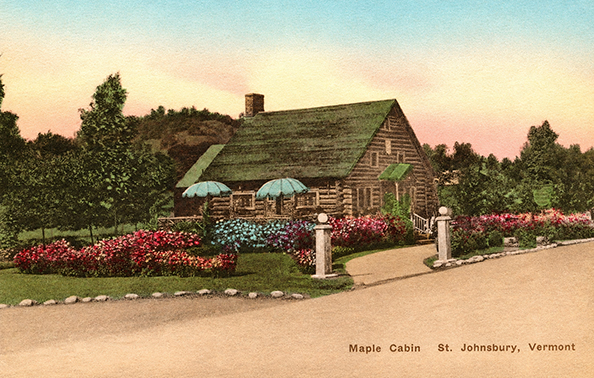
“Keep your eye on Maple Town!” the St. Johnsbury Republican urged its readers at the beginning of a page-one story in 1920. This was the newly minted name for an old stretch of the Vermont village — the upper end of Portland Street, where the George C. Cary Company was then erecting an enormous sugar factory. Standing beside the rising plant was the neighborhood’s first finished landmark: a rustic log structure called the Maple Cabin, completed only days earlier at 167 Portland Street, whose immediate patronage, the newspaper observed, already “justifies the enterprise.”
The enterprise behind the Maple Cabin was considerable. George Clinton Cary had founded the Cary Maple Sugar Company in St. Johnsbury in 1904, building it from a bulk sugar-buying operation — much of his early product went to flavor plug tobacco — into what was reckoned to be a million-dollar business. By the 1920s the company controlled as much as 80 percent of the world’s bulk maple sugar trade, newspapers had crowned George Cary the “Maple King,” and St. Johnsbury was styling itself the Maple Center of the World. The Portland Street plant anchoring Maple Town was the physical expression of that dominance, a processing and distribution complex fed by a network of warehouses and hundreds of local sugar buyers strung along Vermont’s railroad lines. The Maple Cabin was its public face: a place where the traveling motorist, rather than the tobacco company purchasing agent, could meet Cary’s products on friendly terms.
The Maple Cabin settled quickly into the rhythms of a seasonal roadside business, timed to the summer tourist flow along Portland Street, which carried the main highway east toward the White Mountains. An advertisement announced its opening for the season on July 4, 1922, and the operation soon grew beyond syrup and sugar into a full-fledged tearoom and gift shop of the sort then flourishing on the nation’s new automobile routes. A 1925 advertisement promised “a choice selection of Spanish and Italian Pottery and other attractive gifts,” along with woven scarves, table runners, bags, rugs, handkerchief dolls, and babies’ jackets, bonnets, and booties — a lineup of products pitched squarely at the touring wife with a back seat to fill.
Management changed hands more than once in the early years; the Maple Cabin reopened “under new management” in the spring of 1928, and by decade’s end the merchandise had taken on a distinctly continental sweep for a log cabin in the Northeast Kingdom. “Ice Cream — Cold Drinks — Novelty Souvenirs,” ran a 1929 advertisement, which went on to tout “an extensive assortment of Navajo Rugs purchased directly from the Indians in Arizona and New Mexico,” alongside the house staples: “a full line of delicious maple syrup, sugar, and candies.”
The figure most closely identified with the Maple Cabin was Josephine Cary Smith, George Cary’s sister, who by a later account operated the establishment from 1926 to 1939. Under her hand it became one of the busiest tourist stops in the region. In 1929 alone, roughly 10,000 visitors signed the guest book, and in 1930 the sponsors answered the demand by constructing a second building across the way, the Maple Cabin Inn, with a lobby, two rooms with bath, and an apartment for the hostess, to be supplemented — so the plan went — by tourist cabins the following year. The dining room, meanwhile, had found its signature dish, with the local newspaper reporting that it continued “to serve the chicken and waffles for which it has become famous,” along with soups, salads, homemade cakes, and other specialties.
Josephine Cary Smith was not shy about the obstacles between her customers and her door. In 1930 she wrote a pointed letter to the St. Johnsbury Caledonian-Record reporting that seven out of ten tourists complained to her, unsolicited, about the “dreadful condition of Vermont roads.” It was the testimony of a woman who spent her days listening to motorists fresh off the highway, and it landed at a moment when Vermont was debating how far to go in paving its way into the automobile age. Her prices, at least, gave travelers little to grumble over: a 1931 advertisement offered “delicious Sunday Night Suppers for 75 cents,” and a 1932 notice for “Cary’s Maple Cabin” promised a “High Class Tea Room and Refreshments.”
The Cary name on that advertisement had by then acquired a mournful undertone. George C. Cary’s empire, overextended and battered by the Depression, collapsed in 1931; he filed for personal bankruptcy — the liabilities stemming largely from accommodation endorsements on the notes of other business concerns rather than from the sugar company itself — and died shortly afterward. The company survived him and reorganized, and Portland Street kept its maple character. Indeed, the neighborhood deepened it: In 1929 Cary had purchased Maple Grove Candies, the confectionery business Katharine Ide Gray and her daughter Helen had begun on a local farm around 1915, and a new two-story brick Maple Grove building opened in 1931 directly in front of the big Cary plant, a few steps from the Maple Cabin’s door.
Josephine Cary Smith carried on. She had taken to spending her winters in Los Angeles, returning each spring to reopen the Maple Cabin, and she ran the place with an eye for more than commerce. In the summer of 1938 it doubled as a gallery for Ezra C. Young, an amateur painter in St. Johnsbury, who exhibited his work there through the season; Smith reported the sale of one canvas after another, the pictures going home with tourists alongside the syrup tins and Navajo rugs. It was a modest but genuine cultural turn for a roadside tearoom, and characteristic of a proprietor who understood that the establishment sold Vermont itself as much as anything on the menu.
Smith gave up the Maple Cabin after the 1939 season, and in 1940 word reached St. Johnsbury that she had died in Los Angeles following an illness of nearly two years. The obituaries identified her, as they were bound to, as the sister of the late George C. Cary, founder of the Cary Maple Sugar Company — but to a generation of travelers on Portland Street she had been the hostess of the Maple Cabin, the woman behind the chicken and waffles and the 10,000-name guest book.
The war finished what her departure began. The Maple Cabin closed in 1941 for the duration, its shutters staying up through the years of gasoline rationing that emptied Vermont’s tourist roads. Not until 1948 did it come back to life, reopening under Mr. and Mrs. James F. Willey — he was also proprietor of Willey’s Food Shop — with the St. Johnsbury Republican saluting “the famed Maple Cabin, next door to the Cary Maple Sugar Company,” long celebrated “for its tasty luncheons and maple sugar products.”
The Maple Cabin’s final season as a restaurant came in 1951, when it opened under two local young women, Patricia and Ann Boylan — daughters of Edward R. Boylan, the president of the Cary Maple Sugar Company. The arrangement had the feel of a family posting, and it proved a coda. In 1952 the company announced that, “in an effort to make the tourists’ visit to Vermont more enjoyable,” it was converting the adjoining Maple Cabin into the Maple Museum, trading the tearoom’s tables for exhibits on sugaring.
The conversion, as it turned out, was less an ending than a change of costume. The museum idea took permanent root on Portland Street: Decades later, advertising still directed visitors to the “Maple Grove Maple Museum & Factory, 167 Portland Street,” and the operation endures today as the Maple Grove Farms Sugar House Museum and its red-roofed Cabin Gift Shop at 1052 Portland Street, where busloads of travelers sample maple candy a few yards from the plant George Cary raised in 1920. (The address of the building changed when St. Johnsbury carried out a townwide renumbering shortly after Vermont adopted its statewide Enhanced 911 program in 1997.) The company passed to B&G Foods in 1998, and the Cary’s brand survives as the oldest pure maple syrup label in the country. The Maple Cabin’s chicken and waffles are long gone, and so is the guest book — but more than a century after the local paper told St. Johnsbury to keep its eye on Maple Town, tourists are still pulling off Portland Street to have a look.

Maple Muffins
The Maple Cabin opened in 1920 beside the Cary Maple Sugar Company’s sprawling plant in St. Johnsbury, Vermont, then celebrated as the “Maple Center of the World.” Conceived as a welcoming showcase for Cary’s maple products, the rustic log building evolved into a popular roadside tearoom and gift shop, serving generations of travelers on the highway to the White Mountains. The restaurant had its final season in 1951 and was converted into a maple museum the following year. It served these modest, lightly sweetened muffins, which rely on maple syrup for both flavor and tenderness.
Ingredients
- Butter or nonstick cooking spray, for the muffin tin
- 1 3/4 cups all-purpose flour
- 2 1/2 teaspoons baking powder
- 1/4 teaspoon fine salt
- 1 large egg
- 1/4 cup whole milk
- 1/4 cup maple syrup
- 1/4 cup unsalted butter, melted and cooled slightly
Instructions
Heat the oven to 325 degrees. Grease 8 wells of a standard muffin tin.
In a medium bowl, whisk together the flour, baking powder, and salt.
In a large bowl, beat the egg lightly. Add the milk and whisk until combined.
Add the flour mixture to the egg mixture in three additions, alternating with the maple syrup and stirring gently after each addition. Begin and end with the flour mixture, and mix only until no dry streaks remain.
Fold in the melted butter. Divide the batter evenly among the prepared muffin cups.
Bake until the muffins are lightly golden and a tester inserted into the center comes out clean, about 25 minutes. Let cool in the pan for 5 minutes, then transfer the muffins to a rack. Serve warm.
In Our Vault: More Recipes from Maple Cabin
- Maple Cinnamon Toast
- Maple Layer Cake
- Maple Milk Shake


No Comments