

Long before the Huck family arrived, the stretch of Grand River Avenue where it crosses Seven Mile Road was the kind of place Detroiters went when they wanted to slip the city’s leash. Grand River was U.S. Route 16, the old plank-road route to Lansing and the great northwest artery out of town, and in the 1920s and 1930s the roadside building at 25241 Grand River in Redford Township operated as the Ackmur Club, remembered years later in the Detroit press as a haven for “thirsty gamblers” through Prohibition and the Great Depression. The gambling eventually caught up with it. Authorities shut the club down, and the handsome building on its landscaped grounds sat waiting for a more respectable tenant.
As things turned out, it got one with a pedigree. Emil Huck and his brothers Otto and Gus had been feeding Detroit since 1905, when they opened the Schiller Restaurant on Gratiot Avenue. Two years later they moved to the Log Cabin Restaurant on Michigan Avenue, directly across from the old Cadillac Hotel, and in 1912 they took over the Westwood Inn and Garden in Inkster, which they would run for the next quarter century. The Westwood became one of the storied stops of the big-band era — Benny Goodman, Jimmy Dorsey, Tommy Dorsey, and Glenn Miller all played there — but what set it apart from other dance-hall roadhouses was the kitchen. As Danny Raskin, who wrote a weekly column on restaurants for the Detroit Jewish News, most places of that ilk “were not noted for tasty viands.” The Westwood was.
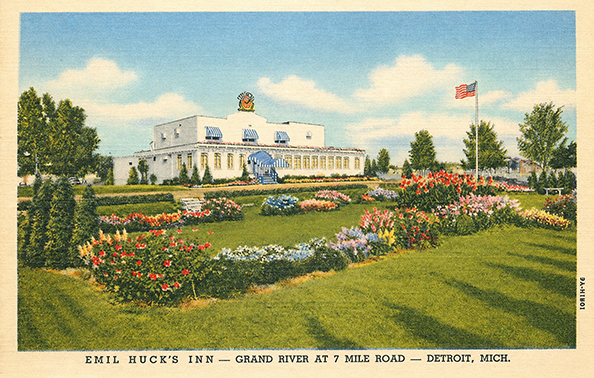
The Hucks left Inkster in 1937, and on July 1, 1939, Emil Huck opened Huck’s Redford Inn in the old Ackmur building with his two sons, Emil, Jr., then in his early thirties, and Harold, barely into his twenties. The announcements promised a cocktail lounge, numerous large meeting and banquet rooms for private parties, dancing nightly, and — a genuine luxury for a suburban restaurant in 1939 — air conditioning. The linen postcards the family commissioned from Chicago-based Curt Teich & Company that first year showed off the tiered gardens and used the back of the card to sell the menu, which is where the Hucks intended the emphasis to fall.
The formula worked immediately. Redford Township was still countryside then, and Huck’s became one of those destinations people liked to drive to on a pleasant Sunday afternoon — far enough out to feel like an excursion, close enough for dinner and dancing on a weeknight. The menu leaned on what the trade called roadhouse dinners: fish, frog legs, chicken, and steak, served in generous platters, with vegetables the family grew on its own farm. There were more ambitious entrées on the card, but it was the roadhouse dinners that built the Huck reputation and, within a few seasons, made the place one of northwest Detroit’s most popular and most profitable restaurants.
The postwar years brought the inn’s only significant physical change and a lucrative new neighbor. In 1950 the family added a new cocktail lounge; otherwise the main building stayed as it was, freshened by periodic redecoration. That same year the Detroit Race Course opened a few miles southwest in Livonia, and the Hucks went straight after the racing crowd. “Before and After the Races,” read the inn’s advertisement in the Daily Racing Form in June 1951, pitching the famous food, the cocktail lounge, the air conditioning, and reservations through the KEnwood exchange — and billing the place, without apparent embarrassment, as “Michigan’s Most Beautiful Roadhouse.”
By mid-decade the dining rooms had acquired an unexpected second identity as an art gallery. Joseph de Grimme, a Detroit art dealer who over the years placed some 50 pieces of fine art into local dining rooms, installed seven masterworks at Huck’s. The showpiece was “The Squire’s Birthday” by William Bromley, the English genre painter whose crowded, storytelling canvases hung in the Royal Academy exhibitions of the Victorian era. The painting was enormous — it very nearly covered one of the inn’s walls — and a 1954 account marveled that this “remarkable museum piece” contained no fewer than 77 distinct figures. Diners waiting on their prime rib could count them.
The family’s private life intruded on the business only once, and briefly. In 1956 Emil Huck, Jr., filed for divorce from his wife, Vivian, whom he had married in 1939 and with whom he had two children. His suit charged that she had an uncontrollable temper, that she had been telling restaurant customers detrimental stories about him, and that in one altercation she had hit him with a lamp. Circuit Judge Robert M. Thoms issued a temporary injunction restraining Mrs. Huck from entering the Redford Inn, from molesting her husband, and from running up charge accounts. The restaurant managed to run on without missing a service.
By 1959 the countryside that had once made Huck’s a pleasant Sunday drive had vanished under houses, gas stations, and a seemingly endless string of storefronts; Emil, Jr., liked to say that the old roadhouse now felt practically downtown. The food had not changed with the scenery. The French onion soup remained on the menu every day, a favorite of long standing, and the demand for roast prime ribs had grown so great that the kitchen was moving a ton and a half of them every week. A generous cut — rare, medium, or well done — went for $3.60 a serving, a price one contemporary account called “an absolute steal.”
The restaurant’s success in Redford Township financed an expansion clear across town. In 1960 Harold Huck purchased the former Beachcomber restaurant at Nine Mile and East Jefferson in St. Clair Shores, on the old lakeside amusement strip where the Jefferson Beach park had drawn summer crowds since the 1920s. The building had housed the Club Marjo in its heyday and a string of mediocre restaurants since, and Harold spent roughly $100,000 renovating it. Huck’s Lakeshore Restaurant opened the first week of May 1960, offering a $1.50 luncheon buffet and a $3.50 dinner buffet under the family’s chosen motto: “Fine Food Appetizingly Served.”
Emil Huck, Sr., lived to see the second restaurant open, but not much longer. He died on February 27, 1961, at age 73, and in his honor Huck’s Redford Inn and Huck’s Lakeshore Restaurant both went dark on March 2. After more than two decades of ownership, the family, with its patriarch gone, sold the Redford operation. The buyer was Burgess, Inc. — Don Burgess, the president of the Knife and Fork Club in downtown Detroit — who dropped the family name from the sign and reopened the restaurant simply as the Redford Inn, advertising a grand-opening celebration with the tagline “Don Burgess, your new host.” Victor Pegg came aboard as the new maître d’, and in 1962 Burgess announced with pride his association with chef George A. Marchand, whose artistry Detroiters had praised at the Knife and Fork.
The revival, however, did not hold. By 1965 the classified pages were listing the property under a blunt heading — “For Sale: Commercial. Formerly Huck’s Redford Inn” — and it was advertised again the following year simply as a commercial site. Emil Huck, Jr., died in 1978 at age 72. Harold, the last of the founding trio, died in 1996 at age 78 in Boca Raton, Florida, 57 years after he had helped his father hang the Huck name over the door of an old gamblers’ club on Grand River Avenue.

Hungarian Goulash with Spätzle
At Huck's Redford Inn was a popular restaurant in Redford Township, Michigan, just west of Detroit, from its opening in 1939 until its closing in 1961. This version of Hungarian goulash was a specialty of the house at Huck's, courtesy of Arthur Havens, the restaurant's head chef in the early 1950s. His version veered from authentic Hungarian gulyás with its use of three green bell peppers and German-style spätzle instead of potatoes or csipetke — a kind of cross between a noodle and a dumpling. Nonetheless, the dish was popular enough to earn Havens an appearance in 1952 on a local television show, where he demonstrated how to make it.
Ingredients
- For the goulash
- 1/4 cup all-purpose flour, plus more as needed
- 1 teaspoon sweet Hungarian paprika
- 2 pounds boneless beef chuck, trimmed and cut into 1 1/4-inch pieces
- 2 tablespoons unsalted butter
- 1 garlic clove, finely chopped
- 3 green bell peppers, cored, seeded and thinly sliced
- 1 large yellow onion, thinly sliced
- 1 (14- to 15-ounce) can diced tomatoes, with their juices
- 1 teaspoon kosher salt, plus more as needed
- 1/2 teaspoon black pepper
- 1/2 cup water, plus more as needed
- For the spätzle
- Kosher salt, for the cooking water, plus ¼ teaspoon for the batter
- 2 large eggs
- 1 tablespoon unsalted butter, melted
- 1 cup all-purpose flour, plus 2 to 4 tablespoons as needed
- 1 to 2 tablespoons unsalted butter, for finishing
Instructions
In a large bowl, combine the flour and paprika. Add the beef and toss until lightly and evenly coated; shake off any excess flour.
Melt the butter in a large Dutch oven or heavy pot over medium-high heat. Working in batches so the pieces do not crowd, brown the beef on several sides, 6 to 8 minutes per batch. Transfer the browned beef to a plate.
Reduce the heat to medium. Add the garlic, bell peppers, and onion to the pot and cook, stirring and scraping up the browned bits, until the onion begins to soften, about 5 minutes.
Return the beef and any accumulated juices to the pot. Add the tomatoes, salt, pepper, and 1/2 cup water. Bring to a simmer, then reduce the heat to low and cover. Cook, stirring occasionally, until the beef is very tender, 1 1/4 to 1 1/2 hours. Add a splash of water only if the pot looks dry; the finished sauce should be thick rather than soupy. Taste and adjust the seasoning.
About 20 minutes before the goulash is ready, bring a large pot of well-salted water to a boil. In a medium bowl, beat the eggs with the melted butter and salt. Stir in 1 cup flour, then add more flour, 1 tablespoon at a time, until the mixture forms a thick, sticky batter that slowly drops from a spoon.
Set a large-holed colander over the boiling water. Working in batches, press the batter through the holes with a flexible spatula or the back of a large spoon. Stir gently. When the noodles rise to the surface, cook for 1 to 2 minutes more, then lift them out with a slotted spoon and drain well. (A spätzle maker may be used instead.)
Melt 1 to 2 tablespoons butter in a large skillet over medium heat. Add the drained spätzle and cook, tossing, until hot and lightly golden in spots, 3 to 5 minutes. Spoon the goulash into shallow bowls and top with the spätzle.
Notes
This adaptation supplies modern measurements where the original was vague, but keeps its straightforward character intact.


No Comments