

In the spring of 1941 the directors of the Cadillac State Bank in Cadillac, Michigan, decided to move. The bank had occupied the same corner at South Mitchell and West Cass Streets since 1901, and its stockholders now voted to relocate down the block into the building the Peoples Savings Bank had abandoned when it failed during the Great Depression. That left a handsome and thoroughly obsolete piece of real estate on the market, and George Banks Kelly wanted it. He paid $14,000 for the yellow-brick building and set about the extensive remodeling required to convert it into a restaurant. He opened Kelly’s Restaurant there in 1942.
The building Kelly bought had been put up as a statement. Banking on that corner traced back to 1883, when D. A. Blodgett of Grand Rapids and D. F. Diggins of Cadillac opened a private banking house under the Blodgett name, with Diggins running it day to day. Diggins withdrew in June 1892 to join the lumber firm of Blodgett, Cummer & Diggins. In 1895 the private house was reorganized under state law as the Cadillac State Bank, capitalized at $50,000, with lumberman Frank J. Cobbs as president and S. W. Kramer as vice president. Deposits nearly tripled in the bank’s first seven years, and in 1901 the directors spent the profits on a new building at Mitchell and Cass. A county history published two years later described the interior with obvious pride: “mosaic floors and mahogany woodwork throughout,” the teller fixtures milled from selected mahogany as well, a heavy steel burglar-proof vault, and two additional fireproof vaults for securities and ledgers.
None of that was of much use to a restaurateur. Kelly’s crews had to pull the cages, break out the vault doors, and carve a kitchen, a counter, and a dining room out of a floor plan built to keep money in one place and people at a distance. When the work was done the corner had a new face entirely — a low, flat-roofed streamline-moderne front with rounded corners and dark trim, the name “Kelly’s” lettered in tall red script across both the Mitchell and Cass elevations, and, above the door, a smaller line that mattered a great deal in the 1940s: “Air Conditioned.”
Kelly was not new to feeding Cadillac. He had come up in the business as the proprietor of Kelly’s Soda Grill, a fountain-service café in the Lyric Theatre Building at 202 South Mitchell, just across Cass Street from the bank corner. The theatre had opened in 1918, a 1,000-seat house operated by the Fitzpatrick-McElroy circuit under manager George H. Kennedy, with novelty “automobile box seats” in the balcony saluting the industry that was displacing the lumber trade. A café attached to a theater that size did steady trade twice a night, plus whatever the downtown shoppers brought in between shows. But a soda fountain is not a restaurant, and by 1941 Kelly clearly wanted the other thing.
His timing was better than it looked. Cadillac in 1941 was not a lumber town anymore; the last hardwood stand in Wexford County had been cut in 1934, and the mills that had built the place were gone or going. What replaced them was a diversified manufacturing economy — metal fabricators, rubber goods, garment plants, and, beginning that February, Chris-Craft, the Algonac-based boatbuilder, which had bought a former Mitchell Brothers plant to expand production against the military contracts it saw coming with World War II and rolled out its first Cadillac-built pleasure boat on February 25. The city sat at the junction of three highways, held the state highway department’s district headquarters for 24 counties, and had been identified by the 1936 Federal Marketing Atlas as the trading center for 33 surrounding communities. J. C. Penney had arrived in 1925, Montgomery Ward in 1928, H. L. Green in 1940. The city had imposed a two-hour parking limit in 1937 and would install meters in 1947. A restaurant at Mitchell and Cass was standing in the middle of the current.
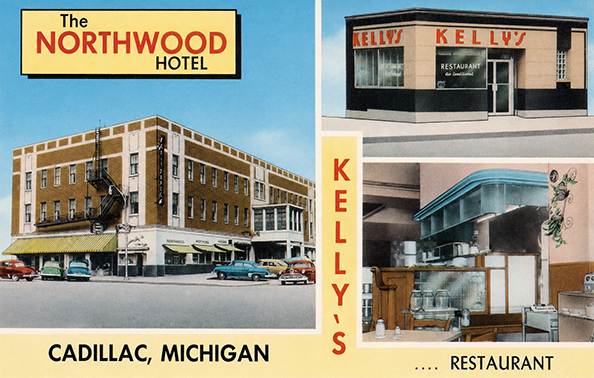
Kelly’s Restaurant caught on quickly. The room itself, as it appears on the souvenir postcard Kelly had printed by the Harry Baker Company of Grand Rapids, was less a white-tablecloth dining room than a well-run American café raised a grade. The interior panel shows a long service counter beneath a sweeping curved canopy finished in pale blue-green, wooden captain’s chairs, a decorative floral motif painted high on the wall, and the general air of a place that could turn a table fast at noon and still hold a steak dinner at seven. Steaks, in fact, were on the menu, which would matter later.
By the mid-1950s George and Ethel Kelly had expanded north along Mitchell Street. They acquired the Northwood Hotel, the three-story brick establishment at the corner of Mitchell and East Harris that was, and had long been, the most consequential building in downtown Cadillac. Its lot had been sold in 1873 by G. H. Cook to D. C. McKinnon for $1,050, on a rumor that a mammoth hotel was coming; the rumor proved out, and the Hotel McKinnon opened the following year in the village of Clam Lake — incorporated as the city of Cadillac in 1877 — and drew crowds partly on the strength of a patented dining-room stove that needed no flue. In the 1920s the owners bought the property to the north and rebuilt the whole structure at a reported cost of $350,000, including the expense of refacing it in brick. Renamed The Northwood Hotel, it opened in July 1928 with a ballroom its advertising called the finest in northern Michigan, a five-chair barber shop, a coffee shop, a portico sheltering the East Harris Street entrance, and a view of Lake Cadillac.
Prosperity, however, did not follow. The Michigan Trust Company of Grand Rapids took the hotel by foreclosure decree on August 25, 1940, against $63,795.26 in obligations dating from 1928 and 1933 that had never been paid, and the property changed hands repeatedly through the war years and after.
The Kellys ran the hotel and their restaurant as a single proposition and printed new postcards to say so. One card carried three panels — the Northwood on the left, Kelly’s exterior and interior on the right — under a line on the reverse announcing that “Kelly’s Restaurant now joins hands with the Northwood Hotel under one-owner managership.” For a traveling salesman coming up U.S. 131, that was the whole pitch: a fireproof room with a telephone and a real restaurant a block and a half away.
Which is how, on the afternoon of Monday, November 4, 1963, Louis Armstrong came to be eating a steak dinner in Kelly’s Restaurant.
The chain of events bordered on the absurd. The Cadillac Chamber of Commerce had built its membership drive around an exhibition jump by Kim Emmons-Knor, the hometown skydiver who had won a world championship the year before. After her jump, hundreds of small white parachutes were released over the city, two of them carrying free memberships in the chamber. Louis Armstrong and The All Stars had checked into the Northwood Hotel the day before. Walking around town that Monday, one of the musicians spotted a white parachute snagged in a tree. Inside was a membership card. The band found its way to the chamber’s office — a log cabin in the city park — and Armstrong himself presented the ticket. Keith McKellop, the president of the chamber, had an annual dinner scheduled that night at Caberfae Lodge and a band with an eight o’clock show in Traverse City, so he improvised an induction ceremony for five o’clock under the Northwood’s portico. The Cadillac Evening News ran a story the next day under the headline “Living legend joins Cadillac Chamber Monday.”
The part of the afternoon that Cadillac actually remembered, though, happened at Kelly’s. The junior high school sat two blocks east of Mitchell Street, and after the last bell students walked downtown to loiter. One group was inside the restaurant when they noticed who was at the table with his wife, working through a steak. Charlie Nystrom went over. “Pardon me sir, are you Mr. Louis Armstrong?” he asked, and remembered decades later how courteously the answer came back. Down the street at the soda fountain in Cunningham’s Drug Store the news traveled fast; Bill White abandoned whatever he was drinking and ran for Kelly’s, awestruck at meeting a man his parents had talked about his whole life. Patty Cuddeback Kingsbury followed White and found Armstrong plainly delighted by the knot of teenagers crowding his table. Later, when word came that he was standing in front of the hotel, Kay Kendall left a cherry Coke on the counter at Cunningham’s, went out the back door, and got his autograph on a sheet of paper torn from a spiral binder.
Armstrong was at a strange point in his career that fall. He had not made a record in two years and the swing era that made him was two decades gone. In December, a month after the parachute jump, he recorded “Hello, Dolly!”; the following May it knocked the Beatles out of the number-one spot on the Billboard chart..
The Kellys closed their restaurant in May 1969, having sold the Northwood Hotel 11 weeks earlier, and moved to Florida. George Kelly died in 1981 at age 80; Ethel died in 1986 at age 79.
The vault is long gone, the moderne facade has been worked over more than once, and the address at 124 South Mitchell Street now belongs to RE/MAX Central, whose agents sell lakefront property out of the room where four Cadillac eighth-graders once interrupted Louis Armstrong’s dinner.
Famous Patrons of Kelly’s Restaurant
- Louis Armstrong
Cinnamon Pudding
In 1942 George and Ethel opened Kelly’s Restaurant in Cadillac, Michigan, converting a former bank building into a streamlined restaurant with a counter, dining room, and kitchen. They also operated the nearby Northwood Hotel, running the two businesses together. The restaurant's recipe for this old-fashioned cinnamon pudding calls for a batter laden with cinnamon, raisins, and nuts to be baked directly in a brown-sugar syrup, which forms its sauce as the pudding cooks.
Ingredients
- 1 1/4 cups packed brown sugar
- 1 1/4 cups water
- 1/2 cup granulated sugar
- 1 tablespoon unsalted butter, softened
- 3/4 cup plus 2 tablespoons all-purpose flour
- 1/2 cup milk
- 1 1/2 teaspoons baking powder
- 1/4 cup chopped nuts
- 1/4 cup raisins
- 1/2 teaspoon ground cinnamon
- Whipped cream, for serving
Instructions
Heat the oven to 350 degrees.
Combine the brown sugar and water in a medium saucepan and bring to a boil over medium-high heat. Reduce the heat and simmer gently for 10 minutes. Pour the syrup into an 8-inch square baking dish.
Meanwhile, in a medium bowl, cream the granulated sugar and butter until well combined. Add the flour in 2 additions, alternating with the milk, and mix just until smooth. Stir in the baking powder, nuts, raisins, and cinnamon.
Spoon the batter evenly over the hot brown-sugar syrup. Bake until the pudding is browned on top and cooked through, about 40 to 50 minutes.
Serve warm, spooning some of the sauce from the bottom of the dish over each portion. Top with whipped cream.



No Comments