

Back in the early 1960s, Jack Kilgore wanted to build a marina on Fripp Island, South Carolina. There was, however, a problem: Before anything could be built on the low, sandy ground behind the beach on the island, the ground had to be raised. And so Kilgore hired Bob Sutton, a Georgia man who had spent years as superintendent and engineer for a large Great Lakes dredging company, and set him to a job with two objectives: deepen the tidal creek behind the site so that boats could tie up there, and use the spoil to lift the building pad. A pipe was laid across Tarpon Boulevard and dredged sand ran through it onto the lot. The second objective was met handsomely. The first was not. Even after considerable dredging, the water behind the property remained too shallow at low tide to float a marina. Kilgore had his elevation. He didn’t have his boat basin.
He had, by then, most of the other pieces. Kilgore had first seen Fripp Island in March 1960 — roughly 3,500 acres in all, held by the 16 shareholders of the Fripp Island Corporation, all of them men who used it as a hunting and fishing retreat. He was 33 years old, with three small sons and a fourth on the way, six years out of a New York finance house and three more selling equipment in Columbia, South Carolina. He and his wife, Anna Jean, put in their $10,000 in savings, and he went looking for people to match it. At first only two would. “They were the only ones who didn’t think I was crazy,” he told the historian Page Putnam Miller years later. Fourteen more eventually came around. That September the shareholders agreed to sell out and took a deposit, and on November 10, in Beaufort, Kilgore — as the president of the newly formed First Security Investment Corporation — handed Joab M. Dowling a check that closed the cash end of a price reported at more than half a million dollars, the balance secured by a mortgage. A photographer for the Beaufort Gazette captured the moment: Dowling taking the check, the Columbia attorney W. Ray Berry and the stockbroker Roy A. Krell looking on.
Krell’s job was to raise the money for what came next. That October the Gazette gave over a full page to First Security Investment Corporation — a map of the island platted into lots and loops of road, thumbnail biographies of the officers and directors, and an offering of 250,000 shares of common stock at $1.10, sold through Krell’s brokerage on Bull Street in Columbia. The page ran under a headline announcing a multimillion-dollar resort center abuilding.
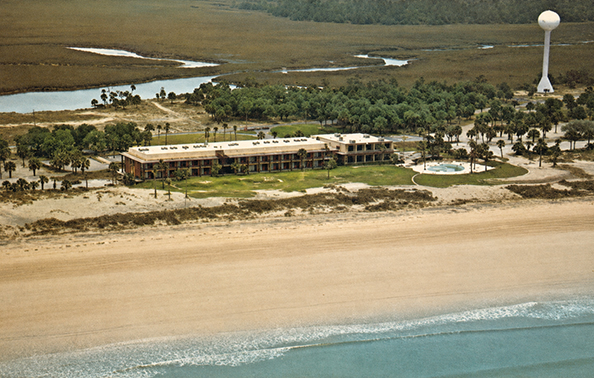
What the shares were meant to build was published alongside them, and it was not modest: a yacht and beach club, marinas, a golf course, shopping centers, an airport, and — promised in the earliest press releases — complete restaurant facilities and a seaside motel. The planners had a particular spot in mind for the club. At one point along the beachfront a deep salt creek swung to within about 800 feet of the ocean, so that docks and surf could be had a few minutes’ walk apart. That is where the La Tai Inn would eventually stand, and that is the creek Bob Sutton would be sent to deepen.
By May 1961, with bulldozers working sunup to sundown and the only approach still by boat, Fripp Island Resort, Incorporated, was advertising in Columbia for the island’s “first families” — 121 lots in three subdivisions, and the promise of “a fine quality motel” to come. The bridge across Fripp Inlet, 300 yards of water between Fripp and Hunting Island, opened in 1963. The first oceanfront lot sold that year for $2,500, and a golf course designed by George Cobb followed in 1964.
Six years on, what the island still lacked was the bed and the table it had been promising all along. Kilgore knew it and couldn’t pay for it, so he did again what he had done to buy the island in the first place: he found partners. Ten investors joined him in a separate company, Resort Lodging Incorporated, to which he promised the land outright if they would build and operate an inn on it. Among them were Ray Berry — the same Columbia lawyer who had stood by while Kilgore handed over the check in 1960 — along with Van Newman and Bill Turbeville, fraternity brothers of Kilgore’s at the University of South Carolina and by then the builders of many of the earliest houses on Fripp Island. Kilgore became the new company’s president, and the boards of the resort and the inn overlapped substantially.
Construction began in 1967 on a million-dollar motor inn with 60 guest rooms. What rose on Sutton’s fill was not a Lowcountry building at all. The roof was shingled and sloping, the walls a pale yellow, the trim a hard orange, the whole profile borrowed from the South Pacific. At the entrance stood a tall orange sign carrying the resort’s early emblem, a man paddling an outrigger canoe. Inside, a chandelier hung over the lobby and a curved staircase climbed to a cocktail lounge with a long view down the beach. The decorating ran to tapa-cloth hangings, carved masks, models of old sailing vessels, and tiki lanterns.
Kilgore named it the La Tai Inn. The words meant “sand and sea” in Polynesian, he said. The name came with a logotype — the two words set on either side of that same paddler — that the resort advertised as its exotic new symbol.
The inn opened without ceremony. On November 16, 1967, the Beaufort Gazette carried two full pages on the La Tai: one headed “We’re still planting grass . . .” over a photograph of the finished building, the other a block of congratulations from the Beaufort firms that had worked on it — the concrete plant, the plumber, the electrician, the roofer, the tile company, the glass company, the pool builder, the bank. The inn was already open for business, the notice said, with 60 rooms, a convention hall, a restaurant and a coffee shop, and a license from the State ABC Board. No formal grand opening would be held until January. Until then the La Tai would simply go on taking guests, and Beaufort residents in particular were invited to drive out and test the food and the entertainment. Anyone coming to eat would not be charged the usual dollar toll to cross the Fripp Island Bridge.
The general manager, William F. Ross, said he had imported one of the “finest food teams” available anywhere. His head chef was Pierre Rosier, a Frenchman who had come to Fripp by way of the Bahamas, where he had been executive chef at the Lucayan Beach Hotel. The maître d’hôtel was Cornelius Pynacker, a native of Rotterdam. A local seafood man, Jim Chaffin, was brought in to work a Lowcountry accent into the continental menu.
By the last day of December a feature on the new kitchen was running in South Carolina newspapers, and Rosier was already exasperated with the American dining public. Americans rushed their meals, he complained; they were intimidated by menus; they had no appetite for anything unfamiliar. He intended to correct all three at Fripp. “The American must slow down and take at least an hour to enjoy any meal,” he said. “He must ask about things on the menu he does not understand.” And, he added, he must get out of the shrimp-cocktail-steak-salad-baked-potato habit.
The raw material was not the problem. “With all of the fresh vegetables and meats available, plus the wonderful seafood at our back door,” he said, “the eating pleasure in South Carolina is virtually untapped.” What American kitchens did to it was another matter. Americans and the English overcooked everything, and they cooked too far ahead. “On the continent and now here at Fripp we cook everything at the minute it is served, not a week before.”
An elegant meal takes time, Rosier said; people ought to plan an evening around a meal rather than fit a meal into an evening. Asked to lay out his own ideal one at the La Tai, he began with a white wine and a seafood cocktail — lobster, shrimp and crabmeat, all of it local — bound in a sauce of chopped celery and chives. Then turtle soup with a touch of sherry, though not, he was careful to say, from the loggerheads nesting on the beach outside: those were native to the island, and “we do not serve our own as they are pets.” His pièce de résistance was tournedos Rossini — tenderloin cooked with goose liver in a Madeira sauce — with sautéed potatoes and a bouquetière of young carrots, turnips, tomatoes, peas, and green beans. “And a nice burgundy.” After that a cheese and celery tray, an assortment of pastries, crêpes suzette, chocolate mousse. “Finish it with a nice cup of coffee and, perhaps by then, a nice nap or rest.”
Asked what he cooked when he cooked for himself, Rosier turned reluctant. “I really hate to say,” he admitted, “but my favorite is a baked potato with two pats of butter, a piece of French toast, and a glass of ginger ale on the rocks.” The service was meant to match the kitchen. The inn imported a staff from the Bahamas and trained it in the continental style, and by the end of 1967 was promoting itself as able to seat luncheons, banquets, and conventions of up to 200.
The formal opening slipped past January and came on March 15, 1968 — four months after the first guests had checked in — and was staged as a weekend rather than a ribbon-cutting. An equestrian team performed. The Marine Corps sport parachute club dropped in. Tahitian dancers danced, a swing band played, Polynesian dishes came out of Rosier’s kitchen, champagne was poured, and at midnight there was a lingerie fashion show. Sixty units were ready for guests; a riding stable and a tennis court were still under construction. A swimming pool sat inside a patio of palms, and a lawn ran out to the foot of the dunes.
Twelve days earlier Dorothy Knox, a travel columnist for the Charlotte Observer, had turned up on what she called a flying trip, made on her way home from Hilton Head because a friend had told her one of the best chefs on the Eastern Seaboard was down there. Ross gave Knox what she described as the briefest interview on record, walked her through the 60 units and the convention space, introduced her to Rosier, and told her that 62 houses stood on the island with 10 more going up. In-season rates ran $36 single and $42 double for an oceanfront room, $32 and $38 for what the rate card still called a marina view (the water Sutton had dredged); breakfast and dinner were included and the greens fee was $5. The $1.75 lunch special the day she passed through was soup, curried shrimp, rice, green beans and pie à la mode. She regretted not staying for it.
Then the ordinary business of the place began, which turned out to be the interesting part. The dining room served three meals a day. Rosier, in whites, supervised the cooking himself, and the dish people remembered was his oyster pie. On weekends the restaurant and its dance floor went formal — women in long dresses, men in suits and sometimes tuxedos, swing music, and a crowd that included a number of Fripp’s early residents who read Vogue and Women’s Wear Daily and dressed accordingly. For gentlemen who turned up without a coat or tie, the inn kept a supply on hand.
Upstairs, the lounge ran live music. Among the performers was Billie Mustin, a pianist and singer who had worked in Columbia and New York City and whose sister, Helen Fant, owned a house on the island. Fant later recalled a night when Mustin was playing to a full room and someone shouted that a loggerhead was up on the beach laying eggs. The room emptied. It was, Mustin observed, the first time she had ever been upstaged by a turtle.
Behind the scenes the operation was substantial for an island that size. In the busy months the inn employed around 80 people across the front desk, kitchen, dining room, and housekeeping. It started a children’s program its first summer and ran a stable so guests could go horseback riding.
The advertising leaned on the same fantasy as the architecture. Fripp promised oyster roasts beside the Atlantic, horseback rides on moonlit trails, and golf on an oceanside championship course, all of it available in what the copy called the Wonderful World of Fripp. Off-season, the inn sold what it billed as Indian Summer magic, with package rates that included breakfast and dinner. By 1969 the listings described a dining room open daily for all three meals, overnight accommodations, and tennis, riding, four-season golf, fresh- and saltwater fishing, and swimming.
Rosier did not stay long. By his own later account he spent about a year on Fripp before moving to California to learn more about American cooking. In the summer of 1971 he was chef at the Inn of the Six Flags in Arlington, Texas, building buffets for a new dinner theater. He surfaced again in Columbia, first running the restaurant at Coldstream Country Club and then, in 1975, opening his own place: Tivoli Scandia, a French and Scandinavian restaurant on the ground floor of the Middleborough Apartments on St. Julian Place, where his wife baked the pastries and the beef Wellington went for $10. He still wanted his customers to linger — two hours, three hours, he told a reporter that spring. It had been eight years since he had said the same thing about a dining room on a barrier island.
Back on the island, confidence peaked in 1970. That year the resort announced a $4 million expansion, most of it condominiums, but with the inn at its center. The La Tai, then 60 units with meeting space for 150, was to be doubled: 60 more guest rooms, convention facilities for 500, and a new dining room seating 225. Forty condominium units would go up in the first phase, some beside the inn and facing the ocean, the rest arranged around a marina proposed for the water in front of it.
Very little of that happened. The convention business the plan was built on never materialized in the volume its authors expected. In 1971 the Polynesian conceit was quietly dropped, with the La Tai Inn becoming the Fripp Island Inn. Meanwhile the island’s underlying problem came due. Fripp had been developed on individual septic tanks, with a community sewer system always promised for later, and by 1972 the South Carolina State Board of Health was seeking an injunction to halt further development until a wastewater plan was approved. That same year Kilgore sold his interest in the resort for $3.5 million and moved back to Columbia. The buyers were a group of savings and loan institutions; John Hardin, an early Fripp homeowner, was a key figure in the purchase. The new owners built the treatment plant.
They also changed course. Presenting their master plan, the new management said its priorities were preserving the island’s ecology and maintaining a tranquil, family-oriented atmosphere — and concluded that the inn, which had drawn only limited convention traffic, did not fit either one. Their solution was to take it apart. The sleeping rooms would be converted into efficiency-suite condominiums and sold off. The restaurant and bar — by then operating simply as part of the Fripp Island Inn — would become the beach club. The promotional literature drew the line plainly: Fripp Island was not a commercial resort spa but a private, full-serviced residential community. “Full-serviced” meant appearance, maintained recreation, and guards on the bridge, and it went a long way toward quieting the friction that had built up between residents and the resort’s owners. Families, not conventions.
The pieces are still there, still doing the jobs they were assigned in the 1970s. The old guest rooms survive as the Sun Suites — studio efficiencies of roughly 325 square feet with kitchenettes, clustered beside the Olympic-size pool, and still the cheapest way to buy into Fripp Island. The restaurant Rosier opened went on serving dinner for another half-century under a plainer name: the Beach Club.
Kilgore lived to see what the island became. He was back for Fripp’s 50th anniversary in 2010, by which time it held some 2,300 homes and condominiums, two golf courses, six restaurants, five gift shops, and a racquet club. “I wanted a low-density, non-commercialized island,” he told the Beaufort Gazette that year. “I would have never dreamed Fripp would have that number of houses today.” He died at home in Columbia in 2015 at age 88.
In 2023 the resort that Kilgore built changed hands for the seventh time since the bridge opened, with Seascape Hospitality Group, the new owner, promising to renovate nearly everything on the island. Out in front of the old inn, the loggerheads that Rosier refused to put in his soup still come ashore every summer. And the creek that runs behind it is still too shallow at low tide.

Pineapple Jubilee
In the early 1960s Jack Kilgore envisioned Fripp Island, South Carolina, as a full-scale seaside destination, with a yacht and beach club, golf, marinas, lodging, and restaurants. La Tai Inn, opened in 1967 as the resort's long-promised hotel and dining room, gave that vision a distinctly Polynesian cast. French chef Pierre Rosier ran its Continental kitchen, which turned out this popular tropical dessert — flambéed orange marmalade and West Indian rum spooned over fresh pineapple and vanilla ice cream.
Ingredients
- 1 fresh pineapple, peeled, cored and sliced
- 1/4 cup orange marmalade
- 1/2 ounce West Indian rum
- Vanilla ice cream, for serving
Instructions
Cut the peeled and cored pineapple into serving-size slices. In a large skillet, heat the pineapple with the orange marmalade until the fruit is hot and the marmalade has loosened into a sauce.
Pour the rum over the pineapple and carefully ignite it. Spoon the flaming sauce over the fruit as the alcohol burns off.
Place a scoop of vanilla ice cream in each dessert dish. Arrange the warm pineapple alongside the ice cream and spoon the sauce over the fruit. Serve immediately.
In Our Vault: More Recipes from La Tai Inn
- Gazpacho


No Comments