

In 1933 Ray Hagle opened a livery on the lower St. Clair River a mile and a half north of Algonac, on the road that carried traffic north from Detroit toward Marine City and Port Huron. His customers went out after pickerel — known everywhere else as walleye — on a stretch of water the town was already advertising, without much modesty, as the pickerel capital of the world. They came back cold, and Hagle began making soup and carrying it down to the docks. Sometime around 1935 he cleared out one room of the livery, put tables in it, and started cooking the fish his customers brought back, within sight of the water it had come out of. Nothing about the arrangement suggested permanence. It would last, in one form or another, for the better part of 90 years.
Algonac in the 1930s was a boat town in the literal sense: it made them. Chris Smith had been building hulls there since 1874, and by the time of the Great Depression the Chris-Craft works at the south end of Algonac was the largest producer of mahogany runabouts in the world and the largest employer for miles. Garfield Arthur Wood — the Gray Fox, winner of the Harmsworth Trophy, and a serial holder of the world water speed record — kept his own operations and reputation nearby. Freighters ran the channel a few hundred feet off the bank, close enough to read the names on their bows. The commercial logic of a riverside eating place was obvious to anyone who stood on the seawall for five minutes, and Hagle’s grew into it gradually, adding sandwiches and hamburgers, and, during the war years, drinks and evenings of dancing.
The man who bought Hagle’s operation in 1945 came upriver from Detroit with a name already attached to a business. Sidney A. McQueen had run Sid’s Cafe at 15241 East Warren Avenue, on Detroit’s east side, and had promoted it with the flat confidence of the period. A Decoration Day advertisement in 1940 aimed squarely at weekend golfers, pitching a breakfast bar that opened at seven on weekdays (“Good Food — Fast Service — Reasonable Prices”) and dinners from 11:30 on Sundays. In 1942 he threw a grand opening for a new cocktail lounge and an enlarged, redecorated dining room; the advertisement counted 388,600 dinners served the year before, on premium beef and fowl, and closed on the house pun, “Our Reputation Is at Steak.” Two years later McQueen sold the Warren Avenue business to Sol Boesky of the Banner Novelty Company, to be run by Boesky’s brother Sam, and within a year he had bought Hagle’s place on the St. Clair River and hung his own name on it.
What reopened on May 1, 1946, was Sid’s Tavern, and the advertising made a point of the continuity: the same standard of food and service the establishment had been known for over the previous 11 years, now under McQueen. He had also acquired a sideline that reads today like a small marvel of local networking. In partnership with Conrad J. Berger of Algonac, McQueen took on a dealership for Gar Wood boats and put the sales room directly next door to his tavern. Berger was not a casual choice. He had gone to work for Gar Wood in September 1928 at its Highland Park plant, moved on to Wood’s personal shop at his Grayhaven estate, and worked at the Algonac plant on the Liberty-Gar Wood marine engines; his association with the company ran to some four decades. The advertisements offered marine taxi service and speedboat rides on the river, promoted the new hulls as styled by Norman Bel Geddes, the brilliant theatrical and industrial designer, and urged customers to order early for delivery. It was a short-lived business. Gar Wood showed four painted, unvarnished models at the 1947 boat show and stopped building boats within months.
The restaurant, by contrast, was becoming a destination. In 1949 it turned up in Ford Times, the monthly travel magazine published by Ford Motor Company, which described it as a spot where diners got a ringside seat on one of the world’s busiest inland waterways — freighters and passenger ships passing during the navigation season, some of them not a hundred feet from the window tables — with deep-fried Lake Erie pickerel named as the dish to order against that backdrop. It was the first appearance of a formula the place would work for the next quarter-century: the view, and the fish.
That same year James and Lillian Mattas bought the business. Mattas was not a restaurant man by trade. A native of Rhode Island who had lived in the Detroit area since the early 1920s, he was a co-founder and later the president of the Columbia Steel Treating Company. He and his wife treated the Algonac restaurant as a permanent construction project. Over the following decade and a half they enlarged it repeatedly, carpeted it, air-conditioned it, and glassed in as much of the river frontage as the footprint allowed, adding two rooms that regulars would name for years afterward — the Seaway Room and the Captain’s Cove. A local history written while the family still held the place called it one of the showplaces of the riverfront, which was less boosterism than a plain description of what had happened to a converted boat livery.
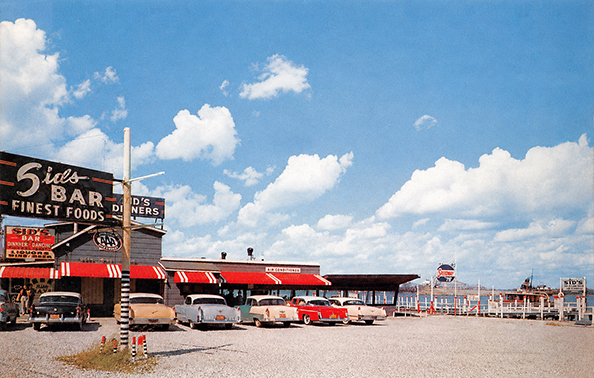
Postcards from those years document the transformation better than any prose. A linen card copyrighted in 1957 shows a long, low, blue-gray building strung out along the seawall, its river side almost entirely window, with lawn chairs — white, green, red — set out on the grass a few feet from the current, and a rooftop sign reading, in all caps, “Sid’s Dinners.” The message on the back is pure mid-century salesmanship: the million-dollar view of the St. Clair River, the largest completely glassed dining room on the river, open year-round, completely air-conditioned. Under that, three words: “Just Good Food.” The same phrase was fired in red type onto the drinking glasses and shot glasses, above the line “On the St. Clair River, Algonac.” A photo card from the same period shows the restaurant’s highway side — a gravel lot full of two-tone sedans, striped awnings, a sign for Vernors ginger ale, and a canopy running down toward the docks.
Active management passed to the owners’ son in 1956, when Charles J. Mattas came home from military service and took over the day-to-day running of the restaurant. The succession had been settled well in advance. In January 1953 a local newspaper reported that Charles had graduated from the University of Detroit with a bachelor’s degree in business administration and would enter the armed services at the end of February — and that on his discharge he would assume management of his father’s bar and dining room at Algonac. He came back at the moment the river was about to change character. The St. Lawrence Seaway opened in 1959, and saltwater ships from Europe began working their way up past the seawall alongside the lakers. The Mattases renamed the restaurant to match, and Sid’s became Sid’s on the Seaway — a name that would hold on menus, matchbooks, and roadside signs, with one interruption, until 1976, even as the sign painters and postcard printers kept mixing it with Sid’s on the River and Sid’s Dinners.
The 1960s were the peak years. A Mother’s Day advertisement in 1962 offered a complete dinner, entrée and dessert included, for $2.50, with a fish fry every Friday night. A 1965 newspaper ad reduced the whole proposition to “finest foods, liquors, entertainment” — and, in a box at the right, the three words that mattered most to the summer trade, “Dock or Park.” Menus and matchbooks billed the place as a restaurant and nightclub, which is roughly what a riverfront supper club in that market had to be to fill tables in February as well as July.
By then the industry that had filled Sid’s dining room was leaving. Chris-Craft moved its administrative offices from Algonac to Pompano Beach, Florida, in 1957; the Smith family sold the company to NAFI Corporation in 1960; and the Algonac plant, the town’s chief employer, shut down in 1970, with the last wooden Chris-Craft — a 57-foot Constellation — completed shortly after. The freighters kept coming, but the payroll that had underwritten Friday fish fries and Saturday nights did not.
The name came off once before the end, and that experiment came from inside the family. In March 1973 Charles Mattas bought a Black Angus franchise and reopened the restaurant as Sid’s Black Angus. It did not take. Eighteen months later the sign said Sid’s on the Seaway again.
The end came in 1976, and it was a decision to leave the business rather than to change it. On June 13 the Port Huron Times Herald reported that Sid’s on the Seaway — by then billed as a nightclub as much as a restaurant — had been sold, pending transfer of the liquor license, to Gerald Silvas, who had owned the Voyageur in St. Clair for 13 years and who had approached Mattas because he wanted the riverfront location. “Basically, it will be the same type of restaurant,” Silvas said, allowing that he had changes in mind but would not make them public because they involved so many people. Mattas, who had opened Sid’s 27 years earlier, would not discuss figures. “I just wanted to get out of business,” he said, and named the Iron Mountain region of Michigan’s Upper Peninsula as the place he meant to retire to. He put down August 1 as the probable date for the transfer, and he was right almost to the day.
On August 1 the Times Herald carried an advertisement for excellent seafood and steaks, live entertainment Monday through Saturday, dancing to Orion on Friday and Saturday nights, and Larry Burda six nights a week in the Captain’s Cove — the lounge keeping the name the Mattases had given it. The restaurant underneath was the Channel Marker, and in smaller type along the bottom, by way of directions: “Formerly Sid’s.” The name had lasted 31 years on that stretch of bank, 27 of them under the Mattases.
Sidney McQueen outlived his name on the building by eight months. He had left Michigan for Florida in the mid-1950s, and he died at Pompano Beach — the town Chris-Craft had chosen for its headquarters 20 years before — on April 3, 1977, at age 80. The death notice in the Fort Lauderdale News identified him by the two rooms he had run: Sid’s in Detroit and Sid’s in Algonac.
James C. Mattas died on April 4, 1982, at age 76, in the Iron Mountain country his son had named six years earlier.
The Channel Marker held the site for six years. In 1982 the building passed to the Brengman family of Detroit, who, after four months of renovations, reopened it as Captain 2 on the Strait — a second Captain’s, after the Captain’s Lounge near Detroit’s City Airport and the Captain 2 the family had opened on Mack Avenue around 1977. The Brengmans believed the venture was fated, and the reason was a Detroit connection that closed a circle nobody had planned. Ed Brengman’s grandfather, the family said, had worked for Sid’s in Detroit for 30 years before the business moved to Clay Township; when it went, he chose to stay in the old neighborhood and opened a restaurant of his own, which is where the family trade began. Whether or not the arithmetic of those 30 years is exact, the lineage the Brengmans described ran straight back to the cafe on East Warren Avenue that Sid McQueen had sold in 1944.
The building outlived all of them. Jack Lietke bought the restaurant in 1993 and renamed it Anthony’s, after the son-in-law who ran it. In 1997 it passed to the McRae family, who called it McRae’s Big River Grille, kept the telephone number that had begun life as Swift 4-3041, and printed the Hagle story on their own materials, dating the house to 1933 and crediting a German immigrant couple who rented boats and cooked what their customers caught. They ran it for roughly two decades on the same two assets Sid McQueen had bought in 1945 — fresh perch and a wall of glass facing the shipping channel.
It is gone now. The restaurant closed, the building came down, and by 2023 the parcel at 9715 St. Clair River Drive was an empty lot with a seawall. The freighters still pass a hundred feet off the bank, and the Algonac Lions Club still runs a pickerel tournament every year on the Fourth of July.

Sid's Tartar Sauce
In 1945 Sidney McQueen bought a modest restaurant on the St. Clair River a mile and a half above Algonac, Michigan, and rechristened it with his name. Within a few years, Sid’s had become a destination for diners drawn as much by its deep-fried pickerel (walleye) as by its view of one of the busiest inland waterways in the world, where freighters and passenger steamers passed within a hundred feet of the window tables. This simple tartar sauce, served with the Lake Erie pickerel, combined sweet pickles, mayonnaise, lemon, celery salt, onion powder, and a touch of horseradish.
Ingredients
- 1/3 cup finely chopped sweet pickles
- 2/3 cup mayonnaise
- 1 teaspoon fresh lemon juice
- 1/4 teaspoon celery salt
- 1/4 teaspoon onion powder, plus more to taste
- Dash of prepared horseradish
Instructions
In a small bowl, stir together the pickles, mayonnaise, lemon juice, celery salt, onion powder, and horseradish until evenly combined. Taste and adjust the onion, horseradish or lemon juice as desired.
Cover and refrigerate for at least 30 minutes before serving, if time permits. Serve chilled with fried fish, particularly pickerel (walleye).
Notes
The original recipe released by Sid's Restaurant in 1949 listed the ingredients as follows: "1/3 portion chopped sweet pickles, 2/3 portion mayonnaise, small portion lemon juice, celery salt, ground dry onion — to suit taste, dash horseradish." This adaptation preserves the original one-part-pickle-to-two-parts-mayonnaise proportion while making the recipe practical for a modern kitchen.
In Our Vault: More Recipes from Sid’s
- Captain's Cove Cheese Spread
- Deep-Fried Pickerel
- Princess Cole Slaw Dressing
- Sid's Roquefort Cheese Dressing



No Comments