

In 1912 James Ferguson “Jimmie” Burns, the Cripple Creek gold millionaire, opened an opera house at 21-23 East Pikes Peak Avenue, a three-story pile of glazed white terra cotta designed by the architects Douglas and Hetherington, with Italian marble floors, cherubs painted on the ceiling, and balconies that swept across the room without a single obstructing pillar. Burns had been a plumber before he was a mining king, and he never entirely forgave Colorado Springs society for its airs; he once remarked that it took more brains to fix a toilet “than to speak bad French.” His theater seated roughly 1,500, and the ground floor of the building carried shops and offices facing the avenue. By 1927 the opera house had been converted to a movie theater. By 1933 it was operating as the Chief Theatre, its neoclassical front interrupted by a neon marquee that later critics would call, depending on temperament, graceless or monstrous. It was in the Burns Building’s own row of storefronts, at No. 27, that a restaurant called the Indian Grill opened in 1932.
Its proprietor was Joseph E. Besseghini, born in 1893, who ran the place with his wife, Rose Biondini Besseghini. They were an Italian family in a town whose civic self-image ran heavily to Anglophile gentility and Pikes Peak scenery, and the restaurant Besseghini built split the difference between the two in a way that now seems almost audacious. The name and the decor were frontier Western. The kitchen, from the beginning, was substantially Italian.
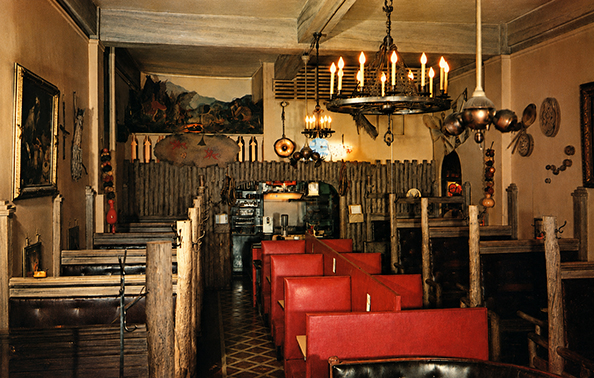
What visitors remembered was the walls. Besseghini collected Native American artifacts, and the pieces that filled the dining room had reportedly been gathered in the surrounding country rather than bought as stage dressing from a catalog. Baskets, beadwork, weapons, pottery, and paintings accumulated over three decades until the restaurant functioned as a small unaccredited museum where the exhibits happened to have tables underneath them. There was a bar off the dining room called the Papoose. The Indian Grill served lunch and dinner every day but Tuesday, and it did not take itself so seriously that it required reservations.
The thing that carried the restaurant’s name beyond El Paso County, though, was a bottle of salad dressing. By the late 1930s Besseghini was mixing an Italian-style dressing in the restaurant kitchen and selling it over the counter. Advertisements from 1939 announced it plainly enough — “Delicious and Different” — and priced a bottle at 25 cents. The federal trademark file for the Indian Grill brand of salad dressings would later fix the first use of the mark at January 1, 1938. The mark itself was registered in 1940, and not to the restaurant: the registrant was Besseghini, trading as the Indian Grill Products Company, a separate name for a side of the business that had already outgrown the kitchen from which it came. The label carried a full-face Indian head, a scatter of arrows, and a broken circle, a design the U.S. Patent Office would eventually index in the dry taxonomy of its own classification scheme. Some newspaper ads for the salad dressing reproduced the emblem — a war-bonneted chief between the words “Indian” and “Grill,” both in all caps, with an arrow running the width of the ad beneath him — and underneath the line “Made by the Indian Grill, Colorado Springs, Colo.” By 1941 the dressing had escaped the dining room entirely and was stocked in groceries in Colorado, Missouri, Nebraska, Oklahoma, South Dakota, Texas, and Wyoming — even as far away as Ohio.
It traveled by the ordinary machinery of prewar food promotion. One such ad, published in 1940 by a newspaper in Casper, Wyoming, borrowed an endorsement from Dorothy Ayers Loudon, a nationally known home economist who conducted a cooking school for the Rocky Mountain News in Denver, and boasted that the dressing was on its way to being the best-selling one in the state — a claim presumably drafted for Colorado readers and then sent north with the rest of the copy. In August 1941 the food columnist Dorothea Hake of the Cincinnati Enquirer made it the lead item in her “News About Food” column, describing an Italian-style dressing of oil, vinegar, and spices meant primarily for greens, noting that vacationers and travelers had been enjoying it for years at the Indian Grill in Colorado Springs, and cautioning readers that garlic was among the flavorings — if that made a difference to them, she wrote, they would not want it on their next green salad. It came in half-pint and pint bottles, and readers who wanted to know where to buy it were told to telephone the newspaper’s food service department. The same month a Corpus Christi grocery advertised eight ounces for 22 cents beneath a headline recommending it “for your wop salad.” The phrase is jarring now and was not then. From the 1930s into the 1980s it was a standing menu heading for a garlicky Italian green salad across Louisiana, Texas, and the Gulf Coast, most closely identified with New Orleans and printed by Italian-American restaurateurs about as readily as by anyone else — a slur worn so smooth by use that most of the people setting it in type appear to have stopped hearing it. It ran that August above a product invented by a Colorado Springs restaurateur named Besseghini.
The Indian Grill salad dressing had escaped the dining room; now it escaped Besseghini, and that is where the story turns. In 1944, according to a complaint filed 16 years later, he released the formula to Castlegate, Inc., a Colorado-chartered food processor that sold products across an 11-state northwestern territory under the brand name Bluhill, under an exclusive royalty agreement — the arrangement that a small proprietor with a good product and no bottling plant would naturally make. The following year he sold the restaurant itself to Paul M. Borchert, a former manager of the Broadmoor hotel, and stepped back from the business he had founded while continuing to collect on the dressing that bore its name. Borchert was Dutch, and had been in the papers himself in September 1940, when word reached him at the Broadmoor that his brother John and his niece Pauline had been killed in one of the first German bombing raids on Holland.
Borchert kept the name, the relics, and the reputation. Meanwhile the dressing moved further away from the man who invented it. On August 4, 1947, an application was filed to register “Indian Grill” as a trademark for salad dressings; the registration issued on June 6, 1950, as No. 525,859, superseding the 1940 registration, No. 374,731. The applicant of record was Bluhill Foods, Inc., of Denver. That 1950 date matters, because the complaint of 1960 would allege that Castlegate registered the dressing in its own name that year while continuing to pay Besseghini his royalties. By then the bottles carried the Bluhill imprint — Castlegate’s own brand rather than a stranger’s, the two names describing one enterprise — and the copy had acquired the mildly confounding jauntiness of postwar grocery advertising: “Try Dressing MEN like!” The reach went upmarket as well as down. In 1948 the dressing was advertised in Gourmet magazine, aimed at a readership nobody was courting with 22-cent grocery specials — a recipe out of a Pikes Peak Avenue kitchen presented to the carriage trade.
The restaurant, for its part, was having a good decade. In March 1954 Ford Times, the monthly travel magazine published by the Ford Motor Company, included the Indian Grill in one of its standing features — about the closest thing a regional restaurant then had to a national credential. A photograph taken in 1956 from an upper window across the Pikes Peak Avenue captures the whole block in one frame: the Chief Theatre’s marquee advertising the motion picture “Attack” with Jack Palance, the Medical Arts Pharmacy, the Out West building, and the Indian Grill’s own sign, all crowded together on a downtown street that was still, in 1956, downtown.
It had also acquired a standing noon congregation. The Rock Pile — an unofficial lunch club of Colorado Springs business and professional people, named, one longtime member supposed, for the rocks its members threw at one another and at everybody else — had been meeting since Billy Jones ran McRae’s Restaurant on East Pikes Peak Avenue, and by the middle 1940s it had settled at the Indian Grill. Among its regulars was Harry H. Hoiles, the publisher of the Colorado Springs Gazette Telegraph.
Joseph Besseghini died on July 21, 1956, at age 63. His estate, according to the litigation that followed, continued to receive royalties on the dressing until 1957, and then stopped.
That same year the restaurant changed hands again. In August 1957, George R. Wadsworth and John E. Graney — Wadsworth a former investment banker, Graney the man who would manage the place day to day — bought the Indian Grill from Borchert and took it on as a partnership.
The royalty question, meanwhile, had escalated into a lawsuit. On March 22, 1960, the First National Bank of Colorado Springs, acting as executor of Besseghini’s estate, sued for $1.2 million in damages. The defendants were Castlegate, Inc.; Bluhill Nevada, Inc.; Richard E. Newman, Bluhill’s president; and Edgar J. Schoen, a Bluhill stockholder. The complaint traced the dressing’s ownership through a chain of transfers: Besseghini had invented the recipe and licensed it to Castlegate in 1944; Castlegate had registered it as its own in 1950 while still paying him; seven years after that, Castlegate sold the formula to a corporation headed by Schoen, who sold it in turn to Bluhill. The suit was filed in El Paso County District Court at Colorado Springs and was on file in the U.S. District Court in Denver the following day, where the wire services picked it up under headlines about a stolen recipe. That a Colorado Springs restaurateur’s kitchen recipe had generated a seven-figure federal claim four years after his death says something about how far a bottle of dressing could travel in the middle of the 20th century.
The seven-year interval in that chain is not arbitrary. Castlegate went out of business on August 31, 1957, and the formula went out the door with everything else. The firm did not go quietly. In October 1959, five months before the Besseghini estate sued it, Castlegate filed a $2.4 million antitrust action of its own in federal court at Sioux Falls, where it had by then moved its main office, against National Tea Company, National Dairy Products Corporation, its Kraft subsidiary, and Miller’s Super Markets of Colorado and Wyoming. The 23-page complaint said the company had been in business 65 years and had operated successfully across 11 northwestern states under the Bluhill trademark, but that because so much of that territory was thinly populated it had to lean on its profits at home in Denver and Cheyenne — where, it charged, Safeway and Miller between them controlled 60 percent of the consumer trade in the first city and 80 percent in the second. It accused the national processors of making secret payments to large retailers for display space and of spending millions on publicists to advertise the superiority of their products — practices, Castlegate alleged, that put it out of business. Whatever the merits, the effect was plain enough: The company that had been paying Joe Besseghini his royalties was, by the autumn of 1957, a company with nothing left to pay them with.
None of this appears to have troubled the dining room. Wadsworth and Graney continued to trade on the collection that had always distinguished the place, and in 1960 they extended it, advertising its “superb collection of original Western paintings” for customers to look at, with the reassurance — necessary, perhaps, once you have begun advertising fine art — that the kitchen still offered “Good Food at Reasonable Prices.”
The Indian Grill lasted two more years. It closed on September 20, 1962, and the news ran on the front page of the Gazette Telegraph. The reason the partners gave was neither bankruptcy nor rent nor changing tastes. Wadsworth and Graney were dissolving the partnership and shutting the restaurant, they said, because of the long hours the business demanded of both men. Thirty years of downtown lunches and dinners had come down to an arithmetic of fatigue. The one loose end that concerned the community was the walls: the Indian lore and early Western art that had covered them since Besseghini’s day would, the partners expected, be sold in a single transaction and kept together as a collection.
The Rock Pile decamped to the Village Inn on East Pikes Peak Avenue — a restaurant founded in 1936 by John Ceresa, a Broadmoor veteran who had also spent several years as the Indian Grill’s chef — where 14 years later some 25 business and professional leaders were still turning up for lunch. The storefront at 27 East Pikes Peak Avenue became a Franklin Optical. George Wadsworth did not long outlive the restaurant; in 1966, at age 61, he was found dead in the garage of his home of carbon monoxide poisoning. John Graney died in Arlington, Texas, in 1972, at age 60.
The building outlasted the restaurant by only 11 years. The Chief Theatre showed its last motion picture on October 31, 1972, after the Exchange National Bank — which held a 99-year lease with a demolition option, and which stood next door — declared the structure unsafe. The Landmarks Council of the Pikes Peak Region took up the fight, won the building a place on the National Register of Historic Places, and pressed the city council to acquire it. That effort collapsed in a manner peculiar to a small city: When the council weighed whether to put a purchase before the voters, two of its own members had to stand aside because they sat as trustees of the bank. An engineering report concluding that the theater proper was structurally sound made no difference either. Demolition followed in 1973. The old Burns Building — by then renamed the Chief Building — proved so well built that tearing it down cost about twice what it had cost to build. Fixtures scattered. In 1977 a solid brass chandelier from the Indian Grill surfaced in a local story, an artifact of an artifact.
The dressing was the last thing standing. The “Indian Grill” trademark, still held of record by Bluhill Foods, Inc., was renewed for an additional 20 years in 1970 — eight years after the restaurant that gave it its name had locked its doors. The registration was not renewed a second time, and it lapsed in 1992, 60 years after Joe Besseghini opened a storefront under a movie marquee and hung Native American relics on its walls.
Poached Colorado Rainbow Trout in Court Bouillon
Joseph E. Besseghini opened the Indian Grill in downtown Colorado Springs, Colorado, in 1932, but before the decade was out he was bottling the restaurant’s popular Italian-style salad dressing and selling it over the counter and in grocery stores. Within a few years it was distributed throughout much of the West and as far away as Ohio. This entrée — rainbow trout gently cooked in an aromatic court bouillon and served with melted butter — was one of the most popular items on the Indian Grill's menu.
Ingredients
- 4 whole rainbow trout, about 8 ounces each, cleaned
- 4 quarts water
- 2 ounces kosher salt
- 1 cup distilled white vinegar
- 2/3 cup sliced carrots
- 1/2 cup sliced onions
- 1 small sprig parsley
- 1 bay leaf
- 1 small sprig thyme
- 1 tablespoon coarsely crushed black peppercorns
- 4 tablespoons unsalted butter, melted, for serving
Instructions
In a large pot, combine the water, salt, vinegar, carrots, onions, parsley, bay leaf, thyme, and peppercorns. Bring to a boil, reduce the heat, and simmer for about 20 minutes.
Arrange the trout in a wide, heavy pot or fish poacher. Pour in enough hot court bouillon to cover the fish.
Bring the liquid just to a gentle simmer. Cook without allowing it to boil rapidly until the trout are cooked through, about 10 to 15 minutes, depending on their size.
Carefully lift the trout from the bouillon and drain briefly. Serve hot, with melted butter spooned over or passed at the table.
In Our Vault: More Recipes from Indian Grill
- Chinese Snow Peas with Water Chestnuts
- Strawberry-Rhubarb Pie


No Comments