

In 1937 Constantine “Gus” Sclavos opened a restaurant at the crossroads of U.S. Route 40 and Delaware Route 896 in Glasgow, Delaware. The location was strategic. Before the interstate-highway era, U.S. 40 was one of the principal automobile routes between Baltimore, Philadelphia, and points farther north, carrying an almost continuous procession of salesmen, vacationers, politicians, diplomats, newlyweds, and families past the restaurant’s front door.
Sclavos had spent years learning how to serve such travelers. Born in Greece, he’d come to the United States in 1917 and gotten a job as a toolmaker at a Bethlehem Steel plant in Baltimore. He later became a co-owner, with a partner named George Vaggie, of the Howard House Hotel in Elkton, Maryland, a town then known as the “Marriage Capital of the East.” Unlike its neighbors, Maryland required neither a waiting period nor a residency to obtain a marriage license, and Elkton, as the state’s most northeasterly county seat, was the closest such haven to Philadelphia, New York, and New England. At the height of the trade the town supported more than a dozen commercial wedding chapels, ministers who performed hundreds of ceremonies a month, and a syndicate of taxicab drivers who met the southbound trains and sold couples a package deal. Elkton recorded better than 16,000 marriages in 1938 alone, and its reputation was national. Joan Fontaine, Willie Mays, Martha Raye, Debbie Reynolds, and Cornel Wilde all took their vows there.
In 1931 Sclavos opened the Elk Restaurant in Elkton, but in 1937 the Maryland legislature passed a 48-hour waiting period for marriage licenses, aimed squarely at Elkton, and nobody in the town’s hospitality business could have mistaken what it meant. Petitions forced the question onto a statewide ballot, buying the chapels and the taxicab drivers and the restaurants a year’s reprieve, but in November 1938 voters approved the measure overwhelmingly, over the objection of Cecil County. The last of Elkton’s few-questions-asked weddings took place that December. Sclavos did not wait for the vote. He kept the Elk Restaurant running until 1938, but by then he had already opened the Glasgow Arms across the Delaware line, on a stretch of highway whose traffic depended on nobody’s marriage license.
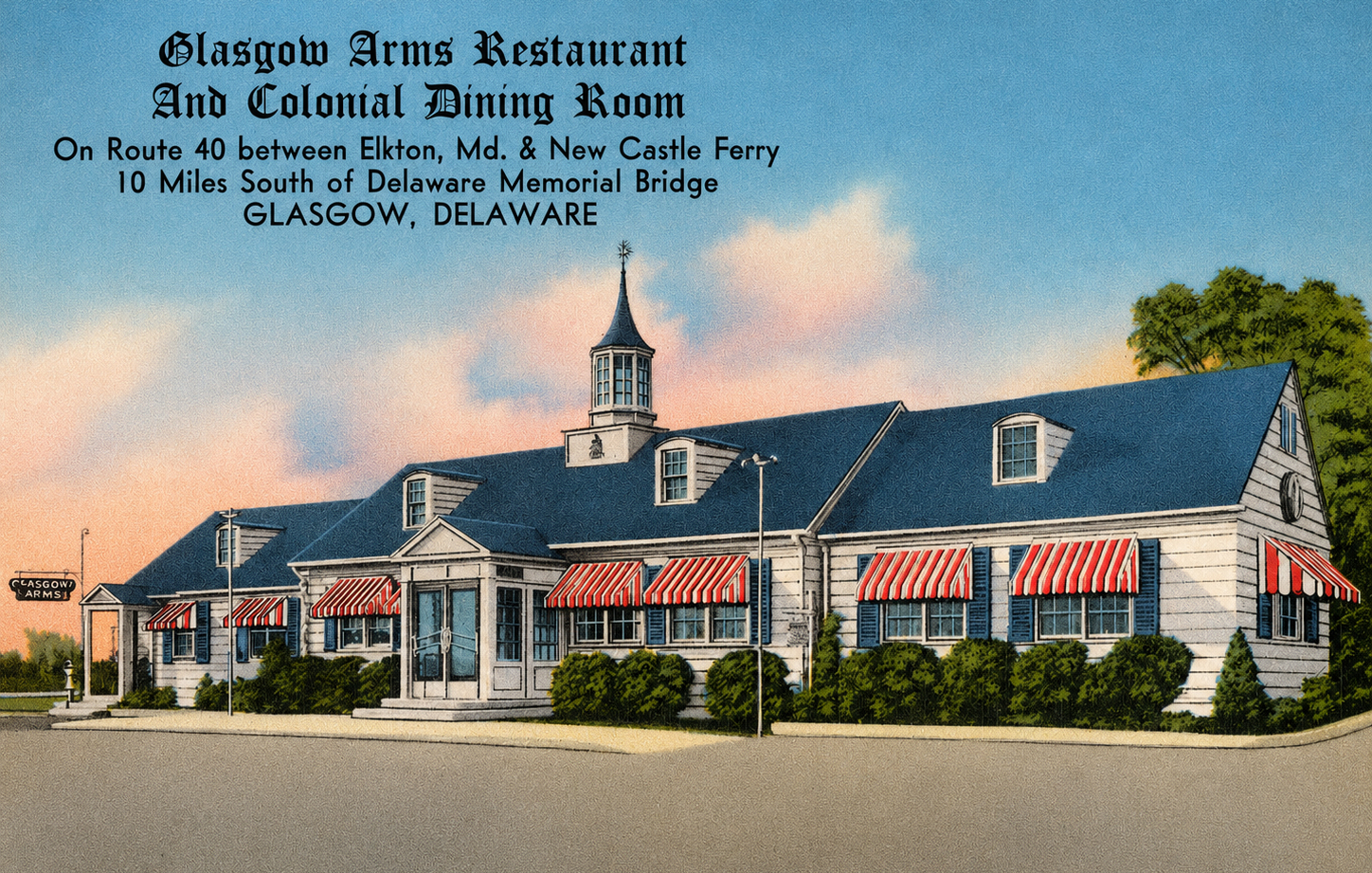
The Glasgow Arms was neither a diner nor a roadside lunch counter. Sclavos conceived it as a proper restaurant — comfortable, substantial, and dignified enough for an anniversary dinner or wedding reception, yet accessible to the steady traffic along U.S. 40. Over time, the building developed into a sprawling, white-clapboard landmark whose Colonial appearance stood out in the broad commercial median where Routes 40 and 896 met.
Its name linked the restaurant to the community, which had itself been named by Scottish settlers for Glasgow, Scotland. The connection was made official in the restaurant’s insignia. With permission from the Lord Provost of Glasgow, the Glasgow Arms adopted that city’s coat of arms as its crest — the tree, the bell, the salmon with a ring in its mouth, and the motto “Let Glasgow Flourish” — and printed it in red on its menu covers above the line “Used by Permission Of The Lord Provost, Glasgow, Scotland.” In the years to come, Gus Sclavos would fill his restaurant with Scottish china, copperware, pewter, antique firearms, paintings, and other such objects.
These were not incidental decorations. They made the Glasgow Arms seem like an inn that had accumulated its furnishings over generations, distinguishing it from the multitude of cookie-cutter highway restaurants that began springing up after World War II. Here, both locals and travelers could relax in the atmosphere of an established country house.
The menus carried the theme as faithfully as the walls did. Printed on green foil stock crinkled to resemble hammered metal, they opened with the coat of arms stamped in red and closed with a back-cover history lesson: “Historic Glasgow, Aikentown (old name). Here came General Howe’s Army, September, 1777, and engaged General Washington’s Army at Cooch’s Bridge, 3 miles north of here, where the American Flag, adopted June 14, 1777, was first unfurled in battle. A substantial monument marks the site.”
Inside, the cooking was plainly and confidently mid-century American. A typed insert dated November 25, 1953, offered a $1.25 special dinner — juice or a cup of soup, a Spanish omelet or golden brown croquettes with brown gravy, two vegetables, rolls and butter, pudding or Jell-O or ice cream, and coffee or tea. Full-course dinners ran from grilled hamburg steak with onions and gravy at $1.60 to a grilled sirloin steak, cooked to order, at $4.00, with a mixed grill of lamb chop, calves liver, and Canadian bacon at $2.25, and backfin crabmeat imperial at $2.30. À la carte platters, served with two vegetables, rolls, and butter, included a boned and breaded center-cut pork chop at $1.10, homemade Boston baked beans en casserole with Canadian bacon at 90 cents, pan-fried calves liver with bacon and roast turkey with giblet gravy and cranberry sauce at $1.75 apiece, and fried half Delaware spring chicken at $1.80 — the last a nod to the broiler industry that had grown up in the counties to the south, and which the restaurant promoted with a small color card reading “Eat Delaware Chicken.” Vegetables ran to succotash, candied yams, pickled beets, and coleslaw. The sandwich list stretched from a chicken club at a dollar down to peanut butter and jelly at a quarter; the salads included jellied tomato aspic on lettuce for twenty cents; coffee was a dime, as were Postum and Sanka.
Three lines printed at the foot of the sandwich page amounted to a statement of principle: “Please Do Not Rush — Everything Is Cooked To Order.” “We Use Only Vegetable Shortening For Frying.” “Our Kitchen Is Open At All Times For Your Inspection.” The bar list opposite was long for a roadside restaurant — five dozen whiskies, brandies, and cordials, with a 25-year-old Ambassador scotch at 95 cents topping the column and Chivas Regal just below it, martinis at 55 cents, beer at 35 cents a bottle, and a bottle of Piper-Heidsieck champagne at $8. It closed with an invitation to visit the restaurant’s package store.
The Glasgow Arms was a family affair. Gus’s son, John A. Sclavos, had been born into the hotel and restaurant business — born, in fact, in the Howard House itself. As a boy at the hotel, he’d sketched guests on pieces of cardboard taken from cracker boxes. After graduating from Elkton High School in 1943, he joined the Marine Corps and served during World War II, and he would serve again in Korea. When he returned in 1947, he went directly to work at the Glasgow Arms, still wearing his uniform. “I didn’t even have time to buy civilian clothes,” he would later recall. “I was working in the restaurant in my uniform. I loved that business.”
John’s artistic interests followed him into the dining rooms. The illustrator Frank E. Schoonover and his wife frequently dined at the Glasgow Arms, and after John showed the noted artist some of his sketches, Schoonover invited him to study at his Wilmington studio. John attended classes twice a week for roughly four years. Schoonover believed that his student had the makings of a professional portraitist and offered to help establish him.
John declined. He enjoyed painting, but the restaurant had the stronger claim on him. “I liked to paint,” he told an interviewer in 1990, “but I loved the restaurant business more.”
He never stopped painting. Some of his landscapes and still lifes hung at the Glasgow Arms, where customers saw them and began commissioning portraits. Over the years, John turned out more than 200 portraits. The restaurant supplied not merely a livelihood but a clientele. John did not advertise his work or carry business cards; diners who knew him, or saw his paintings on the walls, approached him directly.
As the restaurant’s reputation grew, so did the range of people passing through it. Its position on U.S. 40 made it a natural stopping point for travelers between Washington and the Northeast. John Sclavos recalled serving politicians, bankers, real-estate figures, and foreign dignitaries. Among the visitors who made the greatest impression on him was Indian Prime Minister Jawaharlal Nehru. “I don’t know why exactly,” Sclavos said years later. “Maybe it’s only that once you are close to him you never forget the time, the circumstances.”
Even through the 1960s, the Glasgow Arms still benefited from its proximity to Elkton. Although the town had lost much of its earlier fame as the nation’s quickie-marriage capital, couples still arrived there to wed, and some crossed into Delaware afterward for a reception or celebratory meal. In January 1964 actress Joan Fontaine, then 46, married her fourth husband, Alfred Wright Jr., the golf editor of Sports Illustrated, at the Cecil County Courthouse, and the wedding party’s first stop afterward was the Glasgow Arms. “I knew it was a wedding party,” John Sclavos said. “One of the girls told me it was Joan Fontaine. I found an excuse to go over and take a look. I’ll tell you one thing. She’s a lot prettier, a lot younger looking than her pictures would have you believe.”
The Glasgow Arms also appeared in a brochure published by the Congress of Racial Equality (CORE) that identified desegregated restaurants along Route 40, placing it squarely within a larger struggle over travel in the mid-Atlantic states. In the summer of 1961, several newly arrived African diplomats were refused service at segregated restaurants along the highway in Maryland, provoking formal protests to President John F. Kennedy and considerable embarrassment for an administration courting the newly independent nations of Africa. CORE, extending the momentum of the southern Freedom Rides, organized a Route 40 campaign of sit-ins and freedom motorcades between the Delaware Memorial Bridge and Baltimore. During the civil-rights era, African American motorists traveling the corridor could not assume that every restaurant would serve them. CORE publicized businesses where service was available, the Glasgow Arms among them, making restaurant integration a matter not only of principle but of practical safety and mobility.
The Glasgow Arms offered abundance rather than novelty. Portions were generous, sauces familiar, and ingredients, at the restaurant’s best, minimally adulterated. The kitchen’s recipe for a pound of crab imperial began with a pound of crabmeat, and the finished dish carried little filler.
Interstate 95 would change everything. President Kennedy dedicated the Delaware Turnpike, the state’s link in the new expressway, on November 14, 1963, in one of his last public appearances, and the road diverted much of the long-distance traffic that for decades had sustained businesses along U.S. 40. The old highway remained busy, but it was no longer the region’s indispensable east-west artery. Travelers in a hurry now passed several miles north of the Glasgow Arms. What had been a prime position gradually became an isolated one.
The Sclavos family nevertheless kept the restaurant going. John took the reins in 1967, although the business continued to involve other family members, including his sister Mary and his wife, Stephanie “Stell” Sclavos. Stephanie had married John in 1954 and joined him, his father, and his sister in operating the restaurant.
The continuity was a strength, but it also encouraged resistance to changing fashions. By the 1970s restaurants were embracing theme concepts, casual service, lighter cooking, and an expanding range of international influences. The Glasgow Arms remained committed to the menu and manner that had made it successful. Customers came for familiar food, full service, and a setting ideal for anniversary dinners, family celebrations, club meetings, prom-night meals, wedding receptions, and the like. For generations of local residents, being taken to the Glasgow Arms signaled that an occasion mattered.
Gus Sclavos died in 1985 at age 88. He had continued working at the restaurant until two weeks before his death. By then, the establishment he created had become conspicuously old-fashioned. A critic visiting that year observed that it was not run-down but “fashionably dated.” The restaurant still offered two vegetables with dinner. Salads were conventional, the wine list unsophisticated, and most desserts bought from an outside bakery. The one dessert still made on the premises was rice pudding, which had been on the menu since at least the early 1950s. But the portions were generous, service cheerful, and prices moderate. A five-course meal for two, with wine and tip, barely exceeded $30. “Keeping in mind its conventionality,” the reviewer concluded, “the Glasgow Arms is a good restaurant.”
Family and financial troubles compounded the challenges of a shifting market. During the 1980s, a dispute between John and his sister led to the Internal Revenue Service padlocking the restaurant for nearly a year. John declined to publicly describe the underlying disagreement, but in April 1987 he became sole owner of the Glasgow Arms and prepared to reopen the restaurant after renovations that included new carpeting and draperies and an entirely rebuilt kitchen.
The reopening, however, did not provide a lasting solution, as the Glasgow Arms continued to evoke the grand roadside restaurants of the late 1950s. It had once employed as many as 72 people, but its staff had fallen to about 30 by the spring of 1989, when Sclavos closed the doors again and put the property up for sale. He later attributed the business’s troubles in part to undercapitalization, and in part to demographics: Age had taken the restaurant’s affluent clientele, and younger diners had found flashier places to eat. He refused to chase them. “I just wouldn’t get trendy — Cajun food and all that,” he explained.
Still, Sclavos believed in the site, as residential and commercial development was accelerating between U.S. 40 and Interstate 95. “That’s always been a heck of a corner,” he said, “and now everything’s coming to Glasgow.”
A buyer came quickly. In May 1989 John Koutoufaris — the owner of the Blue Coat Inn in Dover and president of Clubs International, Inc., the Dover company that also held the Sea Horse restaurant in Rehoboth Beach — announced that he had bought the Glasgow Arms for $1,125,000. Its purchase and renovation formed part of a $3.5 million financing package assembled through the Commissioner’s Economic Development Fund, a pool of investment commitments that Delaware Insurance Commissioner David N. Levinson had won from state-chartered insurers and directed toward job-creating projects. Koutoufaris proposed hiring 75 workers at the Glasgow Arms, giving preference, at Levinson’s request, to employees who had lost their jobs when the restaurant closed, while an expansion of the Sea Horse was expected to create roughly another 25. Roughly $800,000 was earmarked for Glasgow Arms renovations, including a rebuilt kitchen, a new cocktail lounge, and a reconstructed reception lobby.
Koutoufaris planned changes but understood that the old rooms were the restaurant’s principal asset. “Some of those rooms are so classic that I wouldn’t change them,” he told the News Journal. The menu, long rooted in steaks, seafood, and mid-Atlantic standards, would lean more heavily toward seafood.
With the sale closed, John Sclavos had no restaurant to open for the first time in more than 40 years. He built a skylighted studio beside his house in Glasgow, roughly 600 feet off U.S. 40, and took up full time the work Frank Schoonover had pressed on him four decades earlier. Among his subjects was Sherman Tribbitt, who had eaten at the Glasgow Arms for years before and during his term as governor. “He’d even hold the door open for people — imagine the governor helping you out the door,” Sclavos recalled. “Anyway, soon after he was elected, he came in and said, ‘John, will you paint my portrait when I leave the office?’ and I agreed.”
The new investment could not reverse the larger shifts in dining and development. By the early 1990s, Glasgow was one of Delaware’s fastest-growing areas, but growth did not restore the old roadside culture. Subdivisions and shopping centers brought young families accustomed to casual chains, fast food, and lower-priced restaurants. The Glasgow Arms, with its paneled dining rooms and entrées priced around $15, seemed formal and expensive even though its prices were moderate by fine-dining standards.
In February 1994, general manager Dave Regan announced that the Glasgow Arms would close for remodeling and reopen as two more casual operations. Part of the building would become a pancake house, a concept borrowed from the Blue Coat Inn. The former bar, lounge, and banquet section would become the Glasgow Pub Room, offering “pub-type food” with nearly all entrées priced at around $12. Modifications would not be extensive, Regan said, though the lobby would change considerably and the back-in-time atmosphere of the pine-paneled dining rooms was unlikely to survive.
An advertisement invited customers to give “a fond farewell to the historic Glasgow Arms Restaurant” before its reintroduction as the Pancake House and Glasgow Pub Room. On February 19, 1994, after 57 years, the last meal was served under the Glasgow Arms name.
The replacement restaurants failed to establish themselves. Several family-dining concepts occupied the building in succession, but none inherited the loyalty that had accumulated during the Sclavos years. Eventually the old structure stood vacant.
The white-clapboard building had marked the crossroads for more than half a century, surviving the decline of U.S. 40, the rise of the interstate, family disputes, federal padlocks, and repeated efforts at reinvention. For residents of Glasgow, its end carried a significance greater than the disappearance of another restaurant.
The demolition crews arrived in 1997, and residents gathered at a civic meeting as the building came down. “They bulldozed it today,” Lillian McMichael glumly told her neighbors. McMichael, who’d once waitressed at the Sherwood Diner across the intersection, could scarcely see the logic. “It’s just gone … and for what?” she asked. “An Arby’s?”
“I know, can you believe it?” replied Jeanine Gerrick, the group’s vice president. “More fast food. Just what Glasgow needs.” The Sherwood itself had already given way to a McDonald’s. Two locally distinctive roadside restaurants had now been replaced by national chains on opposite sides of the same crossroads.
There was, however, one survivor. The light that once topped the Glasgow Arms was salvaged and installed atop the ChesDel Restaurant on U.S. 13, south of the St. Georges Bridge — itself an assemblage of two displaced diners, the Country Girl, moved out of Wilmington when Interstate 95 cut through the city, and the Viking, brought down from Hares. There the light went on burning over another stretch of Delaware highway until the ChesDel, too, closed in 2018.
Famous Patrons of Glasgow Arms Restaurant
- Joan Fontaine
Crabmeat Imperial
In 1937 Constantine “Gus” Sclavos opened the Glasgow Arms Restaurant at the crossroads of U.S. Route 40 and Delaware Route 896 in Glasgow, Delaware. Serving generations of travelers and local diners from its Colonial-style building, the restaurant's cooking was confidently mid-century American, with steaks, seafood, and familiar regional dishes, among them this classic preparation of Crabmeat Imperial, which, because it contains no breadcrumbs or other filler, keeps the tender crab flavor front and center.
Ingredients
- 2 pounds backfin crabmeat, picked over for shells and cartilage
- 1/2 medium green bell pepper, minced
- 4 parsley sprigs, minced
- 1 pint (2 cups) mayonnaise
- Pinch of white pepper
Instructions
In a small skillet over medium heat, cook the green pepper and parsley, stirring, until softened. Transfer to a large bowl and let cool slightly.
Stir the mayonnaise and white pepper into the softened vegetables. Add the crabmeat and fold gently until evenly coated, taking care to keep the crab pieces as intact as possible.
Divide the mixture among 5 individual ovenproof casseroles. Broil until the tops are nicely browned. Continue heating until the mixture is hot through the center and lightly browned around the edges. Serve hot.
In Our Vault: More Recipes from Glasgow Arms Restaurant
- Alaskan King Crab Meat Newburg en Casserole
- Backfin Crabmeat au Gratin
- Broiled Tenderloin en Brochette
- Cheesecake
- Clams Casino
- Crab Soup Maryland
- Seafood Newburg
- Tartar Sauce
- Tenderloin of Beef Stroganoff with Wild Rice


No Comments