

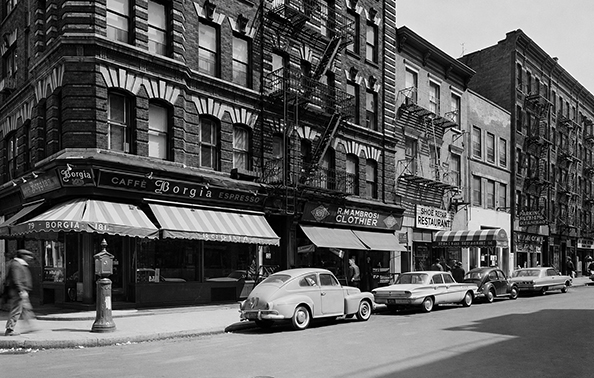
The northeast corner of Bleecker and MacDougal Streets in New York City sits at what was once the busiest crossroads of bohemian America. In the years after World War II, no intersection in Greenwich Village — arguably no intersection anywhere — packed more coffeehouse culture into a smaller radius. Caffe Reggio, pouring cappuccino on MacDougal since 1927, stood a block north. Cafe Le Figaro held down the southeast corner directly across the street. And beginning in 1959, the ground floor of the ornate Beaux-Arts tenement at 185 Bleecker Street belonged to Cafe Borgia.
The couple who opened it were products of the neighborhood in the most literal sense. Mary Latalardo was born on Spring Street, a few blocks south in what was then called the South Village, the daughter of Stephano and Anna Latalardo, immigrants from Salerno, Italy. Her father owned Napoli, a restaurant that occupied a few different locations on Spring Street over the years. Philip Cardaci grew up nearby, and the two met as teenagers. When Philip returned from Army service in Europe during World War II, they married at St. Anthony of Padua Church in 1947. Both went to work at Napoli, learning the family trade, before striking out on their own with a coffeehouse of their own design at the Bleecker Street corner.
The Cardacis named it for the most notorious family of the Italian Renaissance, and they committed to the theme. Portraits of Lucrezia and Cesare Borgia hung on the walls. Shields of armor and electric torches gave the room the look of a Medici-era hall, and a Renaissance-style mural of Venice by Franklin Moody dominated the space. The furniture, though, came straight out of the older South Village café tradition: small marble-topped tables and wrought-iron chairs. In 1964 Shirley and Bob Sloane, a husband-and-wife team of American travel journalists, placed Cafe Borgia squarely in the lineage of the Italian coffeehouses that predated the beatniks — the era, as the piece put it, when it was the neighborhood’s Italians who knew and appreciated a proper coffee house.
Borgia opened at precisely the moment the Village coffeehouse boom detonated. Cafe Wha? opened around the corner on MacDougal the same year; the Gaslight was already running its poetry nights a block away; Le Figaro, across the intersection, had been drawing writers since 1957. Into this ferment poured the Beat poets and their successors, and Cafe Borgia became one of their reliable stations. Jack Kerouac and Allen Ginsberg were counted among its patrons, along with the playwright Edward Albee and, in time, Andy Warhol, who was known to spend hours at its tables. Joan Baez came through during the folk revival years, part of a roster of regulars and drop-ins that Village memory would eventually expand to include Bob Dylan, Al Pacino, Sam Shepard, and the writer Howard Norman.
The photographer Fred W. McDarrah, the Village Voice’s tireless chronicler of the downtown scene, caught the cafe at its cultural high-water mark: His night shot of pedestrians drifting past Borgia’s glowing corner windows, taken May 22, 1966, later became part of a collection documenting Bob Dylan’s Greenwich Village. The image captures what made the place work — the cafe was not a stage or a nightclub but a room for gathering, talking, and reciting poetry, open late, where a cup of espresso bought a seat at the center of things.
Unlike the folk clubs and basket houses that surrounded it, Borgia never depended on performance for its identity, which is partly why it outlasted nearly all of them. When the tourist wave of the mid-sixties crested and receded, and when the folk boom gave way to rock and the clubs began to close, the Cardacis were still doing what they had always done: coffee, pastry, conversation, no cover charge.
Cafe Borgia remained a family operation throughout. In 1975 the Cardacis’ son Philip opened a second location, Cafe Borgia II, on Prince Street near Mercer in SoHo — a hot-pink building across from Vesuvio and Milady’s — extending the franchise into a neighborhood then in the early stages of its own artistic colonization. Philip Sr. died in 1980, and the younger Philip carried on at both locations. Mary Cardaci remained an active presence behind the counter at the original Bleecker Street café until 1995.
Through the seventies and eighties, as the Village changed around it, Borgia settled into the role of institution. A 1983 city guide, ticking off the surviving old-world cafés, described it simply: a cozy Italian café dominated by a mural of Venice, at the corner of Bleecker and MacDougal, second in age among the Village coffeehouses only to Caffe Reggio. Regulars from those decades remembered the little round marble tables, the wire-backed chairs that discouraged lingering but never quite succeeded, the worn menus, and cappuccino at prices that stayed stubbornly below what the tourist traps charged.
The end came the way it usually does in Manhattan. Philip Cardaci was paying $4,100 a month for the corner space when his lease expired, and the landlord declined to offer a new one. Cafe Borgialost its lease in October 2001 and served its last customers at the close of December — 42 years after it opened, and just months after the September 11 terrorist attacks had thrown the city’s small businesses into deeper uncertainty.
On the Tuesday after the closing, Cardaci spent the morning packing up the shields of armor and tearing down the electric torches. “There’s a lot of history here,” he told a reporter for the New York Times. “It’s just too bad, but I guess that’s New York.” He said he hoped to reopen the original someday, and he was salvaging what mattered most: the wrought-iron chairs, the Renaissance mural, and the portraits of the family that gave the café its name. Pointing at Lucrezia and Cesare, he said, “I’m taking them as well.”
The regulars mourned in the key that had become standard for Village obituaries by then. “The Village has changed so fast, it’s made us old fogies before our time,” said Jay Reisberg, a filmmaker and longtime customer who blamed gentrification for outpricing his neighborhood haunts one by one. “All those places with texture and character have disappeared.”
Mary Cardaci died at age 82 in 2005, at her home in Palm Beach Gardens, Florida. Her funeral was held at St. Anthony of Padua — the same church where she had married Philip 58 years earlier — with interment in the family mausoleum in Hawthorne, New York. Perazzo Funeral Home at 199 Bleecker Street, a few doors from the old café, handled the arrangements.
The corner space became Ciao, an Italian wine-bar-style restaurant run by Neapolitan-born Marcello Assante, which operated at 185 Bleecker for years before closing in its turn. Across the intersection, Le Figaro poured its last coffee in 2008, a closing widely read as the final death knell for a crossroads that had once been more Greenwich Village than any other corner of Greenwich Village. In 2013, the building that housed Cafe Borgia was folded into the newly designated South Village Historic District, preserving the architecture, if not the establishment.
Cafe Borgia II on Prince Street carried the name for another decade and a half, a last outpost of the classic Italian Village cafés alongside Caffe Reggio. In 2015 it, too, lost its lease and closed, and the storefront was gutted within weeks. Of the old constellation — Reggio, Dante, Figaro, Cino, Borgia — only Reggio remains, still pouring cappuccino from its 1902 espresso machine a block from the corner where, for 42 years, the Borgias kept watch from the wall.
Famous Patrons of Cafe Borgia
- Edward Albee
- Joan Baez
- Bob Dylan
- Allen Ginsberg
- Jack Kerouac
- Howard Norman
- Al Pacino
- Sam Shepard
- Andy Warhol

Cappuccino Florentino
At Cafe Borgia, the storied Greenwich Village coffeehouse that occupied the corner of Bleecker and MacDougal Streets in New York City from 1959 to 2001, coffee was served amid marble-topped tables, wrought-iron chairs and Renaissance decorations. Its Cappuccino Florentino reflected that old-world Italian café tradition: hot espresso and steamed milk, sweetened to taste and crowned with whipped cream and shaved semisweet chocolate.
Ingredients
- 1/2 cup freshly brewed, very hot espresso
- 1/2 cup hot milk, preferably steamed
- Granulated sugar, to taste
- Whipped cream, for serving
- 1 teaspoon shaved or finely grated semisweet chocolate
Instructions
Pour the espresso and hot milk into a warmed coffee cup or heatproof glass. Add sugar to taste and stir until dissolved.
Spoon a generous cap of whipped cream over the coffee. Sprinkle with the shaved chocolate and serve immediately.
In Our Vault: More Recipes from Cafe Borgia
- Café au Lait (Coffee with Hot Milk)
- Frappè di Menta (Mint-Flavored Italian Milk Shake)
- Hot Chocolate


No Comments