

Long before anyone mixed a cocktail at 1121 North Pennsylvania Street in Indianapolis, the address belonged to Albert E. Fletcher, the youngest of pioneer Calvin Fletcher’s nine sons. Calvin had arrived in the city in 1826, not long after Indiana joined the Union, and built a fortune in law, farming, and banking. Albert, by his father’s own diary-keeping account, was the son least likely to carry the family standard — a boy who once failed to deliver a note to a neighbor because he couldn’t manage to get through the hedge. After repeatedly flunking the mathematics portion of Harvard College’s entrance exam, Albert settled for Brown University, then abandoned his studies altogether in 1868 to marry Eliza Sharpe and join his older brother Ingram at Fletcher & Sharpe, the family bank co-founded by his father and his new father-in-law.
The bank prospered even as Indianapolis struggled through the depression of the 1870s, and in 1873 Albert commissioned Joseph Curzon, a local architect, to design a residence worthy of a banker’s station in life. (In 1852 Curzon had designed the city’s original Union Depot, generally regarded as the nation’s first union station.) The Italianate mansion that rose at 1121 North Pennsylvania over the next year was built to outlast centuries. Its floors were fully six inches thick, resting on three-by-twelve hard maple beams. Its 14-foot double entrance doors and the great interior doors were so precisely hung that decades later they could still be swung with a fingertip — and stay put wherever they were left. The interior woodwork, the finest walnut inset with oak and bronze and overlaid in places with gold-leaf designs, was imported from France and northern Italy; Fletcher brought two Swiss artisans to Indianapolis to supervise its installation, a job that consumed three full years. Every fireplace in the house was of different design, giving each room its own character. There were marble floors and bronze carvings besides.
Albert enjoyed his palace for barely a decade. On the morning of July 15, 1884, depositors arriving at Fletcher & Sharpe found the doors sealed and a notice posted: The partners regretted that they were “compelled to suspend payments.” The failure of one of the city’s oldest banks landed, in the words of historian Jacob Piatt Dunn, like a thunderbolt from a clear sky, and it fell hardest on the small depositors — working people who had trusted the Fletcher name with their life savings. The brothers surrendered everything. Albert insisted to the Indianapolis News that “not one cent of defalcation has occurred in our bank,” and even with the family fortunes thrown into the pot, depositors ultimately recovered only 80 cents on the dollar. The mansion on Pennsylvania Street was sold along with everything else and would pass through six more decades as a private residence. Albert finished his working life as a traveling salesman, drifting from Philadelphia to Connecticut to California and back, and died in Farmington, Connecticut, in 1918.
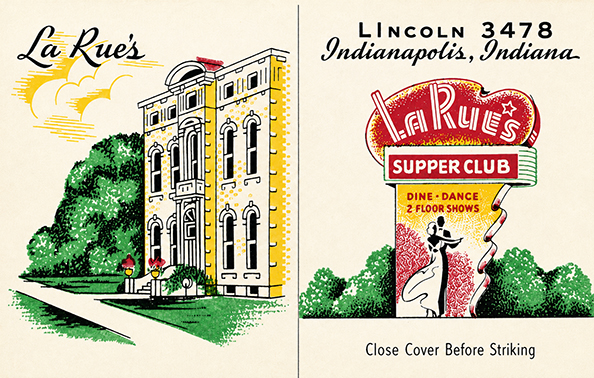
The Fletcher mansion’s second act came in June 1946, courtesy of Jack Ensley, an Indianapolis sportsman who the year before had led a group of businessmen in purchasing Little America, the miniature-golf-and-amusements park at 62nd Street and Keystone Avenue. Ensley announced the opening of La Rue’s, a restaurant at 1121 North Pennsylvania Street, with a schedule built for a full day’s trade: luncheon from 11:30 a.m. to 2:30 p.m., a cocktail hour from 2:30 to 5:30, and dinner from 5:30 p.m. until 12:30 in the morning. The bar went into Fletcher’s former library, where the original built-in bookcase and secretary remained intact — a detail the club would advertise for years.
Ensley was a restless entrepreneur whose holdings would eventually range across Indiana and Arizona — golf centers, restaurants, cocktail lounges, a sports-car garage — and who would find his greatest fame behind the wheel, campaigning Jaguar D-Types in the 1950s and co-driving at Sebring in 1957 with Indianapolis 500 star Pat O’Connor. He did not linger long on Pennsylvania Street, though. In 1947 he announced the sale of his majority interest in La Rue’s to Gust Lycas of Bloomington, a minority partner in the business, explaining that he would devote his full attention to the Little America Recreation Center at 6160 North Keystone Avenue, where he also planned to build a restaurant.
Lycas, a Crete-born Greek immigrant who came to America at age 19, had run the Lycas Restaurant in Bloomington, Indiana, before World War II. He was joined by two part-owners: Forest Keith Klepfer, an Indianapolis businessman, and “Coach” Billy Thom, one of the most celebrated figures in Indiana sport. Thom had coached Indiana University’s wrestling team from 1927 to 1945, winning eight Big Ten championships and the 1932 NCAA title, sending seven wrestlers to individual national championships, and coaching the American squad at the 1936 Berlin Olympics. Through the Depression he had supplemented his university salary in the professional ring, wrestling in long, bright-red tights and at one point holding world titles in three weight divisions simultaneously. On the occasion of what was billed as his farewell ring appearance in Indianapolis, Thom made a speech in which he uttered this long-remembered line: “I wish to thank all of you fans — especially those who boo.”
Under the new owners, La Rue’s was rebranded “The House of Distinction” — in the language of its own advertising, “The Real Place of Excellent Foods and Fine Cocktails” — and the Fletcher mansion was carved into a suite of themed rooms that traded on the house’s Victorian bones. Guests could take a drink in the Gay Nineties Cocktail Room, dine in the Gold Room or the exotic Blackamoor Room, or settle into Ye Olde Tea Room. The showpiece came at the end of 1947. The mansion’s old third-floor ballroom had spent years as a catchall storage room; the partners cleared it out, dressed it in tropical décor, and reopened it as the Penthouse Room — with a grand opening on New Year’s Eve. The ballroom could seat 200, and its floor shows became the club’s big draw.
For the next decade and a half, La Rue’s occupied a particular niche in Indianapolis nightlife: white tablecloths and name entertainment inside a genuine Gilded Age mansion, a few minutes’ walk from the Meridian Street corridor of clubs and lounges. Patrons who remembered it decades later described an automatic grand piano in glistening ebony — said to be the first in the city — playing in the cocktail lounge during the years when Indiana law still barred women from sitting at the bar itself, and floor shows headlined by the biggest touring names of the era: Louis Armstrong, Patti Page, Jack Teagarden. The house also did a brisk private-club trade. A group of downtown businessmen and politicians who had outgrown their table at Hussey’s restaurant took over La Rue’s second floor for their meetings, and it was there that someone proposed an annual antelope hunt in Douglas, Wyoming — the founding ritual of what became the Antelope Club, which still operates in Indianapolis today.
The ownership of La Rue’s was never a settled matter for long. In 1950 the club advertised itself as under new management, with Don Steckler billed as “your new host,” as Lycas stepped away to devote himself full-time to a real estate and insurance position. The transition years produced at least one ugly scene: Jack Ensley was arrested for assault and battery after slugging 28-year-old Forest Klepfer, who told authorities that Ensley was still bitter that he, Harley Horton, and Gust Lycas had taken over La Rue’s.
That account is the first appearance in the record of Harley L. Horton, a real-estate broker, entrepreneur, and man-about-town who would preside over La Rue’s golden years and its collapse. By 1952, when fire damaged his home at 4580 East 75th Street, the newspapers were identifying Horton as the owner of La Rue’s Supper Club. Horton lived in a style that matched his club — acquaintances recalled a multi-level mansion he built on the river near 82nd and Keystone, with a two-way fireplace joining an indoor bar to the pool deck, the bar itself fashioned from a repurposed antique soda fountain that now dispensed gin and scotch.
In 1954 La Rue’s celebrated its eighth anniversary with newspaper ads proclaiming it “Indiana’s Finest Supper Club” — and welcomed back a familiar face. Gust Lycas returned to run the operation he had first managed at its 1946 opening, and Gerald Dreyer, the business editor of the Indianapolis News, gave the move his blessing: “Gust Lycas will make the place ‘go’ if anyone can.”
Not everything at La Rue’s, however, was floor shows and prime rib. In April 1960, the Marion County Liquor Board pulled La Rue’s three-way liquor and dance permit while it investigated a curious piece of arithmetic: The multi-floored establishment had 18 telephones listed under five different numbers — a configuration that suggested, to investigators, a bookmaking operation rather than a supper club. For a week La Rue’s operated on a beer permit only. Harley Horton, appearing before the board as La Rue’s manager, assured its members that all other business operations had been removed from the premises, and the full permit was restored. The episode had collateral damage: The Antelope Club and other organizations that met at La Rue’s severed their ties in the wake of the gambling allegations.
Whatever was or wasn’t happening on the telephones, the entertainment calendar stayed ambitious to the end. In the spring of 1961 the club advertised a genuine coup: Dizzy Gillespie, the bebop trumpet titan, was booked into La Rue’s for two days in May. It was the kind of engagement the Penthouse had been built for, and one of the last big bookings the old house would see.
The end came fast. In 1962 the federal government filed a tax lien against La Rue’s for withholding and excise taxes owed from 1961. Horton insisted the club would remain open, and his son Harold petitioned the Circuit Court to appoint a receiver, a maneuver the family’s lawyer explained was intended to let the club keep operating while it cleared its debts. Harold’s petition included a personal grievance: He claimed that he was owed $300 for his own work as the club’s manager. None of it worked. By July an Indianapolis News columnist was noting the weeds growing up around the shuttered supper club, and on January 27, 1963, La Rue’s went under the hammer at an auction ordered by the federal court.
Gust Lycas did not live to see the house that Albert Fletcher built vanish. He died in Bloomington in 1966 at age 73, remembered as the former owner of La Rue’s and of Lycas’ Delicatessen, as a part owner of the West Point Cocktail Lounge on West Ohio Street, and as the patriarch of a family thoroughly embedded in the Indiana restaurant trade — his son Angelo, who died in 1962, had owned the Cozy Bar in Indianapolis, and his brother George the Star Dust Cafe in Bloomington.
The Fletcher mansion itself lingered a few years longer, long enough to be photographed for Wilbur Peat’s 1962 book Indiana Houses of the Nineteenth Century, and long enough to be memorialized in oil. At the 43rd annual Hoosier Salon in 1967, the Indianapolis painter and Herron School of Art teacher Harry A. Davis — who spent decades documenting Indiana buildings destined for the wrecking ball — won the $500 William H. Block Company prize for the outstanding work in oil, a canvas depicting the mansion at 1121 Pennsylvania as it then stood: decayed, empty, and awaiting demolition for the proposed inner-loop highway. The interstate took the house soon after, along with most of its neighbors, and the site where Swiss artisans had spent three years fitting gold-leafed walnut disappeared beneath the pavement of Interstate 65.

Dungeness Crab à la Maison
La Rue’s, a celebrated Indianapolis supper club that operated from 1946 to 1962, occupied an ornate Gilded Age mansion on North Pennsylvania Street. Known as “The House of Distinction,” it offered white-tablecloth dining, elaborate themed rooms. and floor shows by such famous performers as Louis Armstrong, Dizzy Gillespie, and Patti Page. This luxurious combination of crab and lobster in a sherry-scented cream sauce reflects the richly appointed cooking of the era. Serve it over toast, as the restaurant did, for an elegant luncheon or supper dish.
Ingredients
- 2 Dungeness crabs, about 1 pound each, or 2 pounds cooked Alaskan crab legs
- 1 1/2 pounds lobster or lobster tails
- 1/4 pound unsalted butter
- 1 tablespoon finely minced onion
- 1 cup all-purpose flour, sifted
- 1 teaspoon kosher salt
- Pinch of cayenne pepper
- 2 1/4 cups light cream
- 1 1/2 tablespoons fresh lemon juice
- 1 large egg yolk
- 1/2 cup dry sherry
- Toast, for serving
Instructions
If using whole Dungeness crabs, heat the oven to 400 degrees. Place the crabs in a shallow roasting pan, add a small amount of water, and cover tightly. Steam in the oven for 30 minutes. Let cool, then remove the meat from the shells and pick it over for any bits of shell. If using cooked crab legs, remove the meat and cut it into bite-size pieces.
Meanwhile, bring a large pot of water to a boil. Add the lobster or lobster tails and cook for 15 minutes. Drain and let cool. Remove the meat from the shells and cut it into bite-size pieces.
Melt the butter in a large saucepan over medium-low heat. Add the onion and cook, stirring occasionally, until softened but not browned, about 5 minutes.
Stir in the flour, salt, and cayenne, and cook for about 1 minute. Gradually add the cream, whisking constantly until smooth. Bring the mixture just to a boil, then reduce the heat to low and cook, stirring occasionally, until thickened, about 5 minutes.
Stir in the lemon juice, crab, and lobster. Cook gently until the seafood is heated through.
In a small bowl, whisk together the egg yolk and sherry. Slowly whisk about 1/2 cup of the hot cream sauce into the yolk mixture. Pour the tempered yolk mixture back into the saucepan, stirring constantly.
Cook over low heat, stirring, until the sauce is hot and slightly thickened, 2 to 3 minutes. Do not allow it to boil. Taste and adjust the seasoning. Spoon over toast and serve immediately.


1 Comment
Christopher Lehman
August 2, 2026 at 8:47 pmThanks for this essay about Edmond. Here’s a more lengthy article I wrote about my hometown and the first African Americans there. https://gateway.okhistory.org/ark:/67531/metadc2017465/m1/1/