

The Creole House opened in 1966 in a converted storefront at 324 West Armitage Avenue, on a block in the Chicago neighborhood of Lincoln Park whose chief landmark was the aging movie house next door — a 1916 vaudeville theater known today as the Park West. The restaurant was tiny, its furnishings modest and its prices to match, and its founding premise carried a pleasing inversion: Of the two partners who dreamed it up, a Southerner worked the front of the house and a Northerner ran the kitchen.
Alvin Branch, of Baxley, Georgia, was the host. Guy Cucci, Jr., a native Chicagoan, was the chef. The two had spent years together in show business — Cucci’s stage résumé put him alongside Charlton Heston, Bert Lahr, Bert Parks, ZaSu Pitts, and the singers Blanche Thebom and Patrice Munsel — and the restaurant grew, as Cucci told it, out of an occupational hazard of the touring life. “All show people talk about food a lot because they have to eat out so much,” he told Kay Loring, the Chicago Tribune’s restaurant reviewer, in 1966. “In our case it led to talk of a place of our own — particularly when we were stranded on the road. We tried out many recipes at the club, then picked out the favorites of those who ate there and that’s what we’re serving here.”
The club in question sat near Branch’s farm at Baxley, where the partners worked between engagements and where Cucci put in five years cooking Southern favorites. The men also described a five-year study of Creole cookery before hanging out their shingle — a curriculum one reviewer judged, on the evidence of the plates, to have earned them graduate degrees. Some of the coursework came by mail from Louisiana. “We have Creole friends in New Orleans who have been generous with their family recipes,” Branch explained.
The kitchen’s calling card, from the first year onward, was a salty peanut soup that early visitors likened in body to split pea. Behind it came a gumbo loaded with ham, shrimp, oysters, crabmeat, and vegetables and served at a temperature and heat level that, one critic warned, would open a diner’s sinuses. Channel catfish was flown up from Georgia and fried, accompanied by hush puppies whose batter — like Cucci’s cornbread batter — was cut with beer. The menu ran to jumbo shrimp in a hot sauce, a crisp fried chicken that drew particular praise, and three separate jambalayas, the signature Creole House version blending ham, chicken, and pork in a beef broth. Desserts were homemade: banana cake, cherry pie, plum pie, and freshly sliced oranges dressed with coconut, marshmallow, and sour cream, with chicory coffee to close. Dinners started at $2.75, with à la carte listings besides. There was no bar — guests brought their own wine — and the little room played up its regional theme with hinged doors and shutters, walls of rough-cut split wood, and ceiling fixtures styled after gaslights.
For the next few years the Creole House settled into life as a little neighborhood café. A reporter passing down Armitage in 1969 sketched it as a high-ceilinged room presided over by its pair of ex-singers, by then three years into the venture. But the neighborhood itself had become the problem, and the problem was parking. “We really don’t care for a larger place, just one where people may park a car,” the partners told Kay Loring that year. “Parking becomes worse every year.”
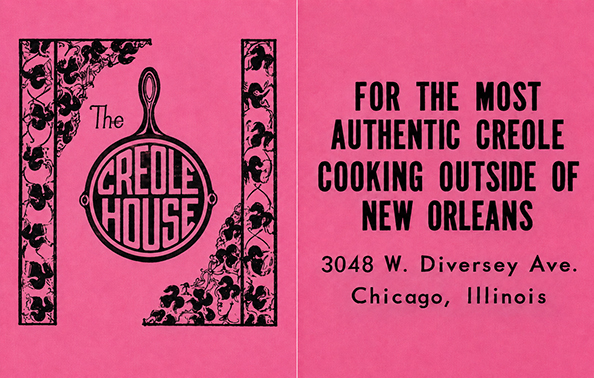
Their answer lay a few miles west. The Creole House served its last dinner on Armitage on December 13, 1969, and the partners moved their restaurant into what had been a private residence at 3048 West Diversey Avenue — an unpretentious old house wrapped in simulated-brick siding, near the seam of Logan Square and Avondale. They reopened in early January 1970.
The move changed the restaurant’s character as much as its address. Arriving guests rang a doorbell — the front door otherwise stayed locked — and Branch answered it, by his family’s account wearing a tuxedo, to greet and seat them. The dining rooms occupied what had been the living room, the dining room, and a tiny first-floor bedroom; Cucci lived on the second floor. The peanut soup had by now become the house trademark, and the dessert list gained a pecan pie built on sour cream rather than the usual molasses or syrup base, along with a coconut-and-chocolate ice cream pie. In the family’s telling, the Diversey incarnation ran on reservations only and served full-course dinners only, with Cucci doing all the cooking himself. “He was extremely diligent and followed his recipes exactly the same way, ensuring over the years the food would taste exactly the same,” his nephew, Jeff Kanter, recalled decades later.
Curiously, the house itself went on the market during that first year on Diversey Avenue. A 1970 real estate ad pitched a “100-year-old home” as a unique opportunity for a restaurant, an antique house or some other creative use, identifying the present tenant as the famous Creole House Restaurant. Whatever became of the listing, the restaurant stayed put.
The Creole House quietly closed in 1974, four years into the Diversey chapter and eight years after the first pot of peanut soup on Armitage. One partner was retiring; the other was headed into another line of business. The Tribune’s Kay Loring registered her regret, and the house’s next operators, according to Cucci’s family, wanted more than the keys: They offered to buy the Creole House name and its recipes. Cucci refused to sell either. By 1975 the building had reopened instead as the Cajun House under Walter and Rita Manor, and a 1977 reviewer found the new owners trading on much the same formula — similar cuisine, similar décor, the same locked door and doorbell, the same step into what was described as a world of Southern gentility. And in the last half of the 1980s it was the Ragin’ Cajun under owner-chef Harvey Durrson.
Cucci, for his part, went back to the stage. In July 1976, after what the papers called a 10-year hiatus, spent at the Creole House, he joined the cast of “Something’s Afoot,” the Agatha Christie–spoofing murder-mystery musical, at the Chateau Louise resort’s theater in Dundee, billed as the Chateau Mysterie. Fittingly, the company also included Ric Riccardo, Jr., lately of Riccardo’s Restaurant & Gallery — the Rush Street landmark founded by his father and namesake, who with Ike Sewell is credited with having invented Chicago-style deep-dish pizza.
The Creole House name proved harder to retire than the restaurant. In 1982 a classified ad offered an unspecified restaurant and property, billed as “Formerly Creole House,” for $100,000. The physical settings endured, too: the Armitage block’s old theater reopened as the Park West in 1977 and remains a concert hall today, while the house at 3048 West Diversey is home to the Little Bird Prep Nursery & Preschool.
Guy Cucci died in 2021 at age 89. His obituary noted that he wrapped up his theater career as an extra with the Lyric Opera of Chicago, where he baked pastries for cast and crew members and where, as Cucci liked to tell the story, Luciano Pavarotti once insisted on having one of his éclairs before a performance.

Peanut Soup
This peanut soup was the signature dish at the Creole House, a small Chicago restaurant opened in 1966 by Alvin Branch, a Georgia native who ran the dining room, and Guy Cucci, Jr., a Chicagoan who did the cooking. The partners had spent years developing their repertoire of Southern and Creole dishes, drawing in part on recipes supplied by friends in New Orleans. Early diners described the soup as salty and nearly as substantial as split-pea soup, and it remained the restaurant’s trademark until the restaurant's closing in 1974.
Ingredients
- 1/4pound butter
- 1 small onion, diced
- 2 celery ribs, diced
- 3 tablespoons all-purpose flour
- 8 cups chicken broth
- 1 cup peanut butter
- 1/4 teaspoon celery salt
- 1/2 teaspoon salt
- 1 tablespoon lemon juice
- Ground peanuts, for serving
Instructions
Melt the butter in a heavy pot over medium heat. Add the onion and celery and cook, stirring occasionally, until softened but not browned, about 5 minutes.
Sprinkle in the flour and stir until thoroughly combined. Gradually add the chicken broth, stirring well. Bring to a gentle simmer and cook for 30 minutes.
Remove the pot from the heat and strain the soup through a fine-mesh sieve. Return the strained soup to the pot.
Add the peanut butter, celery salt, salt, and lemon juice. Stir over low heat until the peanut butter is fully incorporated and the soup is smooth and hot.
Ladle into bowls and serve with a sprinkling of ground peanuts.
In Our Vault: More Recipes from The Creole House
- Hush Puppies
- Frozen Cream Cheese with Brandied Strawberry Sauce


No Comments