

Long before anyone hung a sign reading “Two Guitars” over the doorway at 244 East 14th Street in New York City, the address was already one of downtown Manhattan’s reliable portals to old Russia. The Russian Kretchma — the name means a country inn or tavern — had been serving borscht, shashlik, and chicken à la Kiev to New Yorkers since the mid-1920s, part of a wave of eating places that appeared after the Bolshevik Revolution deposited some 6,000 White Russian exiles, many of them former officers, aristocrats, and members of the intelligentsia, on the city’s doorstep. Most of the celebrated Russian rooms — the Russian Bear, Casino Russe, the Maisonette Russe, the Russian Tea Room — clustered in midtown. The Kretchma held down the Lower East Side end of the trade, a few steps off Second Avenue in the heart of what was then the Yiddish theater district, and it made no apology for its basement Bohemianism. One prewar New York guidebook warned diners that the room lay down a steep flight of stairs, that the waiters in Russian blouses served you when they thought of it and pushed pressed caviar when they didn’t, and that the clientele ran to long-haired gentlemen, short-haired ladies, and sad-eyed literary types in thick spectacles — and then recommended the place anyway, as an adventure not soon forgotten.
The Kretchma’s floor show was the real draw. As late as September 1948, a Minneapolis travel columnist advising a reader who preferred balalaika music to chow mein steered her to “the Russian Kretchma, at 244 East 14th street,” noting that it had been popular for its food and for a floor show full of singing, folk-festing, high-booted dagger-leaping, and juggling. For a stretch in the late 1920s the Kretchma’s star attraction was Nastia (Anastasia) Poliakova, the celebrated Romani contralto who had reigned at the Yar, Moscow’s famous gypsy restaurant, in the empire’s final years. She sang before Czar Nicholas II and at the country estate of the novelist Leo Tolstoy, and toured Russia in a private railroad car before the Revolution sent her fleeing to Turkey and scattered the Yar’s performers across Europe. Poliakova’s deep, dark voice, Time magazine observed when she arrived in the United States, perfectly suited the rambling, improvised style of the gypsy song. Legend attached her even more tightly to imperial Russia’s last days: She was said to have been Grigori Rasputin’s favorite singer. A columnist who recalled the old Kretchma years later mourned that the aging singer, who was reputed to carry more native gypsy melodies in her head than anyone alive, died in 1947 before anyone thought to record them.
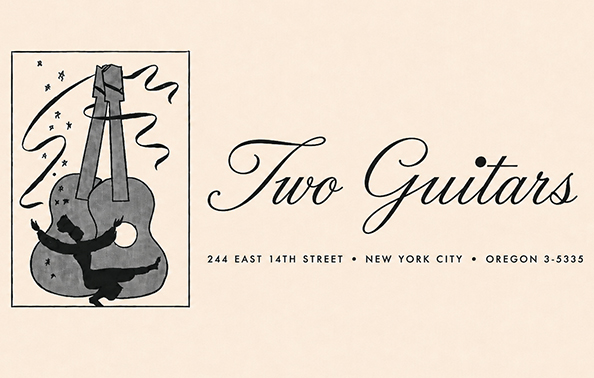
In 1949 Alexis Antonoff, a White Russian from Sevastopol, and his Irish-American wife, the former Betty Lynch, bought the old Kretchma for $20,000 and gave it a new name — one every Russian in New York would have recognized instantly. “Two Guitars,” or “Dve Gitary,” is among the most beloved of all Russian gypsy romances, a song of two guitars whining beyond the wall, and the choice announced exactly what kind of evening the new proprietors intended to sell.
On October 8, 1949, the New York Daily News carried an advertisement for the “bright new night club” at 244 East 14th: dinner from five to nine at $1.75 and up, supper, a Russian floor show, balalaika music, and “dynamic dancers,” with a $2.50 Saturday minimum. A menu dated the very next day, Sunday, October 9, 1949 — preserved in the New York Public Library’s menu collection — shows what $1.75 and up actually bought. The à la carte card opened with Zakuska Two Guitars at 75 cents, chopped chicken liver and pickled herring at 45 cents, shrimp cocktail at 65 cents, red caviar garni at 75 cents, and, for the extravagant, fresh Beluga caviar at $4. The Russian entrées ran from blinchiki with sour cream at $1.25 and Siberian pelmeny at $2 through beef à la Stroganoff at $2.50, the Special Two Guitars Shashlik at $2.55, and Cucumber Shashlik at $2.75, up to Cutlet Kiev — the butter-gushing house glory — and blini with Beluga caviar at $4 and $4.50 respectively. There was even a Cutlet Poliansky at $2, an apparent tip of the toque to Konstantin “Kostya” Poliansky, the house bandleader. The table d’hôte listed Cornish de Volaille, Lamb Kula, filet of sole, roast duckling, Caucasian shashlik, and shashlik à la Tiflis. And the kitchen hedged its bets in the American manner: alongside the zakuska and kissel sat shrimp cocktail, chicken salad, Nova Scotia salmon, and a 45-cent Manhattan at the bar. By 1951 the club’s newspaper advertising had settled into a confident formula: “Superb Food — Gypsy Music — Continental Floor Shows.”
Antonoff’s route to East 14th Street had little in common with the standard refugee itinerary. He escaped Russia after the Revolution aboard a Greek ship and spent eight years knocking around the world’s ports before finally landing in New York. During World War II he served four years in the Pacific as a staff sergeant with the Fifth Air Force. Afterward he took a job as maître d’hôtel at the old Russian Skazka, and it was there that he met Betty Lynch, a buyer of children’s wear who dined at the Skazka often enough for the acquaintance to ripen into marriage. Betty had lived for a time in Hammond, Indiana, and the hometown paper kept affectionate track of her. When a Hammond Times correspondent covering the couture Press Week shows was swept off to the club in 1959 by a party of Midwestern fashion editors, she reported home that Two Guitars, “a gay Russian restaurant supper club,” was operated by Betty and Alexis Antonoff, an Irish-Russian combination of owner and host, and that Mrs. Antonoff was a beauty.
The Antonoffs’ shrewdest decision was to change almost nothing else. They preserved the old White Russian customs for which the Kretchma had been famous, and the club became a fixture of the émigré liturgical calendar — Russian Christmas on January 7, Russian New Year’s on January 13, and Russian Easter, which in some years arrived in tandem with the Western feast. Continuity extended to the payroll: The fierce-looking dagger dancer who pinned dollar bills to the floor with flung knives, Mischa Uzdanoff, had performed the same trick at the old Kretchma. A guidebook writer of the era counted Two Guitars among the last of the oldtime Russian restaurants in New York still offering the full Muscovite bill — gypsy singers, balalaika players, and dagger dancers — and pronounced a visit during the Russian holidays a “must.”
A vivid contemporary snapshot of the room comes from Arthur Gelb, who toured Manhattan’s foreign cafés for The New York Times in February 1961. At Two Guitars, a White Russian establishment where the Irish proprietor’s Sevastopol-born husband presided over the bar, Gelb found a pair of dancers in native dress, Ivan Nepa and Sonia; the balalaika player Sasha Polinoff, doubling as a sad-faced master of ceremonies — Russian temperament, you know; a little gypsy orchestra led by Kostya Poliansky; a singer named Edi Hellas; and, memorably, “one of the most cheerfully inept knife throwers” to be found this side of the Volga.
Poliansky and Polinoff were the twin pillars of the entertainment, and both were considerable figures in the small, tenacious world of Russian musical New York. Poliansky, born in Kharkov in 1901, had led his first balalaika band at age 15, fled Russia through Constantinople in 1918, worked the ships of the Messageries line with an orchestra of fellow exiles, and reached New York in 1923. Over the next half century he played virtually every Russian room in the city while writing for radio, television, and film. Sasha Polinoff, the house balalaika virtuoso, achieved a species of immortality that eluded nearly everyone else on the payroll: Monitor Records, the New York world-music label founded in 1956 by Michael Stillman and Rose Rubin, put him on vinyl. His album “Russian Cabaret: The Balalaika of Sasha Polinoff,” recorded with Poliansky’s Russian Gypsy Ensemble and released in 1965, opened its liner notes with an evocation of the club itself: Wander into the dimly lit Russian café in lower Manhattan called the Two Guitars on almost any evening, the notes promised, and you would find Polinoff entertaining the guests — “Sasha sets the Slavic mood for the vodka, caviar, and the Kiev cutlets.” Polinoff and his ensemble also backed the club’s resident chanteuse, Alya Uno — the Roma-born Alya Yunakovskaya — on a Monitor LP of her own, “Songs of a Russian Gypsy,” with 14 numbers on the joys and sorrows of Romani life. Both records can still be streamed today, which means that anyone can summon, more or less intact, the sound of an evening at 244 East 14th Street.
The regulars who filled the little room needed no liner notes. Many were Russian and Jewish émigrés who came to reminisce, and the club obliged with sing-alongs of the old folk songs. One patron of the 1960s, a Frenchwoman named Françoise, remembered the place decades later as a tiny cellar with only about ten tables, a wonderful woman singer with a smoky voice, and a great deal of communal singing in Russian and Yiddish. Another, Claire, recalled a date there in 1963 or 1964 when Alya Uno sang in many languages: “The evening was unforgettable,” she wrote, adding a lament that would serve as the epitaph for the whole genre — they don’t make them like that anymore. The club even acquired an unofficial theme song of sorts, at one remove: “The Kretchma,” the mock-Russian comedy number by songwriter Gene Raskin that Theodore Bikel recorded for Elektra in 1959 and performed for years afterward, spoofed exactly the kind of candlelit, Cossack-guarded, vodka-soaked establishment that the old Kretchma had been — and at least one veteran of the New York balalaika world insisted the song was written about the 14th Street original. Sasha Ressetar, a balalaika player and friend of Polinoff’s, also passed along the club’s most glamorous piece of lore: that Vera Bryner, the lyric soprano sister of Yul Brynner, once sang at Two Guitars. Bryner, who had performed Russian and Roma songs with her brother in the émigré nightclubs of prewar Paris before building an American career that included the original Broadway run of Menotti’s “The Consul,” was certainly the sort of artist the room attracted.
By the mid-1960s the club was making its accommodations with the age. In 1965 a nightlife column reported, with evident amusement, that Kostya Poliansky and His Gypsies had “succumbed to the Go-Go cartel” and would, if you insisted, play for the Frug, the Monkey, the Mule — or the Kazatski. The old calendar still governed the big nights, though. In April 1968 the club staged a two-night Russian Easter pageant with authentically costumed performers: the singer Alya Uno, the sword dancer Vladimir Lazarev, the balalaika soloist Sasha Polinoff, and Kostya Poliansky and his Gypsy Dance Band. Later that year, after a seasonal closing, Two Guitars reopened with a new show in which Mischa Danilo took over the balalaika solos alongside Uno, Lazarev, and the Poliansky orchestra, and that winter the club advertised its Russian New Year’s celebration — January 14 by then, the calendar having drifted a day — at $15 a head. The last documented flicker comes from a New York Times cabaret listing of April 12, 1969, announcing a Greek Orthodox Easter celebration at Two Guitars, and in December 1970 a new establishment, the Russian Troika, opened at the site of the old Two Guitars.
The club was gone by the time the next generation of balalaika players arrived in New York; Ressetar, who worked the city’s Russian circuit for some 15 years, lamented that he had come too late to hear Polinoff play the room. Poliansky performed in New York’s Russian restaurants until 1972 and died the following year. What survives of Two Guitars is scattered but surprisingly rich: the 1949 menu in the New York Public Library; the Monitor LPs; and a sheaf of promotional glossies preserved from the files of the newspaper restaurant critic Robert W. Dana, whose “Tips on Tables” column archive keeps alive the faces of the club’s forgotten troupers — Kiko de Brazil, Lubov Hamshay (“the Manhattan Gypsy”), Marina Federova, Olga Karpis, the belly dancer Scheherazade, and Alya Uno, who sang, danced, and played guitar. None of them became household names. But for 20 years, in a dim cellar just off Second Avenue, they made a room full of exiles feel, for the length of a floor show, that they were home again.

Beef Stroganoff
Ingredients
- 2 pounds top sirloin, cut into long, thin strips
- 8 tablespoons (1 stick) butter, divided
- 2 pounds onions, thinly sliced
- 2 pounds mushrooms, sliced
- 2 tablespoons tomato paste
- 2 cups heavy cream or sour cream
- 1 1/2 teaspoons salt
- 1/2 teaspoon freshly ground black pepper
Instructions
In a large skillet, melt 4 tablespoons of the butter over medium-high heat. Add the beef and sauté until browned. Transfer the beef to a plate.
Add 2 tablespoons butter to the skillet. Add the onions and sauté for 10 minutes, then transfer them to the plate with the beef.
Melt the remaining 2 tablespoons butter in the skillet. Add the mushrooms and sauté for 5 minutes.
Return the beef and onions to the skillet. Stir in the tomato paste, then add the cream, stirring constantly. Cover, reduce the heat to low, and cook for about 30 minutes, until the beef is tender. Season with the salt and pepper. Serve over rice or with French fries.


No Comments