

In 1946, the corner of Peterson and Cicero Avenues sat at the quiet northwestern edge of Chicago, where the Sauganash neighborhood’s brick bungalows gave way to open lots and the city thinned toward Lincolnwood. That year a small, plain building went up on the southwest corner: a cozy snack shop called The Pie Pan, which built an enormous following on a single specialty — pie, eventually in more than 30 varieties — with hamburgers and frozen custard on the side. Its proprietor was Shelby C. Johnstone, a Texas-born pie man who had come up in the trade the hard way, driving one of the distinctive red-and-yellow pastry wagons that once plied Chicago’s streets.
Johnstone, as it happened, did more than anyone to put those wagons out of business. He developed a commercial method for the frozen pie — crust and filling assembled in advance, held at low temperature, and baked only when needed — an idea that would eventually remake the American dessert aisle, and he was pursuing it on an industrial scale well beyond his corner shop. He had joined the Lloyd J. Harriss Pie Company, one of Chicago’s leading commercial bakeries — a firm that had built its trade before the war delivering fresh pies in metal cases along established city routes to restaurants, lunchrooms, grocers, and other institutional customers — as a special delivery man, and over the years he methodically worked himself up the ladder until he was an officer and, finally, the president of the company’s Chicago-based operation. A news photograph that appeared in the Chicago Sun-Times in 1950 shows him displaying quick-frozen pies ready to be shipped all over the country, along with a frozen strawberry shortcake that required no baking at all; within a few years, Harriss would open a dedicated frozen-pie plant in Saugatuck, Michigan, close to the orchards of the western Michigan fruit belt, on its way to becoming one of the largest independent pie manufacturers in the United States. Johnstone backed his own end of the enterprise with equipment of his own invention: the “Shelby Oven,” as it was called, could seamlessly move pies from freezer to oven in the window of a restaurant, bakery, or other establishment, leaving them table-ready in just 45 minutes.
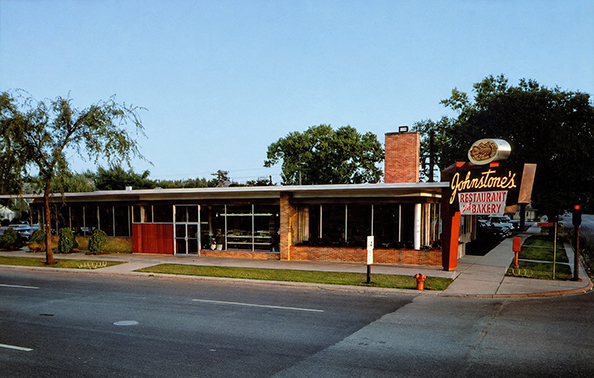
By 1951 the sleepy corner had become valuable ground. The Edens Expressway opened that December, and its curving approach ramps deposited a river of automobile traffic practically at the Pie Pan’s door. Johnstone was ready for it. In December, help-wanted advertisements began appearing for “Chicago’s newest and most beautiful restaurant,” set to open in a week’s time and promising top salaries, ideal working conditions, hospitalization, insurance, and paid vacations. The debut slipped to January 3, 1952, but when the doors opened, the southeast corner of Peterson and Cicero, on leased ground directly across from the little drive-in, held a big, showy, California-style building of brick and glass: Johnstone’s Restaurant and Bakery.
The new restaurant was built to impress. Some $3,000 worth of living plants — 38 varieties, each labeled for the botanically curious — filled the dining room, which seated 306; the parking lot held 500 cars. The kitchen was all gleaming stainless steel. A thousand pies at a time waited in the deep freeze, and the Shelby oven turned out 400 of them a day. A columnist for the Chicago Tribune, surveying the intersection that first year, pronounced it “a pie eater’s paradise” and crowned Johnstone its “potentate.” The Pie Pan advertised no fewer than 32 varieties; the new restaurant fielded an equally formidable lineup. The bakers were proudest of the lemon meringue, raspberry, strawberry, and Southern pecan, but the adventurous eater could find nearly anything between the flaky crusts — sweet potato, gooseberry, boysenberry, even fruit salad.
Where the Pie Pan leaned on the hamburger, the dining room across the street concentrated on a tight roster of a half-dozen entrées, including fried chicken, deep-fried shrimp, lake perch, prime rib of beef, and frogs’ legs. Four salads came with every dinner, served family style. It was solid, generous, middle-of-the-road cooking, and the neighborhood heartily embraced it.
Johnstone himself was rapidly becoming one of the Northwest Side’s more colorful citizens. In 1954 he was showing movies of an Alaskan hunting expedition to local audiences: He and his wife, Marie, had hunted wild sheep and caribou in the Kenai River country south of Anchorage, gotten thoroughly lost, and been rescued by a bush pilot. The walls of the Pie Pan filled up with mounted prize catches and hunting trophies, mementos of the owner’s consuming passion for rod and gun.
The Tribune caught the operation at its peak in 1955. Sauganash housewives, the paper’s “Have You Heard?” columnist observed, didn’t bother baking pies — not with a resident expert who had been “dabbling in dough for over two decades” across the street. The count now stood at 31 varieties — including apple, cherry, banana cream, coconut custard, pineapple, gooseberry, boysenberry, blackberry, rhubarb, lemon cream, raisin, and cherry cream — and if the one you wanted wasn’t on hand, the bakery would have it ready within two hours. In season, fresh fruit went into the whipped-cream pies. The columnist’s own dinner began sensibly with the four family-style salads, proceeded through a filet of fresh whitefish broiled in butter, and detoured happily into a bottomless basket of hot breads — cornbread among them, along with a crisp, feather-light biscuit the house called batter bread — before arriving at a strawberry cream pie piled with whole berries and fresh whipped cream. The writer detected “a slight tinge of southern influence” running through the menu — the pan-fried chicken, the pecan and sweet potato pies, the cornbread — and Johnstone confirmed that all of it was a souvenir of his boyhood in Georgia, where his parents had moved after he was born. The menus themselves carried a tongue-in-cheek motto that told customers exactly how seriously to take it all: “What foods these morsels be.”
Success bred expansion. In 1956 Johnstone took over the Mardi Gras restaurant at Touhy and Lincoln Avenues in suburban Lincolnwood — the former House of Pierre — and opened his third establishment, a rambling, ranch-type Johnstone’s with a New Orleans motif. Some 200 diners could be seated in its New Orleans, Pink, and Louisiana rooms, with more space at a C-shaped bar (the only bar in the chain; the Peterson Avenue restaurants had none) and in a thickly carpeted lobby. A fountain played in the main room, huge bay windows overlooked the busy intersection, background music soothed the diners, and the Louisiana room’s west wall carried a colorful display of cutouts, mobiles, and Old South folklore symbols.
The Johnstone empire’s numbers, laid out in a pair of 1956 newspaper features, were remarkable for a business built on a snack shop: three booming restaurants and bakeries selling 25,000 pies a month over the retail counters alone. The Lincolnwood menu ran to U.S. prime charcoal-broiled steaks and chops prepared on an open hearth — a filet mignon was $4.25 à la carte with salad bowl, potatoes, and Johnstone’s own rolls; a porterhouse, $5 — and the menu instructed diners precisely what each degree of doneness would deliver, from a rare steak’s “red cool center” on up, while the management recommended rare or medium for fullest enjoyment. There were giant butterfly French-fried shrimp with potatoes and salad for $1.60, hickory-smoked baked ham with candied yams, and fresh seafood. But the pride and joy remained the pan-fried chicken: $1.60, served disjointed — no carving required — with potatoes, tossed salad, and hot rolls. One reviewer, working through an enormous slice of the best-known pie in the house — the fresh strawberry cream — concluded that Johnstone attached no secrets or formulas to his success; he simply served good food at fair prices in a pleasant environment.
The Peterson Avenue flagship, meanwhile, had been dressed in a modern-American motif: three comfortable rooms with leather booths, a distinctive beamed ceiling, and a color scheme of sandalwood tan and forest green. Its kitchen now deployed a special fryer that could prepare 150 chickens every 15 minutes.
The Lincolnwood palace turned out to be a short chapter in the story. In early 1957 Johnstone sold it to Steve De Kosta of the Near North Side’s Huckster Key Club, who reopened the room that March as the Huckster’s Country Club, admission by key only.
Johnstone had bigger game in mind — literally. That same year, he and three friends — Norman Johnson, a manufacturer of fireproof doors; William Koenig, a building contractor; and Arvin Strom, the owner of a chain of gift shops — capped a full year of preparation with a three-month safari through Kenya, Tanganyika, and the Belgian Congo, their first trip to Africa. They carried the flag of the Adventurers Club of Chicago, the storied explorers’ fraternity founded in 1911, and they came home with 27 trophies — rhino, buffalo, zebra, antelope, hartebeest, gazelle, waterbuck, and other plains game — along with, as one account tallied it, “inexhaustible memories, insect bites, and a few broken bones.”
The safari would define the restaurant’s final act. In 1958 Johnstone took on a partner: Richard “Dick” Grassfield, a restaurant man who had spent nine years with the Cleveland-based Stouffer restaurant organization and owned Grassfield’s Jefferson Cafeteria in Bloomington, Illinois. When Johnstone retired in May 1960, Grassfield carried on, advertising the house as Grassfield’s Johnstone Restaurant, and he kept the founder’s spirit conspicuously on the walls. A 1961 write-up singled out the restaurant’s unusual Safari Room, done up in leopard carpeting and leopard lampshades, hung with wildebeest and zebra skins, game heads, and masks — all reflecting, as the item noted, the hobby of the original owner, the Adventurers Club member and wild-game hunter Shelby Johnstone.
Under Grassfield the kitchen kept up its industrial rhythms: By 1962 it was running a thousand lake perch a day through the fryer. In 1963 the restaurant advertised a complete seven-course old-fashioned turkey dinner, with all the fixings, for Thanksgiving or Christmas at $3.25. Johnstone himself, though retired from the restaurant, was anything but idle — that same year Chicago television viewers could find him on WBBM-TV’s World of Adventure, hosted by Carter Davidson, in an episode billed as “Hunting the Big 5 in Angola,” matching his rifle against Africa’s most dangerous game. But for the restaurant, the end was near. By 1964 it had closed its doors, replaced by Hagerty’s Buffet Restaurant, with Schmitt Bakeries advertising from the same address. Twelve years after the California-style palace of pie opened for business, the Johnstone name had disappeared from the corner it had made famous.
Shelby Johnstone never stopped chasing the wild. He resurfaced in the national press in 1967, and the story was pure Johnstone. Residents of Portland, Oregon, called the police one morning to report a huge cheetah loose in their Southeast Side neighborhood. It belonged to Johnstone — now describing himself as a professional hunter and photographer — who was staying overnight with friends and had tied his 70-pound cat, Sheba, to their fence. “Oh, that cat wouldn’t hurt anybody,” he assured a reporter for the Associated Press. “She’s very gentle.” Sheba, he added, had always been “very well accepted” at hotels and motels. And in 1981 a columnist for the Oakland Tribune in California noted that Shelby Johnstone, Jr., a representative of the Jolly Time Popcorn Company of Sioux City, Iowa, had been squired to dinner at Francesco’s and identified the young man’s father, in passing, as “the famous big-game hunter of Sedona, Arizona.” The senior Johnstone had died earlier that year at age 81. The pioneer of the frozen pie, the potentate of the pie eater’s paradise, had passed into the record one last time, 2,000 miles from Peterson and Cicero — remembered not for a wedge of pie, but for the gun.
Chicken Mushroom Soup
In 1952, having risen from a deliveryman for the Lloyd J. Harriss Pie Company to the president of its Chicago operation, Shelby C. Johnstone opened Johnstone’s Restaurant on the city's northwest side. Every day it offered more than 30 different pies, from lemon meringue and Southern pecan to sweet potato and fresh strawberry cream. This modest mushroom soup, lightly thickened with flour and enriched with chicken fat, represents the savory side of a restaurant remembered above all for dessert.
Ingredients
- 2 tablespoons chicken fat or unsalted butter
- 1 cup sliced fresh mushrooms (about 3 ounces)
- 1 1/2 tablespoons finely grated or minced onion
- 1/4 cup plus 1 1/2 teaspoons all-purpose flour
- 6 cups chicken broth, preferably low-sodium, heated
- 1/3 teaspoon monosodium glutamate
- Kosher salt, as needed
Instructions
In a large saucepan or Dutch oven, melt the chicken fat over medium heat. Add the mushrooms and onion and cook, stirring occasionally, until the vegetables are tender and the mushrooms are lightly browned, 6 to 8 minutes.
Sprinkle the flour over the mushroom mixture and cook, stirring constantly, for about 1 minute.
Gradually add the hot chicken broth, whisking or stirring vigorously to prevent lumps. Bring the soup to a gentle boil, then reduce the heat to maintain a simmer.
Stir in the monosodium glutamate, if using. Season to taste with salt, taking into account the saltiness of the broth.
Simmer, stirring occasionally, until the soup is slightly thickened and the flavors have blended, 15 to 20 minutes. Taste, adjust the seasoning, and serve hot.



No Comments