

In 1838 an Irish immigrant named Philip Roach bought a stretch of high ground above Alexandria, Virginia, for his family, and when he died soon after, the property passed to his son James, a contractor who had made money supplying brick and stone for the Aqueduct Bridge, the Alexandria Canal, and the Alexandria, Loudoun & Hampshire Railroad. In 1841 James Roach built a Federal-style mansion on the crest and called it Prospect Hill. From its windows the family looked across the Potomac River at a capital city still under construction.
The war took the hill away from them. Virginians voted for secession on May 23, 1861, and at dawn the next morning federal troops crossed the river to seize Arlington Heights. Union engineers threw up Fort Albany on Prospect Hill to command the approach to the Long Bridge by way of the Columbia Turnpike. The fort was an earthwork with a perimeter of 429 yards and emplacements for a dozen guns. Soldiers cut the Roach timber for clear fields of fire, ate the livestock, and camped on the surrounding acreage, including the patch of ground where, 60 years later, a small frame building would go up. The Roaches emerged from the war impoverished and sold the property. By 1920 the land had passed into the undeveloped holdings of Philip Campbell.
Gertrude Lynde Crocker came to that parcel by way of a jail cell. She was born in Milwaukee in 1884 to Eliza Warner Lynde and John Tweedy Crocker and raised in Hinsdale, Illinois, where her father worked as a purchasing agent for the Chicago, Milwaukee & St. Paul Railroad. She enrolled at Vassar, her mother’s college, in 1903, left after two years, and finished at the University of Chicago with a bachelor of science in mathematics in 1911. In 1914 she and her older sister Ruth sailed for Europe; the war caught them in Austria and sent them home early. Within months Gertrude was in Washington, D.C., working out of the headquarters of the Congressional Union for Woman Suffrage, the militant organization founded in 1913 by Alice Paul and Lucy Burns, learning the mechanics of congressional procedure, marching in poster brigades, and hawking copies of the organization’s weekly paper on the street.
She rose fast. By the fall of 1915 the Washington Evening Star, tallying up the largest force of suffragists ever gathered in the capital for a demonstration set for December 6 to 13, listed “Miss Gertrude Crocker of Illinois, who is acting as headquarters secretary” among the leaders already on the ground. She served as a marshal in the opening march to the Capitol and the White House. By February 1916 she was the Congressional Union’s assistant treasurer, tracking memberships and donations and wiring money to organizers in the field; when the Union merged into the National Woman’s Party the following year, she became its treasurer.
The publicity stunts of that period have a strange sweetness to them now. On May 5, 1916, the Evening Star reported that a dozen suffragists had descended on Statuary Hall to hand Representative William Elza Williams of Illinois a Susan B. Anthony birthday cake bearing 59 unlit tapers, one for each of his years. Two young women from his home state carried it in on a stretcher improvised from an American flag and a suffrage banner: Ruth and Gertrude Crocker. It happened to be Ruth’s birthday too. Written across the icing in the colors of the wisteria bloom was the wish that the coming year would bring Williams joy and the Susan B. Anthony amendment. He thanked them heartily. Representative William Kent of California, acting as the Union’s aide-de-camp, had lured him out of the House chamber without telling him why.
Eighteen months later the tone had changed entirely. Crocker was among the 12 women — the “Silent Sentinels,” as they were called — who stood at the White House gates on January 10, 1917, in the first picket line of the campaign. On October 22, 1917, the Evening Star ran the arrests on its front page: Alice Paul and Dr. Caroline E. Spencer to six months in the Occoquan Workhouse, “and Gladis B. H. Greiner and Gertrude L. Crocker to 30 days each in default of a fine of $25 each.” The pickets announced they had no intention of paying. Crocker served three sentences in all and went on hunger strike during each of them. In a letter smuggled out of the Washington Asylum and Jail (commonly known as the District Jail) in November 1917, she told her mother that she felt like “a rat in a trap,” locked up “merely for holding a banner in front of the White House.” After a six-day hunger strike following her arrest in August 1918, party accounts described her as among the most severely ill of the prisoners; a photograph shows her being helped out of a taxicab at headquarters, barely able to walk to the door. She received one of the silver prison-door pins the party awarded its jailed members that December. In January 1919 she was arrested again for burning the text of Woodrow Wilson’s speeches on European freedom in a watchfire outside the White House.
The 19th Amendment to the Constitution was ratified on August 18, 1920. By then Crocker was already in business. Alexandria County had been renamed Arlington earlier that year, and the little frame building on the ridge went up during the changeover. It opened on Tuesday, June 1, 1920, under cool and cloudy skies, with Gertrude and Ruth Crocker as its proprietors.
Gertrude’s account of how it began, given to the Washington Post in 1934, has the flatness of someone describing arithmetic. A friend had told her the way to build a business was to “find a need and fill it.” She noticed there were almost no tea houses near Alexandria, so she found a site and hired an architect to put up a little house. At the start there were a handful of rooms and no more than six tables. She wanted to be independent and answer to no one; she also, by a later telling, needed the money.
It was, at first, literally a tea house. The pivot to a full menu arrived by accident, in the form of a telephone call requesting a chicken luncheon for two. Crocker accepted the reservation and only then confronted the fact that she had never fried a chicken and, in her words, “didn’t know what to do.” A neighbor kept poultry. She hurried over, bought two birds, and paid extra to have them plucked and cleaned. Then she stalled out on an instruction that the tendons be drawn from the legs, until a second neighbor assured her the chickens were young enough that it made no difference. She cooked the lunch with a cookbook propped open beside her. Fried chicken stayed on the menu as a house specialty for the next 40 years.
From there the place grew addition by addition, without a master plan. Hams, steaks, Virginia skirt steak, and lobster joined the chicken. By the early 1930s the operation ran to four buildings, seven dining rooms, and six open porches, several of which were eventually glassed in. Annual business was running around $120,000. The most sought-after of the rooms was the Washington View Room, an enclosed sunporch built over what had been an open brick patio; it looked out over beds planted deliberately to draw butterflies and hummingbirds, and past them to the whole panorama of the nation’s capital and the Virginia lowlands. Real-estate advertisements in the Washington newspapers had begun using the restaurant as a survey marker; one 1934 notice located a subdivision about half a mile south of the Little Tea House and expected readers to know exactly where that was.
The feature nobody forgot was the tower. A round fieldstone well house with a conical roof, it looked like a fragment of a small castle that had wandered onto the property and settled in. Ellen Puterbaugh, the daughter Gertrude and Ruth adopted, remembered decades later only that her mother had worked with an architect whose surname she believed was Deming — almost certainly William I. Deming, a Washington native and 1894 graduate of Columbian University, later George Washington University, who built revival-style houses around the District of Columbia and specialized in restoration work. The Tea House put the tower on the back of its menus and in its newspaper advertising because no competitor had anything like it.
Behind the dining rooms was a household. Crocker kept enlarging the residence she called Gray Gables until it reached nine bedrooms and five baths, with a basement apartment lit by a skylight built in from below grade on the east side. Her daughter’s room was a sleeping porch. A converted garage on the grounds became a one-bedroom cottage with a pine-paneled living room and a fireplace, rented to a woman named Mary Backer; a woman named Ethel Greenburg lived in the tower for years and paid $40 a month for it. That two unmarried women had adopted a child at all was, in the 1920s, close to unheard of, and Puterbaugh recalled that the arrangement always required explaining. Neither of them seems to have minded much. Ruth, who had put in the early years beside her sister, eventually moved to Boston, where she died in 1932; Gertrude ran the place alone for the 14 years that followed. A 1947 profile put it that Crocker stood five foot two and had the nerve of a six-footer.
Puterbaugh’s own memories were of an oddly bucolic childhood in the middle of a commercial enterprise. She rode her pony to sixth grade at the Hume School a few hundred yards down Arlington Ridge Road and turned it loose afterward to walk home, where the chauffeur-gardener put it back in its paddock. Her mother did not drive. She worked from eight in the morning until the dining room stopped taking orders at eight at night, then planned menus and kept the books. “She was a workaholic in the true sense,” her daughter wrote, and “an incredibly smart business woman.”
What turned the well house into an institution was courtship. The upper deck of the tower proved irresistible to couples, some of whom refused even a single candle so as not to compete with the moon. Crocker, who watched this from the kitchen door, observed dryly that she did not see how they managed to eat, though she supposed it hardly mattered. When the first newlyweds asked to rent the tower for their honeymoon they had to cross the lawn to another building to bathe; they extended a one-night stay to four anyway. Crocker took the hint and put in a bath and a small kitchen. The Post was writing about honeymooning couples gravitating to the Tea House by June 1934. Novelists noticed too: Nancy Hoyt used the restaurant as a setting in Roundabout (1926), and in Edwin Bateman Morris’s The Silk Coquette, published the same year by Penn Publishing, lovers meet there to say goodbye.
The clientele that made the place famous arrived on official Washington’s schedule. Florence Harding entertained the Cabinet wives at tea there. Grace Coolidge and Eleanor Roosevelt both dined, the latter sometimes with Elinor Morgenthau. Oliver Wendell Holmes came from the Supreme Court for dinner and the view. Diplomats and ambassadors used the quieter rooms for conversations they did not want overheard downtown. Amelia Earhart would come up directly from Hoover Airport on the flats below — the airfield later buried under the Pentagon — to argue for an enlarged and improved airport for Washington. Crocker also said, in a 1936 deposition, that Woodrow Wilson had stopped in for tea during one of his automobile rides through the countryside. A local columnist eventually wrote that more consequential business was settled over the tables of the Little Tea House than in the official halls of the capital, which was nonsense, and which everybody repeated.
A single evening from the restaurant’s fifth year shows what kind of establishment it really was. On Friday, April 24, 1925, a group called the Little Club Around the Corner gave a dinner at the Little Tea House in honor of Harriet Taylor Upton, the veteran Ohio suffragist. The guest list, printed in the Evening Star two days later, amounted to a directory of the women then running the federal government’s work on women and children: Grace Abbott, chief of the U.S. Children’s Bureau; Julia Lathrop, her predecessor there, representing the National League of Women Voters; Mary Anderson and Agnes Peterson of the Labor Department’s Women’s Bureau; Lucile Atcherson, the first woman admitted to the American diplomatic service, from the State Department; Mina Van Winkle, who ran the Metropolitan Police Department’s women’s bureau; Ethel Smith of the National Women’s Trade Union League; Selma Borchardt of the American Federation of Teachers; and the superintendents of nurses for the Navy, the War Department, the Veterans’ Bureau, and the Public Health Service. Six years past her last arrest, Crocker had built the room where that network ate.
One decision mattered more than any of those guest lists. The Little Tea House seated racially mixed parties at a time when both Virginia and the District of Columbia were segregated by law and by custom, and it did so decades before the county’s lunch counters gave way. Arlington’s businesses did not desegregate until 1960, after a series of sit-ins in the Cherrydale neighborhood. Crocker and her sister had been on the wrong side of a jailer’s baton for a principle; they appear to have found this one uncomplicated.
Crocker was not a proprietor who stayed behind the register, either. When the Auth Provision Company proposed to put up a $200,000 slaughterhouse on the north side of Columbia Pike, near the Highway Bridge and not far from the planned approaches to the new Memorial Bridge, she went after it. The Evening Star of February 20, 1927, reported that the National Capital Park and Planning Commission had declined to censure the project, and identified Crocker, a member of the Arlington County Chamber of Commerce, as one of the leading canvassers against it; she had already worked her way through a list of state and federal officials looking for a way to stop it. “It is impossible to build an abattoir that will not be offensive,” she told the newspaper, running down the odor of scalded animals, the railroad sidings, the cattle cars, the pens of herded hogs and sheep. It was an outrage, she said, that Arlington should become the slaughter ground for industries Washington itself did not want. John Auth, an official of the company, had assured the same reporter that the plant would be a modern two-story structure with sanitary pens, that there would be “absolutely no odors,” and that nobody would know the hogs were there except for hearing their squeals now and then.
By 1930 the restaurant was substantial enough to be written up in The Book of Washington, the Board of Trade’s promotional volume, with photographs of the building and the garden. Six years later Crocker was in court. At age 52 she sued for her share of her late father’s estate and won, after a judge found she had reached what the papers called an age of prudency — she had, after all, built a tearoom business then valued at roughly $100,000. The Chicago Tribune covered it under a headline calling her the tea hostess of presidents.
The war years gave the dining rooms their strangest amenity. From 1941 to 1943, guests on the porches watched the Pentagon rise out of the mudflats directly below them — five concentric rings of concrete going up where the Hoover airfield had been. Rationing thinned the menu, but the restaurant’s own gardens supplied greens and herbs that needed no coupons, and eating out remained one of the few available escapes from the pressure of a capital at war. Washington had always fled uphill in summer — to Kalorama, to the Maryland heights, to Arlington Ridge — and the Tea House had been trading on that instinct since before air conditioning was a consideration.
Crocker retired in 1946, at age 62, and took the presidency of the Arlington Soroptimist Club, a service organization for professional women of which she was a charter member. She leased the restaurant to Gertrude Allison, a native of Johnson City, Tennessee, and a 1927 graduate of Carson-Newman College who had gone to Johns Hopkins to study dietetics. She had meant to teach home economics, and said she got into the food business by accident: three of her Hopkins classmates turned up as dietitians at the Oriole Cafeteria in Baltimore and talked her into joining them. A few years later, at a restaurant convention, she met the Washington cafeteria operator Evan Sholl, who offered her a job. She stayed with him for twelve years, taking time out at intervals to finish a master’s in institutional management at Columbia, and during the war produced a cookbook for the merchant marine at the War Shipping Administration. Allison put her own name on the door. From 1946 on the place was Allison’s Little Tea House.
The souvenir postcard from those years is a good short course in what she was selling: brass and copper antiques, shelves of rare old cookbooks, a tinkling Swiss music box, and an establishment devoted, as the caption had it, for the past quarter of a century to the art of gracious eating. A menu dated September 3, 1947, shows what the kitchen actually put out. Fried chicken and fresh lobster held their places. So did a mixed green salad made with herbs from the garden. Wine and champagne were available; beer and hard liquor were not. The dessert list ran to a deep-dish cherry cobbler, strawberry shortcake, and the coconut cream pie that became the restaurant’s most durable legacy, outliving the building by decades in cookbooks and clippings. The menu closed with a toast lifted from Macbeth, wishing good digestion on appetite and good health on both, with William Shakespeare’s name misspelled. An advertisement from January 1950 supplies the arithmetic: roast prime ribs of beef, with two vegetables, salad, hot bread, beverage, and dessert, for $2.50.
Allison kept studying. She took classes in New York with the English chef Dione Lucas, whom she judged “adept but not very precise,” and in 1952 she went to Paris and enrolled in Le Cordon Bleu, where she met Julia Child. By her own account she became one of the first three private students in the lessons Child was then giving in her own kitchen on the Rue de l’Université, with Simone Beck and Louisette Bertholle — the school the three of them called L’École des Trois Gourmandes. Child devoted most of a page of My Life in France to her: an early student, enthusiastic and hardworking, with a background in home economics at Columbia and “a sound business sense.” Child recorded the particulars of the Arlington operation as Allison described them — an inn that fed Pentagon officers at lunch and family groups in the evening, with dinner running $1.75 to $3.50. When Child pressed her on the economics, Allison passed along the rule that a restaurateur should not pay more than six percent of gross receipts in rent. That same year, 1952, Crocker sold her the business outright.
She talked about that apprenticeship for the rest of her life. “We combed the markets together and prowled the hotel suppliers’ places for equipment,” she told an interviewer in 1970, calling it a wonderful opportunity. She rated Child “wonderful” as a cook and “fantastic” as a person, and her favorite story was of an evening when a dish they meant to flambé for guests would not light — nothing, she said, could bother Julia. The cookbook that would make Child famous was still only a dream.
Allison’s ambitions had outgrown Arlington Ridge. In 1954 she bought the Olney Inn in Montgomery County, Maryland, founded in the mid-1920s by Clara May Downey and known for house-cured hams and produce from its own grounds. She married Kingman Brewster, becoming Gertrude Allison Brewster, and was widowed when he died in October 1957. She joined the board of the national restaurant association in 1956, and by the end of 1958 she was the first woman president of the 700-member Washington Restaurant Association — cutting the ribbon that December on a regional convention of 5,000 delegates at the Sheraton-Park Hotel, where she served as official hostess. She had just learned that Life magazine had named the Olney Inn one of the 40 outstanding country dining inns in the United States.
She let the Little Tea House go in 1956 to concentrate on Olney. On January 27, 1957, Mr. and Mrs. Etienne Weber — formerly of the Graystone Restaurant in Washington — took out an advertisement in the Evening Star announcing that they had bought Allison’s Little Tea House, and the name reverted to what it had been for its first 26 years. Within a few years the property changed hands again, to Mr. and Mrs. John Digenis, whose names appear on the last generation of postcards.
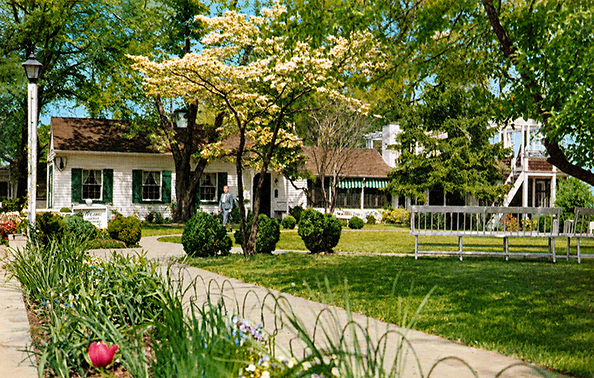
The place still worked. A postcard mailed on July 8, 1959, and now in the collection of the Arlington Historical Society, reports the garden as so cool and tranquil that the writer had settled in beside one of the petunia beds. A woman who had gone there as a high-school student in the 1950s remembered joining her mother and her mother’s colleagues from the Pentagon for spring and summer lunches, learning the word smorgasbord at the terrace layout, and then carrying plates to the tables — “blue skies, white fluffy clouds, birds singing,” as she described the setting more than half a century later. It had the feel of a private house, she wrote, except that it was always overflowing with people.
What killed it was arithmetic no different from the kind Crocker had once done in her head. The same qualities that drew the Crocker sisters to Arlington Ridge in 1920 — elevation, quiet, an unobstructed view, land nobody else wanted — drew apartment developers to it 40 years later. The River House complex to the east had already clipped part of the panorama. In late 1958 the Robert Towers, a pair of seven-story buildings, opened directly across South Arlington Ridge Road. The rural retreat was hemmed in, and the ground under it was worth more empty than full.
The restaurant was still working the season when its fate was settled. On May 31, 1963, an advertisement in the Evening Star billed it as a historic landmark with superb cuisine, taking reservations at OTis 4-7900, offering accommodations for private parties, and noting that it was closed Mondays. Six nights later the Arlington County Board took up the question of what would stand in its place.
John Digenis, the owner, had asked for the zoning to build a 12-story apartment house called the Ridge House, with the Little Tea House reconstructed on the top floor and its antiques moved into the new restaurant and the lobby. Apartment construction closer to the Potomac had already taken the view, his spokesman, H. C. John Russell, told the board, and the only way to restore it was to go up. The building would cost $2.5 million and carry three levels of underground parking; the architect, W. L. Mayne, had drawn 38 efficiency apartments, 79 one-bedrooms, and a three-bedroom penthouse. The board was unmoved. Chairman Thomas Richards said the project would create definite traffic problems and moved to deny it, and Roye Lowry, seconding, called it a violation of the county’s master plan. The planning director, Richard Arms, had already filed the more wounding objection: Nothing put before his office showed how the charm, intimacy, and character of the existing Tea House could be carried up to the 12th floor of an apartment building, and a restaurant with that view would be well patronized wherever it was put.
The warning nobody acted on came from Eleanor Lee Templeman, a local historian who would write the restaurant’s elegy 11 years later. The land was already zoned for apartments, she pointed out, and under that existing classification the Digenises could build without asking the county for anything — a building that would necessarily cover the maximum ground area and take the trees and the garden setting with it. The beauty and atmosphere of a tangible Arlington County cultural asset, she said, would be lost to all people, forever. That is precisely what happened. The application was denied, and the owners built by right instead: nine stories, 89 units, no restaurant on the roof. Every structure on the property except the tower came down. On June 24, 1964, the Northern Virginia Sun recorded the transfer of 1.6657 acres of the old Campbell tract from John Digenis and his wife to a partnership of the Digenises with Donald F. and Clarence C. Simpson, styled The Ridge House; county inventories date the development to 1964, and the building was converted to condominiums in 1979. Prospect Hill, James Roach’s mansion next door, was demolished in 1965.
Crocker outlived her restaurant by six years. She had fallen out with the National Woman’s Party in 1947, after helping convene a rump convention of members unhappy with Alice Paul’s tactics on the Equal Rights Amendment, and her involvement there tapered off; she stayed active in the League of Women Voters, Arlingtonians for a Better County, and the Arlington Civic Federation. She never married. She died in 1969 in Fairfax, Virginia, at age 85. Her name is inscribed today on the Turning Point Suffragist Memorial in Lorton, a few miles down the road from the workhouse where she was once held. Gertrude Allison Brewster ran the Olney Inn until about 1966 and did not much mourn the sale; things had changed over the years, she said afterward, and she had found it hard to get and keep help who cared. “There’s money to be made in the restaurant business, and then there’s a certain feeling of accomplishment,” she told an interviewer in 1970. “But there are very few people who would want to work as hard as I worked.” She retired to Asheville, North Carolina, where two of her sisters lived. The Olney Inn burned to the ground in 1978 while its then-owner was negotiating its sale to a developer.
In July 2000, the Arlington Historical Society received a letter from Rustburg, Virginia. Ellen C. Puterbaugh had one question. Was the tower still standing, or had it gone the way of the two residences and the Tea House? She had hundreds of photographs, she wrote, going back to when Arlington Ridge Road was dirt. Told that the tower survived, she mailed the society four dozen postal views of the property and a second letter. “I lived in a world of beauty,” she wrote of the grounds she grew up on. “Progress destroys so many lovely things.”
The tower is still there, at the point where South Lynn Street breaks off from South Arlington Ridge Road. It holds equipment and supplies for the condominium swimming pool. A parking lot covers the rose beds and the butterfly garden. Pedestrians on their way down the hill to the shopping mall at Pentagon City pass a round fieldstone building with a conical roof and no explanation attached to it, and the county’s photographic record of what stood behind it — Collection PG 215 at the Charlie Clark Center for Local History at the Arlington Public Library, most of it from the first five years — sits a few miles away in a climate-controlled research room.
Famous Patrons of The Little Tea House
- Amelia Earhart
- Eleanor Roosevelt
- Oliver Wendell Holmes

Chicken Curry
Gertrude F. Allison served this mild, coconut-enriched chicken curry during her tenure as owner of the Little Tea House in Arlington, Virginia, during which time the restaurant was known as Allison’s Little Tea House. Allison took over the restaurant in 1946 and later bought it outright; in 1952, while studying at Le Cordon Bleu in Paris, she met Julia Child and became one of the first three private students in the cooking lessons Child was giving with Simone Beck and Louisette Bertholle, the beginnings of L’École des Trois Gourmandes. This recipe combines chicken with a gently seasoned sauce made by steeping fresh coconut in hot milk, a notably careful technique for an otherwise straightforward midcentury American curry.
Ingredients
- 3 cups whole milk
- 1 cup finely shredded fresh coconut
- 1 tablespoon finely chopped onion
- 1/2 small garlic clove, finely chopped
- 4 tablespoons unsalted butter
- 1/3 cup cake flour
- 1 teaspoon curry powder
- 1 1/2 teaspoons packed brown sugar
- 1 teaspoon fine salt, plus more to taste
- 2 1/2 cups cooked chicken, cut into 3/4-inch cubes (about 12 ounces)
- Cooked white rice, for serving
Instructions
In a small saucepan, heat the milk until steaming but not boiling. Place the coconut in a bowl and pour the hot milk over it. Let stand for 1 hour.
Strain the milk through a cheesecloth-lined sieve into a bowl, then gather the cheesecloth around the coconut and squeeze firmly to extract as much liquid as possible. Reserve the coconut for another use or for serving alongside the curry.
In a medium saucepan, melt the butter over medium-low heat. Add the onion and garlic and cook, stirring, until softened and lightly golden, 3 to 5 minutes.
In a small bowl, whisk together the flour, curry powder, and brown sugar. Stir the mixture into the butter and cook, stirring constantly, for about 1 minute.
Gradually whisk in the strained coconut-infused milk. Cook, whisking frequently, until the sauce comes to a gentle simmer and thickens, 5 to 8 minutes.
Stir in the salt, then add the chicken. Cook gently until the chicken is heated through, about 5 minutes. Taste and adjust the seasoning.
Spoon the curry over hot rice and serve.
Notes
The original recipe used at the Little Tea House, which made 50 servings, called for adding the salt only after the sauce had thickened, warning that adding it too early could cause the milk mixture to curdle; the recipe allotted about 2 ounces of chicken and 3/4 cup sauce to each serving. This adaptation reduces the restaurant's recipe to home-kitchen proportions while preserving its method and characteristically gentle seasoning.



No Comments