
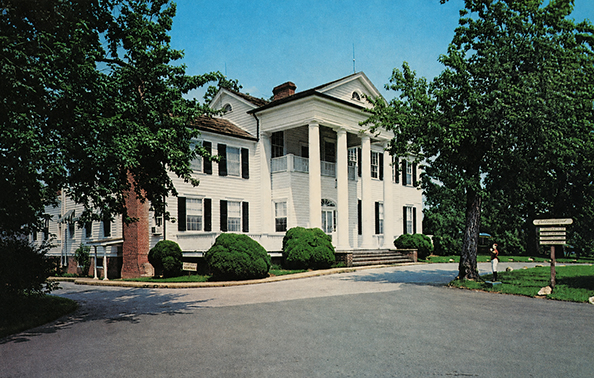
The carpenters came in 1932, and when they left the farmhouse on the bluff in Alexandria, Virginia, was no longer a farmhouse. Two two-story wings had been grafted onto a plain seven-room dwelling — a building the surveys describe inconsistently, as two stories in one account and a story and a half in another — and a colonnaded portico had been thrown across the front, aimed at a bend of the Potomac River and, beyond it, the Maryland shore. Nearly 40 years later, surveyors for the Historic American Buildings Survey looked at the result and could barely find a date to hang on it. “The original house was built about 1785 and probably served as an overseer’s house,” their 1970 report concluded — a date later research would dispute — before noting that the building had not reached its present size until the 1932 expansion. That single season of construction turned a working farm dwelling into what looked, to anyone driving south from Alexandria, like an antebellum plantation house — which was precisely the point.
The woman behind the work was Natalie Yates. Her husband, Mark Reid Yates, had bought the property in 1922 from Clayton Emig, who had bought it from LeRoy Delaney, who had bought it in 1894. The Yateses promptly sold off the acreage west of what would become the George Washington Memorial Parkway to residential developers, leaving the house sitting on a handsome but shrinking remnant of riverfront. What remained was a view, a spring, and a name with a long pedigree. Natalie Yates decided to trade on all three, remodeling the house as a Colonial Revival and opening it as a tearoom.
The timing was not accidental. The Mount Vernon Memorial Highway opened in 1932, built by the federal government for the bicentennial of George Washington’s birth, and it delivered automobile traffic past the front door in volumes the old Washington, Alexandria & Mount Vernon Electric Railway had never managed. A property that had spent 70 years as a dairy farm suddenly sat on a scenic parkway between Alexandria and Mount Vernon, at the exact midpoint of a drive that thousands of Washingtonians now took on Sunday afternoons.
The land underneath had been changing hands since the 17th century. Giles Brent laid claim to a large tract on the Virginia side of the river between Alexandria and Occoquan in the 1650s; on his death it passed to his cousin George Brent, and in 1739 to William Clifton, whose holding of roughly 1,800 acres was known as Clifton’s Neck. In 1760, having married the widow Martha Dandridge Custis the year before, George Washington bought Clifton’s land after negotiations that ran from February to May and involved the General Court of Chancery at Alexandria and the Privy Council. The tract became River Farm, the northernmost of the five farms of his Mount Vernon estate. A small house is believed to have gone up on the site around 1785 for Washington’s overseer, Sam Johnson, who ran the farm, operated a ferry across the Potomac, and collected fees from vessels drawing water at the spring; for a time the place was known as Johnson’s Spring and Johnson’s Ferry. The ground between the house and the river acquired a reputation as a dueling field, Marylanders having crossed the river to settle quarrels their own colony frowned upon. Washington’s secretary Tobias Lear held a life tenancy in the land and lived there until his death in 1816, and it is from Lear that the name most likely descends: During his years as consul general in Algiers he was associated with Vice Admiral Cuthbert Collingwood, Admiral Lord Nelson’s second-in-command at the Battle of Trafalgar in 1805.
After Washington’s death the property passed to his nephew’s descendants, George Fayette Washington and Charles Augustine Washington, who sold it off in pieces. In 1852 Henry Allen Taylor, a young Alexandria lawyer turned farmer, bought the site and either built the house that became Collingwood or substantially enlarged something already standing there. Taylor died in 1856, and the following March his brother and John Augustine Washington III of Mount Vernon advertised the place for sale in the Alexandria Gazette. In 1859 a 652-acre slice of the old River Farm went to three Quaker brothers from Mullica Hill, New Jersey — Stacey, Isaac, and William Snowden — who had come south to demonstrate that a Virginia farm could pay without enslaved labor. Isaac took Wellington; Stacey and his wife, Sarah, took Collingwood and ran it as a dairy. Stacey Snowden represented the Mount Vernon district on the Fairfax County Board of Supervisors from 1883 to 1885, and when the electric railway came through in the early 1890s, one of the stops carried the family’s name.
None of which would have mattered much to a tearoom in 1932 except as marketing, and Natalie Yates used all of it. By the spring of 1933 the Collingwood Tea House was already a fixture on the Washington society pages. On a March morning that year she gave a breakfast there for the German ambassador, Friedrich von Prittwitz und Gaffron, and his wife. In April, Mrs. Owen J. Roberts, wife of the Supreme Court justice, held a luncheon at Collingwood for a visitor from Philadelphia. That June, a Washington man named Edmund Brewer Montgomery gave his bachelor’s dinner there on the Thursday before his wedding — the bride was Natalie Yates herself, who was attended by her six-year-old daughter Nancy while her sons Mark Reid Yates, Jr., and John Sellers Yates held the ribbons for the bridal party. In September, Senator Alben W. Barkley of Kentucky and his wife hosted a dinner at the Collingwood Inn for their visiting daughter. In December the Washington alumnae of Beta Sigma Omicron marked their sorority’s founding with a dinner there, and Mrs. Edmund Brewer Montgomery — as she now signed herself — gave a luncheon for 35 in honor of a visitor from Vienna.
The formula held through the decade. The rooms were leased out for bridge parties and house-guest dinners; the kitchen turned out food that the newspapers, and the management, called Southern. An advertisement in November 1938 offered Thanksgiving dinner at $1.75, served from noon to 8:30, under a small line drawing of the columned facade and the promise of a house “Overlooking the Potomac.”
The fullest contemporary portrait came a year later, in the Washington Post’s weekly “Serve It Forth” column, which still called the place the Collingwood Tea House. The column explained the name — Admiral Collingwood, described as “the real hero of the Battle of Trafalgar” — and repeated the local tradition that English captains sailing from Alexandria in colonial times had anchored offshore to replenish their water casks from the spring, and that the same Johnson spring water, so called by Washington himself, was still poured for guests. It reported that Mrs. Montgomery was then living in Mexico, where her husband was serving in the foreign service, and that a manager named Ben Wade, Jr., had run the dining room since its establishment in 1932. It noted that Collingwood stayed open all year except from December 1 to March 1.
The neighborhood actually contained two Collingwoods. “Little Collingwood on the Potomac” was the adjacent estate of Colonel Robert Davis, retired, where his daughter Elizabeth Gould Davis was married in August 1934. By the late 1950s Little Collingwood was the Montgomerys’ own home, and in June 1958 nearly 400 guests came through its terraced gardens to mark the couple’s 25th wedding anniversary, filling a 40-foot living room with a fireplace at either end. The restaurant was the larger house up the road.
The war interrupted everything. With Washington’s population swelling and hotel rooms impossible to find, the building was pressed into service as housing for airline crews. In 1944 the U.S. Army took it over and ran a school for military intelligence on the grounds. According to a history compiled by the museum that later occupied the property, a good deal of the propaganda material aimed at Japanese forces was produced there under Army supervision. The mansion’s wartime record has attracted more legend than documentation. It sits a short drive from Fort Hunt, the interrogation center known to its personnel only as P.O. Box 1142, where some 3,400 high-value German prisoners were questioned between 1942 and 1945, and stories that German prisoners were also handled at Collingwood have circulated locally for decades without ever being pinned down. A 1976 real estate column would go further still and describe the property as a wartime OSS training center, which appears to be a garbled memory of the intelligence school rather than a separate fact.
Collingwood reopened after the war as a restaurant, and by 1950 it was running at full steam. An advertisement that April invited readers to take the drive down the Mount Vernon Highway to “Collingwood-on-the-Potomac,” promised Charleston pecan pie, Virginia ham, and spoonbread, listed luncheon from noon to 3:30 and dinner from 6 to 8:30, advertised a “Fashions-at-Luncheon” event for April 11, and mentioned overnight accommodations. A display advertisement in the Washington Evening Star that May put it more grandly: “An Open and Generous Hospitality Awaits You at Collingwood,” it read, on George Washington’s River Farm, five miles south of Alexandria.
That same advertisement carried a second line at the bottom: Collingwood Theater on the Potomac. The newly formed company opened on May 30, 1950, in a 400-seat house operated in conjunction with the inn, with a summer season promising French Without Tears, Yes, My Darling Daughter, Papa Is All, and Strictly Dishonorable. The producing group signed as director Steve Zacharias, who had staged Equity Library Theatre productions in New York City. In early July the company took on Sidney Howard’s They Knew What They Wanted, with Eugene Marlo as the aging Napa Valley vintner bewildered by his much younger wife and Fran Benton and Lee Bergere heading the support, while The Two Mrs. Carrolls closed out its run; the Post described the venue as an “open-to-the-skies theater” off the Mount Vernon Highway and noted that the company played nightly except Mondays. Bergere, then in his early thirties and still a decade from Hollywood, would spend the 1960s and 1970s as one of American television’s most recognizable character actors and end up, in 1981, as the majordomo Joseph Anders on the television series Dynasty.
The proprietor himself was drafted into the company. In July 1950, a Post columnist reported that Edmund B. Montgomery, formerly of the foreign service and now the owner of the Collingwood Inn, would appear with the Collingwood Players in Heaven Can Wait. His first question on being offered the role, the item noted, was “How big is the part?”
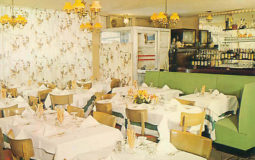
Through the 1950s the house settled into the rhythm of a country inn with a seasonal clientele. In 1951 a national magazine published by the Ford Motor Company described it as a country inn in an old Southern mansion on former Washington land, serving lunch and dinner every day but Monday, with rooms upstairs, and open only between mid-March and Thanksgiving. An Evening Star advertisement in March 1955 announced that Collingwood-on-the-Potomac was open for the season, with fried chicken, Smithfield ham, the house spoon bread, and fresh pecan pie, closed Mondays. At some point in these years the restaurant earned a recommendation from Duncan Hines, whose approval was the closest thing mid-century American road dining had to a star rating, and which the Post was still citing 30 years later.
The management changed hands more than once. From 1960 to 1963 the manager was Patricia R. Cummings, wife of an Air Force colonel, who had followed her husband to postings in the Philippines and Japan and who took the job during a Washington assignment. By October 1964 the manager was a man named Harl Outman, and it was Outman who found the night watchman. The restaurant closed Mondays, but Outman had driven over that afternoon to bring in some umbrellas left outside, and shortly after one o’clock he discovered James Williams, 50 years old, who lived in a basement room on the premises, handcuffed to a radiator. Two men had woken Williams at gunpoint the previous evening, marched him upstairs and chained him there, then went at the top of the safe with tools they found in Outman’s own kit. Workmen arriving to fix a water leak frightened them off before they got it open; they left with $15 from a cash drawer and a wallet holding $93. The Mount Vernon Rescue Squad sawed Williams free after four hours.
In 1968 the property was sold to Daniel Cohen and William Eacho. Cohen was a Brooklyn native who had managed a produce business in New York before the war, led a tank destroyer battalion in the European theater, and come home with a Bronze Star. He had been managing partner of Fan & Bill’s, a well-known Washington restaurant, until it closed in 1962, and had run the Fire Fountain Inn at the Sheraton-Silver Spring in the mid-1960s; he would finish his career as food and beverage manager at the Shoreham Hotel in Washington, retiring in 1978. Collingwood on the Potomac was the restaurant he ran in between.
It did not last long. The restaurant’s last service came in 1975. A real estate column in the Washington Post of April 24, 1976, described the place in the past tense: until recently a restaurant, now eight acres of waterfront on the former River Farm, listed at $395,000 by Mount Vernon Realty, whose president was W. Howard Rooks. The column conceded that the building “needs some gussying up,” noted that the property retained two banquet rooms and four working fireplaces, and pointed out — in what reads today as a warning shot — that the property’s residential zoning left room for house lots without disturbing the restaurant’s special-use status.
What happened instead was stranger and, for a while, better. At about the same time, a retired Army brigadier general named Archibald W. Lyon and several fellow retired officers had begun looking for a home for a museum devoted to what they called Americanism. They had concluded that Washington’s great institutions, for all their holdings, expressed nothing of the sentiment they wanted expressed. A boarded-up mansion on Washington’s own River Farm, less than four miles from Mount Vernon, struck them as the right address. A foundation was incorporated in 1976, and on March 31, 1977, the sale closed: $395,000, paid by the foundation for a National Library and Museum on Americanism, headed by Colonel LaVon P. Linn, whose principals were affiliated with National Sojourners, Inc., an organization of active and retired commissioned officers who were also Master Masons. The purchasers announced that they would repair the property extensively and keep the acreage intact, and — unlike most buyers of large riverfront parcels in Fairfax County in 1977 — they meant it.
The restoration produced the building most people now remember. The first floor held a small library in a room with 13-foot ceilings and crystal chandeliers, the collection spilling into the hallway; an adjacent room housed the 19,000-volume Library of American Civilization on microfilm, purchased with a $25,000 grant from IBM. Upstairs were Native American artifacts, including a seven-foot Sioux chief’s headdress a century old, and one of 500 silver-and-gold facsimiles of the 1215 Magna Carta cast, the Post reported, by the Library of London. Miniature flags of the 50 states hung above the entry archway; a portrait of Washington after William Joseph Williams’s 1794 painting hung over a mantel; three poles out front flew the American, National Sojourners, and Bennington colors, floodlit through the night. A portfolio on a table recorded the weddings held on the lawn.
Not everyone was impressed. When the Post visited in May 1984, several museum professionals in Washington said they had never heard of the place; Margaret B. Klapthor, curator emeritus in political history at the National Museum of American History after 40 years there, said she had not known such a thing existed, and an official who declined to be named called it “an embarrassment,” faulting it for holding nothing of note. Lyon was unbothered. The museum, he said, existed to say what was right about America rather than what was wrong with it, and to that end Collingwood staged Constitution Day each September with speeches and patriotic songs drawn from different eras, and on June 2 and 3, 1984, was to host members of the 1st Virginia Regiment, who would camp on the grounds and march in tricorne hats to show visitors what campaign life had been like.
The house also became, for the first time in its history, the subject of sustained research. Peter W. Pedrotti, a retired Army lieutenant colonel who served as curator, spent years assembling a history of the property; a condensation of it, published under the title The Collingwood Story, ran through the ferry operators, the farmers, the airline crews, the intelligence students, and what it called “one of the better area restaurants.” Some of what Pedrotti gathered is documented and some is folklore — the account has Jim Bowie killing a man in a duel on the grounds over a slur about Thomas Jefferson and Sally Hemings, an episode that appears in no reliable record and that would place Bowie in Fairfax County at a time he is not known to have been there. The value of the document is less as a chronicle than as evidence of how Collingwood understood itself.
The arithmetic eventually caught up with the foundation. An events building called the American Legacy Center was put up to generate revenue, and the mansion was rented out for weddings, birthdays, reunions, and corporate retreats, but the debt grew faster than the bookings. In July 2012 the foundation listed the property through TTR Sotheby’s International Realty for $5.9 million. Paul A. Frank, its executive director, called the decision heart-wrenching, said the Sojourners’ supporters had 35 years of attachment to the place, and reduced the sales pitch to a sentence: “George Washington walked here.” He held out hope that a developer might build around the mansion, or that a buyer might keep it whole, and said that if a major donor appeared the foundation would take the property off the market. No donor appeared.
The museum wound up its operations, and the property sold in 2015 for $2.6 million to Tyler Murrell, a son in the family that owns the Five Guys hamburger chain. What followed was the sequence the 1976 real estate column had foreseen. In December 2018, Anne Stuntz, chair of the Fairfax County History Commission, wrote to Mount Vernon District Supervisor Daniel Storck arguing that the site held archaeological potential relating both to the house and its outbuildings and to Native American occupation, and that surveys had already produced artifacts. A demolition permit application was filed in June 2019. Fairfax County granted it on July 1, along with a permit for a new single-family house.
Collingwood was listed on the Fairfax County Inventory of Historic Sites, which turned out to mean nothing. “This designation is honorific only,” Brian Worthy, a county public information officer, explained, adding that it did not prevent an owner from tearing a building down. The county could ask the owner to photograph the house before it came down, and he did. Elizabeth Crowell of the Fairfax County Park Authority noted that there were two archaeological sites on the property and said that the demolition would not disturb them. Storck said that once Collingwood was gone it could not be recovered, and that he wished the owner could build what he wanted while acknowledging the house’s role in shaping the community. Tammy Mannarino, a local historian who had spent years untangling the building’s construction sequence, made the case that its accretions were the point: “It’s a house that evolved to meet the needs of this community,” she said, adding that if it had to come down she hoped an expert would be present to read the structure one last time.
The mansion came down, apparently around the turn of 2019 into 2020 — the demolition permit ran through the end of 2019 — and by the spring of 2021 a large new house stood on the hilltop. The architect who designed it kept an oval window in the portico and four columns across the front, a gesture toward what had been there. The construction permit Fairfax County issued alongside the demolition order describes the rest: a single-family luxury house with an elevator, a wet bar, balconies, a three-car garage and, out on the lawn where the Sojourners had flown three floodlit flags, a detached pool house. Ken Lopez, who grew up three doors down on East Boulevard Drive and had watched the neighboring Andalusia mansion blown up in his childhood, called the loss gut-wrenching and allowed that the replacement was, architecturally, a fine homage.
The county’s own numbers had said plainly enough what was going to happen. In the 2019 tax year Fairfax County assessed the land at $3.055 million and the building standing on it at $203,690 — the house that had served Southern-style meals to senators, ambassadors, and Sunday drivers across more than 40 years was worth less than seven cents on the dollar against the ground beneath it.
Famous Patrons of Collingwood-on-the-Potomac
- Alben W. Barkley

Spoon Bread
At Collingwood-on-the-Potomac, a riverside restaurant that operated south of Alexandria, Virginia, from the 1932 until 1975, spoon bread was one of the specialties of the house. After World War II, its newspaper advertisements promoted a menu of Virginia ham, spoon bread, and Charleston pecan pie, and by 1955 the restaurant was specifically advertising its “house spoon bread” alongside fried chicken and Smithfield ham. The recipe is characteristically simple: a lightly sweetened cornmeal batter enriched with milk, butter, and egg yolks, then lightened with beaten egg whites before being baked at high heat. The result falls somewhere between cornbread and soufflé — tender, airy, and best served hot from the oven.
Ingredients
- ½ cup cornmeal
- 2 tablespoons baking powder
- 2 tablespoons sugar
- ½ tablespoon kosher salt
- 2 cups whole milk
- 4 ounces unsalted butter
- 4 large eggs, separated
- Butter, for greasing the baking dish
Instructions
Heat the oven to 450 degrees. Generously butter a 1 1/2- to 2-quart baking dish.
In a large bowl, whisk together the cornmeal, baking powder, sugar, and salt.
In a medium saucepan, combine the milk and butter and bring just to a boil over medium-high heat. Immediately pour the hot milk mixture over the cornmeal mixture and stir until thoroughly combined.
In a small bowl, beat the egg yolks until smooth, then stir them into the cornmeal mixture.
In a clean bowl, beat the egg whites until they hold soft peaks. Gently fold them into the cornmeal mixture in 2 or 3 additions, taking care not to deflate them.
Transfer the batter to the prepared baking dish and bake until puffed and deeply golden brown on top, about 20 to 25 minutes. Serve immediately.
In Our Vault: More Recipes from Collingwood-on-the-Potomac
- Candied Sweet Potatoes
- Southern Homemade Chicken Soup
No Comments