
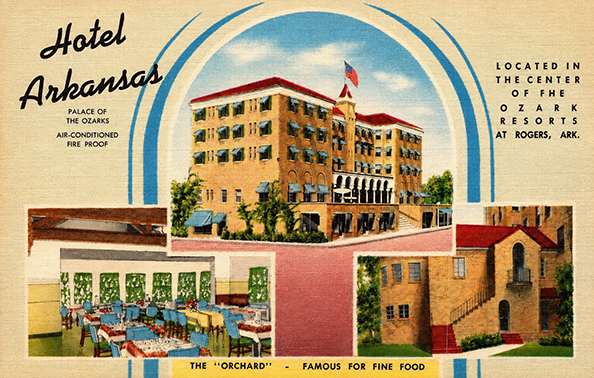
In the summer of 1928, S. A. “Gus” Lane of Little Rock began putting up a five-story hotel at the corner of West Poplar and Second Streets in Rogers, Arkansas, a Benton County town of a few thousand people whose money still came out of apple orchards, poultry houses, and the Frisco line. Rogers wanted the hotel enough to buy it a site: the Rogers Community Club acquired the corner lot, worth $10,000, and gave it to Lane as an inducement to build there. Ground was broken on July 16. Lane was a former district superintendent for the Southwestern Bell Telephone Company who had crossed into the hotel business as the proprietor of the Gleason and Terminal hotels in Little Rock. To design the hotel in Rogers, he hired John Parks Almand, a Little Rock architect then in the middle of a 50-year practice, who gave him something Arkansas had almost none of: a full-dress Spanish Colonial Revival building. The building went up in yellow-buff brick beneath a low hipped roof of red Spanish tile, with the guest floors lifted a full story above the sidewalk so that a row of rentable storefronts could occupy the ground level facing Poplar Street. A broad flight of limestone steps climbed from the street to a nine-bay arcade of glazed terra-cotta archwork carried on slender limestone columns, and a narrow square brick tower, recessed in vertical panels of pale glazed terra cotta and capped with a pyramidal roof and small finials, rose above the cornice to fix the center of an otherwise symmetrical facade.
The arcade set an 18-foot ceiling height that ran straight through the public rooms inside — lobby, ballroom, lounges — spanned by exposed redwood beams carved and stenciled in color, with wrought-iron sconces and light fixtures, red tile floors, and colored tile worked into trowel-patterned plaster. There were 72 single rooms on the three upper floors, half of them with baths, and the two wings were framed so that the hotel could be enlarged to 152 rooms if the traffic ever justified it. Part of the second story over the shops was given over to a terrace, raised about ten feet above the sidewalk in front of the entrance facade. The building had a 160-foot frontage on each street, cost about $200,000, and when it was finished no commercial building in north Arkansas was taller or covered more ground. The location was chosen with the same care as the elevations: The hotel sat between the bus station on Second Street and the railroad depot on First, close enough to both that a traveler could walk to either with a grip in each hand. In September, with the walls up to the second story, Lane incorporated the Lane Hotel Company to own and operate the place, taking the presidency himself and putting his brother J. L. Lane in as vice president and treasurer. The company was capitalized at $2,000. The building it existed to hold was to cost a hundred times that, and the difference was raised in mortgage bonds, an arrangement that worked precisely as long as the bonds could be serviced.
It opened in 1929 as the Lane Hotel, with another of the brothers, Lander A. Lane, installed as its manager. The Great Depression arrived immediately behind it. The hotel called itself the “Palace of the Ozarks” in its own advertising, and the state’s application to add the building to the National Register of Historic Places would later describe it, accurately enough, as “the most elegant hostelry in north Arkansas.” Elegance, however, was the wrong product for 1930. People with money for a fancy hotel room stopped having money for a fancy hotel room, and the litigation that would eventually consume the building began within a few months of the opening.
On April 1, 1932, the Lane Hotel Company failed to make a bond payment of $7,300. Three weeks later a chancellor in Fayetteville put the company into receivership on a petition from creditors that included the county tax collector, the county clerk, and a St. Louis stationery house, and named a Little Rock insurance man, Elmo E. Walker, as receiver, with instructions to keep the hotel running. It was widely expected that a good summer season would clear the arrears. That August, three months into receivership, Lane was advertising in the Arkansas Gazette over his own name as president, and the advertisement is the best surviving portrait of what he had built and what he thought it was for: the Palace of the Ozarks in the center of the resort region, large, modern, fireproof, five hours from Little Rock on paved and scenic road, with open-air dinner-dances every night on the terrace to Johnny McGuire’s University of Missouri orchestra, dinner a dollar, no cover charge, dancing free. Rates had not been raised for the resort season; they had been cut, to $1.50 for a single room. It was not enough. In October 1933 the company filed a voluntary petition in bankruptcy, and the schedules Lane filed listed assets of $234,440 against liabilities of $221,446, nearly all of it secured. On March 14, 1935, the hotel was sold at auction for $61,650 to a Pine Bluff attorney bidding for the first-mortgage bondholders. The only other bidder in the room was a baker in Rogers named Earl Harris.
Two blocks away, another business had been going in the other direction. Earl A. Harris and his sister Effie had started the Harris Bakery at 107 West Walnut in 1926. Harris had quit school after the eighth grade to support his mother and six older siblings, and he had found the one product that sold better in a depression than out of it. Harris was turning out bread at a dime a loaf and trucking it to grocery stores across Northwest Arkansas, on the plain arithmetic that buying a loaf had become cheaper than baking one. Losing the auction did not settle the matter. The bondholders had bought the hotel to protect their claims, not to run it, and said as much: the committee would operate the place temporarily until a sale could be arranged. The sale it arranged was to Harris, for $100,000, half what the building had cost to put up seven years earlier, and he renamed it the Harris Hotel. In 1936 he put up a new bakery immediately north of it, advertised without visible embarrassment as the most beautiful bakery in America. The two buildings were joined at the rear, and Harris ran steam off the hotel’s heating plant to heat the bakery’s ovens — a piece of thrift that tells you most of what you need to know about how he operated.
What Harris bought was a building; what he made was an institution. The room off the lobby to the right became the town’s ballroom — hosting dances, balls, and wedding receptions — and the bands that played there drew people from all over Rogers, including a good many who had not been invited and simply sat on the curb outside to listen. To the left of the lobby was a shop selling newspapers and sundries, with a shoeshine stand; farther west, a room large enough for piano recitals. Traveling salesmen worked out of the place. So did tourists coming down for the Ozark Playgrounds season, and college football teams in the state to play the Razorbacks. Harris moved in himself; when he married Helen Bialock Anderson of Little Rock in December 1937, the Gazette recorded that the couple were at home in the Harris hotel. The names of the hotel’s most famous guests — Amelia Earhart, Jack Dempsey, Errol Flynn, Henry Fonda — have been repeated in Rogers for three generations, and are mostly beyond checking. One endorsement is on the record. Henry Miller came through Arkansas in 1940 and 1941 gathering the material for his travel book The Air-Conditioned Nightmare, and he called the place one of the best and most reasonable hotels in the whole United States.
There was one problem Harris inherited. The hotel had never lacked food service; the original plans put a dining room on the second floor beside the lobby, there was a coffee shop, and under Lane the terrace had run dinner-dances nightly. What it lacked was a room built to be a restaurant. Meals ended up in the big ballroom at the front of the building, which worked for a banquet and not much else. On January 3, 1940, crews began clearing the garden on the north side of the hotel for the foundation of a $25,000 annex. It was two-thirds up by the middle of May and finished that year: a Spanish-type structure, semicircular at the protruding end and built, as the Gazette put it, on extreme Spanish lines, with the restaurant on the second floor and a beauty parlor on the level below. Harris told the paper it would be one of the most modern restaurants in the Central Southwest. The detailing matched the interiors Almand had designed eleven years earlier — the same beams, the same plaster, the same iron. They called it the Orchard, a name that took its cue from the apple country the hotel’s guests had driven through to get there. The restaurant occupied the upper level and an outside staircase dropped from the dining room down to what was left of the garden. The beauty parlor underneath became, at some point before 1943, the quarters of the hotel’s manager. Diners sat at round wooden tables under chandeliers that had been designed to double as ceiling fans, which in an Arkansas August was not a decorative flourish. The kitchen would in time be run by Russell M. Roderick, whom the Ozark tourist guides billed simply as the “famous Chef Roderick” and whose roquefort dressing, mixed a gallon and a half at a time, was still being printed under his name two decades later.
Three years after adding the restaurant, Harris sold the hotel. The deal was announced at noon on a Saturday in January 1943; the buyer was R. D. Goff, the founder of a Fayetteville-based string of grocery stores across Northwest Arkansas, and the Fort Smith Southwest American reckoned it the largest real estate transaction in Rogers in the eight years since Harris had bought the place himself. Harris kept the bakery and a stock farm north of town and said he would give his whole time to the two of them. Goff held the hotel for six months. He had taken it through a new company, the Arkansas Hotel Company, and in July 1943 he sold his entire stock in it to the three men who sat on the board with him, Claude Duty, Warren Felker, and W. R. Vaughan, all of Rogers, acting for the rest of the stockholders. Management went to Irene Sparger of Oklahoma City, lately of Rogers, who had been assistant manager since January and now took the whole of it. Forrest Calvin had the job for most of the 15 years that followed, and his daughter Kay grew up in the building. The family apartment had no kitchen, which meant that every meal the Calvins ate for 15 years came out of the Orchard’s kitchen upstairs. Kay Calvin also left the best description anyone has of what the room was for. The Orchard was where the business of Rogers got done: judges, attorneys, physicians, store owners and managers, real estate men and insurance agents all turned up there at some point in the day, so that a stranger could learn more about the town at one table by the window than in a week of calls.
By 1948 Felker had emerged as the principal among the Rogers men, and he would run the hotel through the corporation until the day it closed. The building’s civic role did not change with the ownership. In June 1949 the Rogers Chamber of Commerce staged an Ozarks Golden Wedding Jubilee there, honoring couples married 50 years or longer. The Chamber said 126 couples had registered from all parts of the country, and on June 16 nearly 100 of them, with better than 5,000 years of marriage between them, assembled on the hotel’s limestone steps for a mass ceremony to reaffirm their vows. The photograph that survives is one of the more remarkable crowd pictures ever taken in Benton County.
In 1952 the Northwest Arkansas Times ran a short notice out of Rogers reporting that the Harris Hotel would carry a new name after that month: the Hotel Arkansas. The name was not new to the people who owned it. They had been the Arkansas Hotel Company since Goff organized it in 1943, and the building had taken nine years to catch up with the letterhead.
Through the 1950s the hotel stayed busy and the ballroom stayed booked. Teenagers in Rogers went to Pep Club dances and to the Blue Demon Ball under the high ceilings and the chandeliers, and enough of them have written about it since that the memory of the room outlasted the room’s working life by half a century.
Both of the men who had made the building died as it went into its last years. Lane went first. In the early hours of a Friday morning in March 1958, the two-story brick house he lived in two miles west of Russellville burned to the ground while he was in Georgia visiting relatives. His wife, Grace, was alone in it; a caretaker living 50 yards off woke at half past four to the barking of dogs, saw the big house in flames, and was driven back by the heat. She was 56. Lane died in September, in a Russellville hospital after a long illness, at age 78. He had bought the telephone exchange at Russellville in 1929, the year the hotel opened, and over the three decades that followed he built it into the Western Arkansas Telephone Company, serving 16 towns along the Arkansas River Valley. Earl Harris died in 1959.
But the ground was shifting under the whole downtown-hotel business, and Rogers is a nearly perfect specimen of how it happened. In September 1961 the Sands opened at 208 South Eighth Street — 24 units with air conditioning, television, a swimming pool, and a restaurant, and free parking at the door. It was the first modern motel in Rogers, and among its managers was Forrest Calvin, the man who had run the Harris Hotel for 15 years. Two years later the Town and Country Motor Lodge opened on Highway 71 South; the Jan-Lin Motor Inn followed in March 1964, and a Holiday Inn arrived in 1966 with a 70-foot Razorback laid out in gravel on the roof. Every one of them was on the highway, and every one of them had a parking lot. The Hotel Arkansas had limestone steps and a bus station.
The end came in the summer of 1963. Felker, as the president of the Hotel Arkansas Corporation, announced on July 9 that the hotel would close the following Monday and that the 75-room establishment would be “boarded up and sold.” It had not been operating at a profit for some years, he said, and the closing was a matter of economic necessity. Edgar Barnes, the last manager, closed the doors on July 15. The Gazette, writing the building off, described it as a showplace that had been beset by financial difficulties since its completion in 1929. The Northwest Arkansas Times called it the latest crisis in a rocky 34-year history — a fair summary of a building that had been in financial trouble before its first guests checked out.
The building sat boarded up for four and a half years. It was bought at the end of 1967 from the Felker estate by Defenders of the Christian Faith, Inc., a nonsectarian religious organization founded at Wichita in the mid-1920s by the fundamentalist publisher Gerald B. Winrod, a defendant in the 1944 mass sedition prosecution in Washington that collapsed into a mistrial when the judge died and was dismissed thereafter. Winrod had been dead a decade; the Defenders were now run out of Kansas City by Hart Armstrong, who announced that the Rogers landmark would become a retirement hotel on the model of the organization’s 13-story Townhouse in Kansas City, itself a converted hotel, the old La Salle. The Defenders took possession on January 31, 1968. Armstrong said the 70 rooms were in excellent shape and would rent for something between $75 and $150 a month, meals available.
Joe and Dera Keen took over in 1977 and ran the building as the Rogers Townhouse. At the end of the 1990s the building became Peachtree at the Lane (borrowing half its name from the hotel of 1929), an assisted living facility run by Dr. Annette Landrum’s Fort Smith–based Peachtree Village company. In August 2001 the home cleared out the accumulated inventory of three hotels to make room for a residents’ recreation room, in a two-day sale it called “All through the Ages.” Out of the basement and the closets came white permanent-wave rods and a 30-pound iron from the beauty salon, orange dining chairs from the 1920s, oil paintings, wooden writing desks, a three-foot silver coffee urn, roughly 1,500 books, and a Taylor & Farley pump organ.
The facility closed in October 2003, and the building went on the market and stayed there. When the Arkansas Democrat-Gazette looked at downtown Rogers in April 2004, the five-story former hotel on Poplar Street was the largest of the empty buildings, and the merchants who remained were worried less about paint colors than about demolition. The city was creating a historic district commission to compete for preservation grants and keep buildings standing; Bill Watkins, an attorney and the chairman of Main Street Rogers, made the case for it in four words: “But property changes hands.” The former Hotel Arkansas had changed hands eight times by then and had been dark for a year. It changed hands once more that year. Raymond Eshaghoff, a New York developer and co-owner of the real estate investment firm Ninety-Second L.P., bought it for a little under $1.3 million in 2004 from Lexington Retirement Properties of Fort Smith and announced a $3 million renovation that would make it a high-end building of restaurant, apartments, offices, and shops. Nothing, however, was built. Three years later he flew back in from New York with a consultant from a global hotel firm to work out what the building could be used for at all, the earlier plans having failed, as he put it, to make economic sense. The consultant put the count at 52 rooms and two elevators in 40,000 square feet. “This is a trophy building,” Eshaghoff said.
It stayed dark for more than a decade. In June 2015 KLS Leasing, a Delaware company affiliated with the Walton Family Foundation, bought the building for $1.6 million from Eshaghoff’s group, which had been trying to sell it since 2009, and spent two years on a restoration that put new classrooms behind the original walls while returning the second-floor lobby to its 1929 condition — brick floor, stenciled redwood beams, iron fixtures. Haas Hall Academy opened its Rogers campus there in 2017. It moved to a larger site off Interstate 49 in the summer of 2024, and the School for Advanced Studies–Northwest Arkansas opened in the building that fall. Almand’s semicircular dining wing still projects from the north facade, its Spanish detailing intact.

Hotel Arkansas French Dressing
Russell M. Roderick, remembered as "the famous Chef Roderick” of the Hotel Arkansas in Rogers, Arkansas, ran the kitchen of the hotel’s Orchard Room, the Spanish-style dining room that a new owner added to the "The Palace of the Ozarks" in 1940. His dressings were made on a decidedly institutional scale — his Roquefort dressing, for example, was mixed a gallon and a half at a time — and this tangy French dressing likewise combines oil, vinegar, prepared dressing, mustard, ketchup, paprika, and Worcestershire sauce in the robust, sweet-savory style popular in midcentury American dining rooms.
Ingredients
- ¾ cup neutral oil, such as vegetable or canola oil
- 1/4 cup distilled white vinegar
- 6 tablespoons prepared salad dressing, such as Miracle Whip
- 2 tablespoons prepared yellow mustard
- 6 tablespoons ketchup
- 1 teaspoon Worcestershire sauce, plus more to taste
- 1 1/2 teaspoons garlic powder
- 2 1/4 teaspoons kosher salt
- 2 1/4 teaspoons paprika
- 2 tablespoons granulated sugar
Instructions
Combine the oil, vinegar, salad dressing, mustard, ketchup, Worcestershire sauce, garlic powder, salt, paprika, and sugar in a medium bowl.
Beat with an electric mixer on low speed until smooth and well emulsified, about 3 to 5 minutes. Alternatively, whisk vigorously by hand until thoroughly blended.
Taste and adjust the Worcestershire sauce if needed. Transfer to a covered container and refrigerate until ready to use. Stir or shake well before serving.
In Our Vault: More Recipes from The Orchard
- Chef Roderick's Roquefort Dressing
- Chocolate Chiffon Pie
- French Chocolate Pie
- Meat Loaf

No Comments